1:1 exams, ways to start class, leadership lessons, and more
An excellent week, some good pedagogy, and an invitation!
In my first year of college, a visiting professor from Oxford ran 1:1 tutorials with each student in a political theory class. I remember my first one vividly. I sat down opposite his desk and he picked up my weekly reflection paper and read aloud the opening sentence. He asked, “What do you mean by this word here?” He asked about the next sentence and what its key idea was. It was an unforgettable lesson in the precision of my thinking and writing. It seems we’re moving back to this style of learning, where it is possible — and this isn’t a bad thing as part of a repertoire of approaches. I think it’s probably a very good thing — as part of a repertoire of approaches.
In the features this week, find one teacher’s first tests with oral exams at a small scale. It’s a math professor, and I think the lessons and format are customizable to most any context. Also in the features, find early evidence that phone bans may be having a positive effect on learning.
Elsewhere this week: a pedagogy section with several start-of-class possibilities, a leadership section with a reminder that leaders are best when we are effective storytellers, several provocative curriculum posts, and more.
Also, I’m so happy to highlight that I’ll be at Gather in Boston on December 4, the week after Thanksgiving. If you’ll be there, please drop a line and I hope we can say hello.
All this and more, enjoy!
Peter
PS. I’m happy to share a list of engagements coming up in the months ahead, and would love to connect if you’ll be at any:
December 4:Gather — NAIS, Boston
I’m thrilled to be sharing selections from Act One of Schooled at Gather this year. With cast and crew from Tony-winning shows in NYC, as well as incredible young talent from Boston-area conservatories, please stop in for (what I think is) a compelling presentation of school in a time similar to our own.
December 14: “Heads and CFOs: AI as Arrival Technology” — PAIS/PAISBOA, Hershey, PA
This joint membership meeting also includes Patrick Schuermann and Andy Van Schaack to facilitate heads and CFOs in a day exploring the question: What would need to be true to feel fully known, supported and strengthened as you face the headwinds of today and tomorrow, so the ‘power of the flock’ is behind you?
January 12: “Moving Your AI Conversation Forward” - SAIS Webinar, online
Does AI polarize your community? Join this webinar to gather tools for framing your community’s conversation so that different perspectives feel heard and you have the vocabulary to move forward together.
March 4: “Schools and AI: Running in Two Directions at Once” - NAIS Thrive, Baltimore
AI is pulling us ever further into technologically mediated experiences. Yet educators know the most powerful learning remains a social, human-to-human experience. The result is that schools must travel in both directions at once in order to continue providing the relational experiences excellent schools are known for while also preparing students for a technologically inundated world. I’m thrilled to lead this session with Indu Singh, in which we surface both high-level principles for navigating these seemingly divergent paths and also practical tools for the deliberate work of uniquely human thinking, learning, and relationship building.
Later events will be announced in future issues.
What if Bloom’s Taxonomy were inverted? See the pedagogy section for more.
“During the exam, students could not use any resources at all – just their memory. However, I explicitly permitted (and encouraged!) students to practice in advance, including with classmates, and to use any resources that would be permitted when completing the portfolio problem.”
“The study looked at 3.3 million students between 2021 and 2026. They were in third through 10th grade, attending 4,600 U.S. schools. Using scores on MAP tests, which track achievement from fall to spring, it compared the performance of students at schools that put in strict phone bans with those at similar schools that did not have such bans. The annual gains reversed about half the annual loss that an average student experienced in the years leading up to the pandemic… He cautioned against being too optimistic about modest achievement gains, but added that “if they accumulate over time, year after year, that could be really important and really meaningful.”
“John Hattie’s visible learning research reinforces this, demonstrating that teacher beliefs, student self- efficacy, and collective teacher efficacy rank within the top 10 most influential factors on student outcomes. The stories we tell ourselves, whether it’s “this kid stands no chance” or “this kid hasn’t had the help he needs yet,” reflect and reinforce our beliefs about what’s possible. The primary way we change beliefs and the stories people tell themselves is by providing them with different experiences and results… Collectively, the stories we tell ourselves and hear from others reflect and shape our shared beliefs, or culture. Strong school cultures are marked by stories of student success, staff collaboration, and family involvement.”
AI as a moderating force, how the workplace is changing, and more
Two powerful — and very different — features this week.
First, the new Harvard resource is an excellent tool for making decisions about what forms of AI use may be effective at different developmental levels for students. Arriving at a cultural consensus will take some time, but this is a good, evidence-based approach to thinking about what students might be ready for.
Second, see the first of two posts this week from Alex Kotran that suggest a surprising reversal in perspectives. What is it? One of the fears about chatbots is that they will deepen the epistemic bubble that social media has created. But Kotran observes a different trend: that AI models optimize around accuracy, not engagement, which means that they actually have a normalizing effect on discourse. They move away from polarizing fringes and towards the common middle ground. Social media is “epistemically diverging” while AI is “epistemically converging.” This is a real surprise, and potentially a real social/cultural benefit. (AI has already been shown to more effectively debunk conspiracy theories than people do.) I’m curious whether this behavior will continue as the technology develops. The other post by Kotran is in the Ethics and Risk section — a rare positive post in that section.
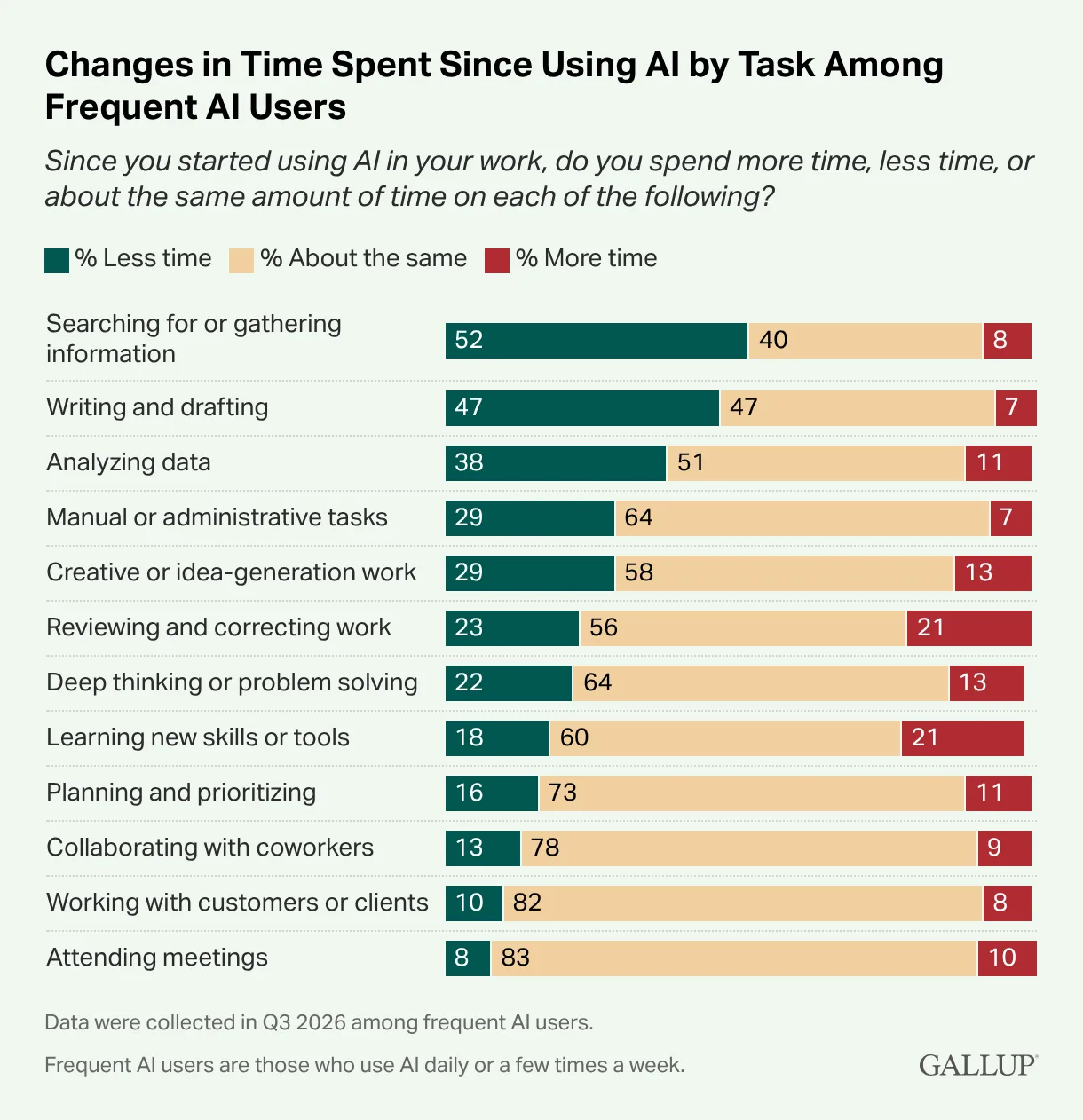
Also this week, another example of a student committee on AI, an interesting report by Gallup on how AI is changing the way employees spend time at work, and more.
These and more, enjoy!
Peter
How do people spend their time differently at work? See the Gallup poll in Uses and Applications.
“AI Guidance by Age, created by Compass Collaborative at the Harvard Graduate School of Education, makes hypotheses about where AI might help learning and development, where it likely hinders, and how the answer might change with age… AI Guidance by Age explores two different axes. 1/ a learner’s age and 2/ the developmental capacity they’re building, like early literacy or managing emotions. Where those two axes meet (e.g., 0-2 and numeracy), we craft a unique perspective because a five-year-old and a fifteen-year-old are developmentally different, and what’s happening for them in each developmental domain is different too. Every one of these perspectives explores four questions: 1. What is developing at this age, in this area? 2. What emerging research exists on AI here? 3. How might AI hinder this development? 4. How might AI help this development?”
“For people who turn to chatbots instead of scrolling a feed, AI pulls the information they receive toward higher quality sources and away from the polarizing fringe.”
“Unlike social media, which is driven ultimately by a quest for more engagement, chatbots are benefitting from a concerted effort to improve their accuracy.”