Renewed interest in smartphone bans, more college closures, and growing AI usage
An excellent week!
The features this week — and a surprising spurt of other articles — revolve around phones in schools. The first feature is a study that appears to draw a causal relationship between smartphone bans in schools and increased student health and performance. The second feature focuses on a video that has emerged from a day in the life of a high school in the late ’90s. The response to the video is part nostalgia (from Gen Xers) and part awe (from Gen Zers, who seem to long for social interactions uninhibited by devices). Check out the video for yourself to see if it’s much different from what you observe in your classrooms.
See also the tech section for more posts on smartphones, including a catalog of different kinds of smartphone limits.
Also this week explore the documentation on the acceleration of college closures in the past eight years. Look, too, in the Leadership section for an analysis of what the warning signs were that led to these closures.
See also the AI updates at the end for more ways AI is proving to be both beneficial and complicating.
“Combining detailed administrative data with survey data on middle schools’ smartphone policies, together with an event-study design, I show that banning smartphones significantly decreases the health care take-up for psychological symptoms and diseases among girls. Post-ban bullying among both genders decreases. Additionally, girls’ GPA improves, and their likelihood of attending an academic high school track increases. These effects are larger for girls from low socio-economic backgrounds. Hence, banning smartphones from school could be a low-cost policy tool to improve student outcomes.”
“This video has nearly 30,000 comments, some from Gen Xers nostalgic for their ‘90s youth—but many from Gen Z, aching for a world they never experienced. Older generations might dismiss this as teens wanting to be different and reject modern culture, as they often do. But the comments reveal something deeper: “As someone who graduated in 2015 this looks like such a nice time. Not a phone in sight. People actually talking face-to-face. I wish I could have grew up in an era like this.””
““Educators working in these models — their feeling of isolation is lower,” Maddin said. “Special educators in particular are way more satisfied. They feel like they’re having a greater impact.””
“In 2020, only 268 titles sold more than 100,000 copies, and 96 percent of books sold less than 1,000 copies. That’s still the vibe… The DOJ’s lawyer collected data on 58,000 titles published in a year and discovered that 90 percent of them sold fewer than 2,000 copies and 50 percent sold less than a dozen copies.”
“Results from two experiments indicate that even when people are successful at maintaining sustained attention—as when avoiding the temptation to check their phones—the mere presence of these devices reduces available cognitive capacity. More- over, these cognitive costs are highest for those highest in smartphone dependence.”
“From the belief that academic advisors only handle course scheduling, to the assumption that they make all decisions for students, there are a few persistent myths about academic advisors and their responsibilities. As an academic advising researcher and former post-secondary advisor, I’m sharing my expertise to debunk some common myths and show that their work extends beyond just course scheduling or decision-making to crucial guidance and support for students through their educational journey.”
A.I. Update
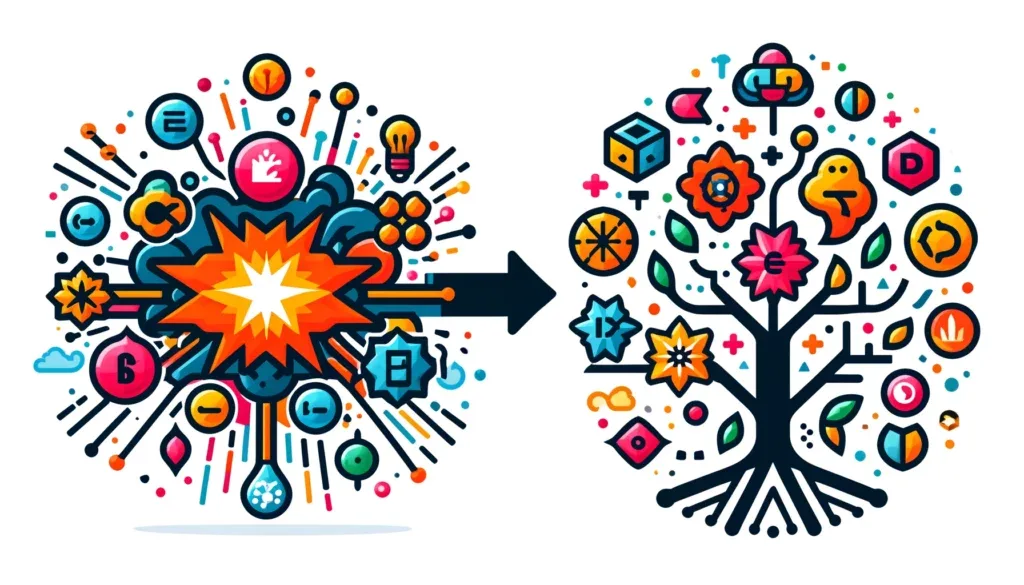
The big picture: A Cambrian explosion, Darwinian natural selection...
Excellent updates, including a harrowing story of how an employee created a deepfake recording of a principal in a social revenge event (the first feature), and an emerging understanding of intellectual property may be applied to works created with AI (the second feature). The US Copyright Office’s approach to what can and cannot be copyrighted offers an interesting angle into how we might read student work.
But I want to take a step back for just a moment. In his reflection on the recent ASU GSV conference, EdTech Insider’s Ben Kornell wrote that “the Cambrian Explosion of AI in edtech is entering a Darwinian moment.” This is a perfect characterization. Last year, AI technology exploded with vision and opportunity, and with remarkable speed, edtech companies burst out of the woodwork. This year, teachers and schools will be assessing these new edtech tools to assess which will survive. In the next two years, the field will narrow and other forms will emerge. But what’s most compelling to me is that schools have the opportunity to determine what survive. This is the time when teachers and leaders provide feedback to the industry to direct it to what actually helps.
But perhaps as a friend of mine said, if we’re coming out of the Cambrian explosion and into Darwinian natural selection, then is the next stage the AI domination? Well, we’ll see.
See below for excellent posts on these and other topics, including a helpful piece on brainstorming strategies with AI.
These and more, enjoy!
Peter
DALL-E’s representation of a Cambrian explosion of AI leading to Darwinian natural selection.
“The USCO’s notice granting Shupe copyright registration of her book does not recognize her as author of the whole text as is conventional for written works. Instead she is considered the author of the “selection, coordination, and arrangement of text generated by artificial intelligence.” This means no one can copy the book without permission, but the actual sentences and paragraphs themselves are not copyrighted and could theoretically be rearranged and republished as a different book.”
“A Maryland high school athletic director is facing criminal charges after police say he used artificial intelligence to duplicate the voice of Pikesville High School Principal Eric Eiswert, leading the community to believe Eiswert said racist and antisemitic things about teachers and students.”
“The Defense Advanced Research Projects Agency (DARPA) revealed that an AI-controlled jet successfully faced a human pilot during an in-air dogfight test carried out last year.”