Revisiting the year, creativity, highlights in humanities, generative AI, and more
So many thoughtful pieces this week:
In this week’s features, don’t miss the two lengthy reports Stanford released together, one from a working committee on the Muslim, Arab, and Palestinian student experience and another on Antisemitism and Anti-Israeli bias. While the reports are mostly specific to the Stanford experience, close reading the pairing provides a more nuanced understanding of the layers of issues going on in schools. Both reports include recommendations.
This week’s other feature is a thought provoking exploration into how we define intelligence. The essay focuses on other forms of animal intelligence and backs into today’s AI conversation from there. But mostly, it pushes us to let go of the preciousness with which we hold our own intelligence and examine what different kinds of intelligence enable. It is a perspective-broadening piece.
In other news, this past week’s Tony Awards have led to a series of excellent pieces on the creative process. Also, thoughtful discussion continues on the extent of today’s mental health crisis in kids and what it stems from, and there’s an excellent and video in the Tech section of a nuanced discussion about the promises and perils of AI in education. See also this week’s AI section at the end for much more on AI.
These and much more, including the extraordinary story of Virginia Hislop, who started her degree in education in 1936 and just picked up her diploma in Stanford GSE’s graduation ceremony last week at age 105. Amazing.
Enjoy!
Peter
PS. I have noticed that with AI crowding the news cycle, stories on teacher practice are less prevalent. I am working on some projects laser focused on practice and connecting teachers around practice, and I would like to hear from you, either as teachers or administrators or 3rd party organizations that are supporting teacher practice. If you’re open to speaking with me about your focus on teacher practice, please schedule a 20 minute meeting with me at this link. I would love to speak with you. Thank you!
Virginia Hislop at her graduation, age 105. See the article in “Other” below. (photo: Charles Russo)
“Humanity’s relationship to AI is characterised by similar cycles of underestimation and surprise, followed by exploration, understanding and explanation, and a subsequent downgrading of our belief that intelligence is currently at play… This is sometimes called the ‘AI effect’, explained by the computer scientist Larry Tesler as our tendency to believe that ‘Intelligence is whatever machines haven’t done yet.’ Now that it is possible for machines to beat human chess grandmasters, the game is no longer widely seen as a marker of ‘true’ intelligence… Eventually, instead of talking about how machines, animal collectives, or individual birds and bugs exhibit intelligence, we should be better prepared to investigate how they evolved or iterated those actions in their own evolutionary spaces, unshackled from human-shaped standards… A planet full of problem-solving life exists apart from humans, and none of it is obligated to fit neatly into our subjective, self-serving mindset. We need to avoid the real risk that we will miss animal or machine (or plant, fungal, bacterial, or even extraterrestrial) ways of succeeding just because they are fundamentally alien to our conceptual toolkit.
“Two separate committees – the Muslim, Arab, and Palestinian Communities Committee and the Subcommittee on Antisemitism and Anti-Israeli Bias – have each released reports from their seven-month reviews of what people in their communities have experienced before and after the events of Oct. 7, 2023.”
“He’s a moderator for three college-admissions forums on Reddit, including one of Reddit’s largest communities about the topic, called ApplyingToCollege, which has 1.1 million users.”
“After you explain the situation to him, your father approaches the conductor and begins asking questions about what kind of engine he’s got in this thing.”
“In tennis, perfection is impossible… In the 1,526 singles matches I played in my career, I won almost 80% of those matches… Now, I have a question for all of you… what percentage of the POINTS do you think I won in those matches? Only 54%.”
“Adjmi writes on instinct. So much so that he didn’t initially write “Stereophonic”’s dialogue on a page; he dictated it to an assistant. “I would just start talking, and then I would have her transcribe everything I said, and then she would read it back to me and I’d say, ‘Cut that.’ ‘Put that line over there.’ ‘Now read it again.’ ‘Now add interruptions here, here and here.’ ‘Okay, now I’ll read it with you,’” he recalled. “I was just talking off the top of my head.” Which accounts for the dialogue’s uncanny naturalism. Characters talk on top of one another. They start one conversation and it turns into another entirely. They think out loud. Because that’s what Adjmi was doing.”
“Because the “family drama” feels deeply American, Jacobs-Jenkins wanted to write his own. But he was stuck. So he reread every play he could think of that fit the genre — those by Eugene O’Neill, Arthur Miller, Tennessee Williams, Horton Foote, Lorraine Hansberry, August Wilson, Sam Shepard — and decided to “steal one thing from every play that I really liked, and I typed up pieces of the plays, and I put them in one big Word document, and I would just work at that thing and call that my negative first draft,” Jacobs-Jenkins said. “In some ways, I tried to imbue all the energy of these plays into this one.””
“The report by Challenge Success, a nonprofit affiliated with Stanford University’s graduate school of education, found a significant number of students do struggle with getting adequate sleep, high levels of stress, and academic worry. But it also found relatively stable trends over time regarding students’ sense of belonging and engagement in school.”
“Crisis contexts, whether due to conflict, economic or political upheaval, climate change or natural hazards, impact young children in myriad ways. They can displace children from their homes, cut off access to education, health, nutritious food, and other services, and impact them psychologically and emotionally. Play in these contexts becomes even more important as it enables young children to repair the fractures of their protective environment, reestablish relationships and routines, decrease stress, and pave the way for learning to continue. That learning goes beyond academic skills of reading, writing, and math. Learning through play enables children to practice and develop critical breadth of skills such as empathy, collaboration, problem-solving, negotiation, and more that they need to thrive and contribute positively to the world.”
“In fact, Shakespeare’s Hamlet says just that: “I once did hold it, as our statists do, A baseness to write fair, and labored much How to forget that learning” That is, elegant handwriting was a tell-tale skill of the upwardly mobile, not those who were born into power and privilege. Writing carelessly could be a way of asserting one’s social or political clout by forcing others less privileged to struggle to decipher what one had written.”
“The results found that 44 percent of the messages were around logistics.. Only 8 percent of messages were about academics, followed by homework at 5 percent.”
“For this analysis, we evaluated more than 40 million meetings from 11 organizations, spanning more than 450,000 unique employees… Both camera enablement and no-participation rates show strong correlations with retention. Employees who would leave their organization within one year of the sample period (attrition group) enabled their cameras in 18.4% of small group meetings, compared to 32.5% for those who stayed (retention group).”
“After a while, his memory grew planetary. When you see cabbage-like plants thriving along the sides of a Russian country road, he learned, you’re most likely looking at Sakhalin Island. On a bridge lined with pea-green pavement? You’re above a river in Indonesia’s Central Kalimantan province. If your vista, but for the sweep of golden grasslands, screams South Africa, you’ll be in Eswatini.”
Earlier in the year, I cited a post by EdTech Insiders that characterized this past year as a Cambrian Explosion of AI technology. Indeed, the landscape has been flooded with companies and products and hype. This current year, therefore, was naturally going to become the Darwinian Selection of which technologies and companies would last. And this would happen because this would be the year when schools and other contexts began to determine where actual value could be found with the new technology, and what was just hype.
This week’s posts prove this out. They demonstrate a growing understanding of the implications of generative AI and how we can actually navigate and engage with it in schools. In this issue, find reflections on the importance of friction in learning (as opposed to ease with AI), on AI in the writing process, on AI and grading, and one of my favorites: Maha Bali’s musings on how AI might affect our imagination. See general pieces, too, on the teacherpreneur: the special founders who know exactly how AI might be useful, because they see ways that AI can solve problems they have in front of them.
There is so much still to learn in this moment of extraordinary opportunity.
Enjoy!
Peter
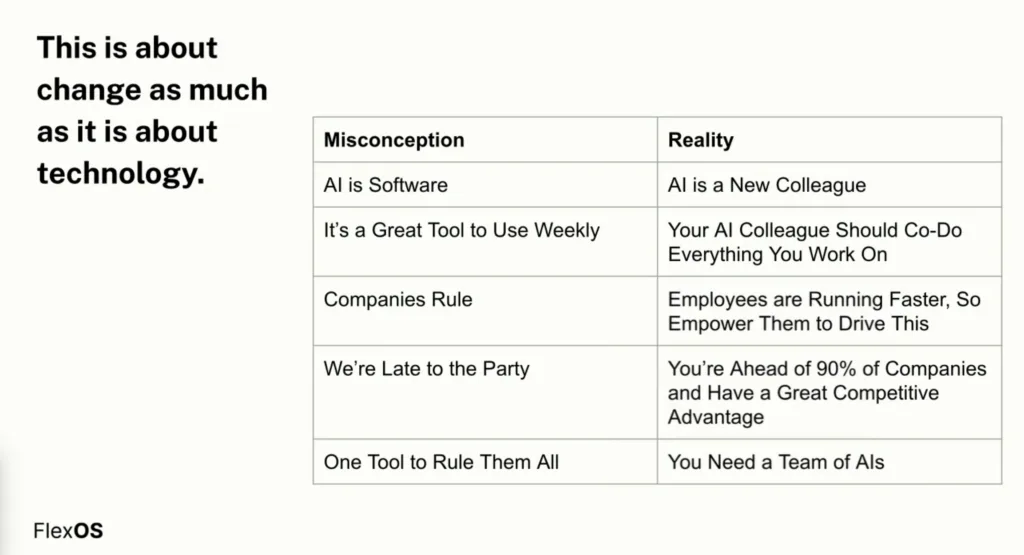
Several key insights from last week’s post from FlexOS. Find last week’s posts at www.educatorsnotebook.com
“In this one, I’m going to provide some guidance and insights about how faculty might engage with students once they suspect that a student might have inappropriately used generative AI.”
“Human creativity augmented with AI would only be beneficial, IMHO, if the weight of human judgment before and after AI use is high. In the same way it’s important to make a mental calculation of something before you put it into the calculator so that you know roughly what should come out, I think with AI we need to constantly do this, not just to preserve our imagination, but to also preserve our criticality and awareness of epistemic bias.”
“If making current AI systems work better is about expert guidance, then we need experts to share what they learn, or people will use AI in ways that don’t draw on latent expertise. For every student using our tutor prompt, tens of thousands of students are just asking the AI to explain something “like I am 10 years old.” For every carefully build job description, thousands of people are just using LLMs and getting indifferent results. Success is going to come from getting experts to use these systems and share what they learn.”
“In order for students to make informed choices about AI, they have to be knowledgeable not only about AI tools themselves but also about their own writing processes. Unfortunately, most students enter my class without a well-defined, well-developed, or personalized process, much less a deep awareness of that process. They have to cultivate their own process and a reflective stance on that process at the same time that they’re trying to figure out how AI might affect their growth as writers. This strikes me as an exceedingly difficult task.”