This week, I am so happy to share the arrival of AthenaLab.io.
Many of you may have followed the evolution and growth of Athena over the years. Now, it is reborn as Athena Lab, and we are bringing it from a side project to scale. Why? Teachers are still isolated. Administrators want to support teacher growth. Both say they are hungry for better, more effective ways to connect teachers around resources. Both say that this is exactly what Athena Lab does for them.
Some updates:
* Refreshed website: We’ve streamlined and refreshed our new home at AthenaLab.io.
* AI and Teaching & Learning: We have partnered with the Middle States Association to support the RAIL endorsement for artificial intelligence, enabling teachers across participating schools to collaborate, share resources, and provide feedback for each other on how they are integrating AI into their teaching and learning.
* Learning about the African Diaspora: We continue to deepen our relationship with the African Diaspora Consortium, which is growing their AP seminar course materials (now in over 100 schools) and expanding into both higher education and K-8 settings.
* As always, find resources: the first day of class: Here are over 100 ways to engage students on day one. One of my favorites: “Identify tensions in current events to set a basis for understanding historical tensions.” (Anything happening in current events these days…?). Want to train students for Harkness discussions? Here are practical exercises to build Harkness skills. Find these and more. I’d love to keep learning from you about your experiences and needs. Are you a school leader looking to connect teachers around practice to improve teaching and learning? Are you a teacher looking to expand your network of colleagues, or to find new approaches to what you teach? I’d like to hear about it. Please don’t hesitate to sign up for a 20 minute call.
---
So many other good things in this week’s issue, too.
In the features, find posts on student sleep habits and on concrete data about student wellness. The Gallup data is super helpful for seeing kids’ emotional lives in context.
Also, for joyful,free, content-based discussion groups on great texts, check out the Catherine Project. Registration for their next round of reading groups is open this week only. I wrote about the Catherine Project here. See the humanities section for more. Registration closes this Friday, 8/16.
Also in the news this week: religion in schools. Oklahoma and Louisiana, where superintendents have required teaching the Bible and posting the Ten Commandments, have prompted discussions both within their states and across the country about the role of religion in schools. See the curriculum section for more.
See also the pedagogy section for more first day activities (see above), active learning approaches, supporting executive function, and more.
“The 2024 Student Voice Report presents a comprehensive analysis of high school students’ emotional and physical health, sense of connection and belonging in school, and engagement with learning, based on data collected from over 375,000 students from 2010 to 2023. On average, high school students report receiving only 6.6 hours of sleep per night, far below the recommended 8-10 hours for their age group. This sleep deficit is not just a minor inconvenience—it has profound implications for students’ health, well-being, and academic performance.”
“The most recent survey, which is part of a larger body of research on Gen Z by the Walton Family Foundation and Gallup, was conducted online March 13-20, 2024, with 1,675 10- to 18-year-old youth and one of their parents or guardians via the probability-based Gallup Panel. It finds that, rather than being completely positive or completely negative, the emotional lives of preteens and teenagers are complex. Nearly all of these children (94%) say they felt happiness a lot of the prior day; however, 45% also felt stressed, 38% anxious, and 23% sad.”
“Our objective in making this film was something of a psychology experiment: We sought to capture people facing a difficult situation, to make a portrait of humans in doubt. We’ve all seen actors playing doubt in fiction films, but we have few true images of the feeling in documentaries. To make them, we decided to put people in a situation powerful enough not to need any classic narrative framework. A high dive seemed like the perfect scenario.”
“Public schools can meet the requirements of a new Louisiana law that calls for a Ten Commandments poster in every classroom without violating students’ constitutional rights, Attorney General Liz Murrill argued. The law, signed June 19, has already been challenged in federal court. But supporters of such displays are emboldened by recent U.S. Supreme Court decisions they see as cracking open the door to more religious displays and texts in schools.”
“Will your students have the opportunity to be exposed to other religious texts such as the Torah, the Quran, the Bhagavad Gita, or the Tripitaka (just to name a few) to compare and contrast their historical and present impact on societies around the world? …Will your policies also engage students in discussions of why humans are or are not religious at all? Will you make all students, even the nonreligious ones, feel welcome to learn in your schools?”
“It is gone. What began as Ted Sizer’s ground-breaking effort to reform U.S.’s 25,000 high schools in 1984 reached 1000-plus schools by 1997, the year Sizer retired from CES. By 2017, however, CES had closed operations with less than 100 affiliated schools. Is this another story of a reform birthed in one educational crisis and dying during a later one? Or is it a story of a national program centered around one smart, engaging, and knowledgeable high school reformer who, over time, built an organization that lost energy after the founder left? Or is it a time-tested story of a reform that succeeded by spreading its gospel far and wide in policies, programs, and places?”
“If accreditation serves as the concept model for the endorsement-as-credential, then Stewart Brand’s “pace layering” model is the concept model for the endorsement-as-implementation framework. Brand’s pace layering model reflects how complex, adaptive systems change over time. The layer at the bottom changes the slowest, with each layer above changing more quickly.”
“Learning, getting better, happens successfully when our brains, through repeated experiences, engage in a good struggle to a) create or extend an existing neuronal chain b) make a neuronal constellation more complex or c) hardwire an existing chain so that it fires automatically and becomes sticky. When this happens we acquire knowledge, develop our skills and deepen our understandings in different ways and over different periods of time.”
“One of this past year’s great joys was participating in a reading group on Socratic Dialogues with The Catherine Project. Every Tuesday night for 3-4 months I joined a zoom call with more than a dozen strangers from around the world to talk about Plato’s writing for 90 minutes. It was free and it was excellent. As an educator, I had found references to Socrates unavoidable — the Socratic method, the maxim “Know thyself,” the pursuit of a “good life” — but I had never encountered Socrates on my own, and I felt I should do something about it. I had encountered the Catherine Project through a reader of the newsletter and I thought to try it out… What a joy. In my group were 18-20 individuals from all walks of life. They spanned from retirees to recent college graduates. They came from across the Americas, Australia, and Europe. They were women and men. They were like our classes: full of diverse personalities, skeptical and enthusiastic, quiet and verbose, full of questions and full of answers.”
“We offer a variety of courses focused on particular great books, ancient languages, and other related subjects. These courses offer opportunities to focus one’s learning in a welcoming intellectual community. Our courses are open to adults 16 years or older from all educational backgrounds and walks of life. Most courses meet weekly for between 1-2 hours.”
“You’ll have tons of time to assess students’ strengths and weaknesses. You have months to discuss high stakes testing and standards. You’ll spend weeks probing the textbook. So the first few days of school should be dedicated to rapport-building and to joy. Your goal should be that students go home that night and tell their parents: “I’m going to love this class!”
“For the meta-analysis, the researchers drew on 119 studies published between 2010 and 2023 to examine the use of various digital interventions in kindergarten through fifth grade, including computer programs, e-books, online games, and videos… Their analysis found positive effects on elementary school students’ reading skills overall, indicating that generally, investing in educational technology to support literacy is warranted. But when the researchers isolated particular learning outcomes to measure effectiveness, they found wide variability, suggesting that the effectiveness of a particular edtech product can depend on different factors, including features of the tool and characteristics of the users.”
““This is a good six-page speech,” he said. I was thrilled. He liked it! And then he added: “It would be a great five-page speech.” I chuckled. I thought he was teasing me. He wasn’t. “See if you can shave a page off,” he said, handing me the speech and walking back to his cabin. I looked down at the pages, assuming he’d offered some suggestions on what to cut. He hadn’t.
“The effect extreme heat is having on schools and childcare is starting to get the attention of policymakers and researchers. Last week, the Center for American Progress, a left-leaning think tank, published a report on the issue. In April, so did the Federation of American Scientists a nonprofit policy organization.”
“The project would require $43,613 in startup money. It would be profitable within roughly five years, the students said. And over 50 years, it would save the university $787,130 in energy costs.”
AI Adoption continues growing, AI Companionship grows, too
Much to learn from this week.
Most significant, I think, is the growing trend of AI companionship. In one of this week’s features, Marc Watkins describes this as “synthetic relationships.” He is right that human beings need authentic relationships, but also that there may be a space for AI-human connection to support specific needs. This will be a very complex puzzle for us as a society in the years ahead. See the Uses and Applications section for one such effort, called “Friend,” which I think misses the mark but is a sign of what is to come.
These and more, enjoy!
Peter
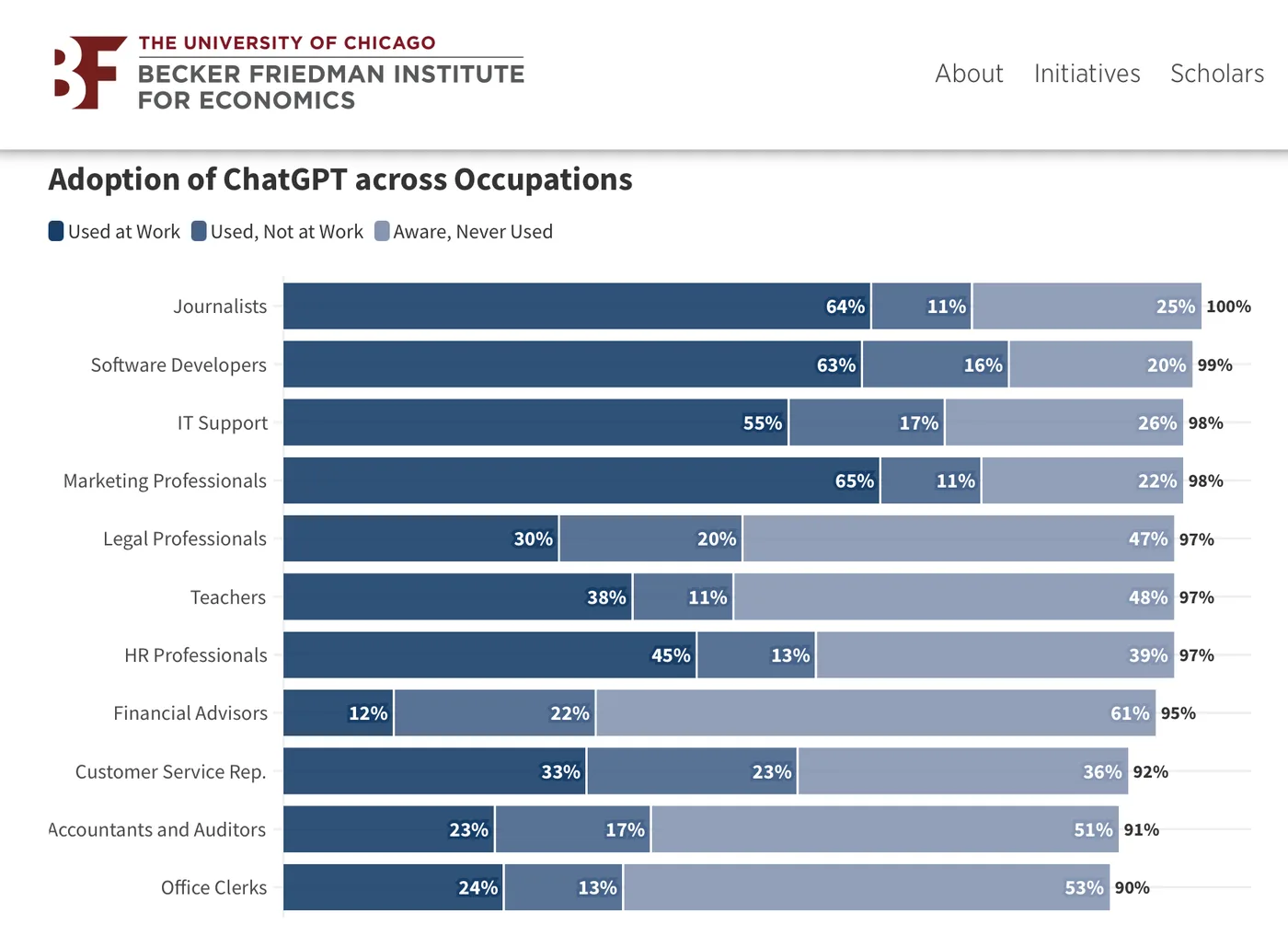
Adoption of ChatGPT across Occupations (see Uses and Applications for more)
“It is increasingly looking like generative AI won’t become intelligent to achieve true AGI, but human beings will still put their trust into these black box systems and may one day be willing to cede autonomy and critical decision-making to an algorithm. To those who scoff at this, and I imagine there are many, know that I was very much among your ranks. Then I started thinking about how much of my life is already mitigated by algorithms and machine learning. How many of us are lost without GPS guiding us, mobile food orders, and all things digital commerce, or our wearable smart devices informing us of our diets, heart rates, and even when a female is ovulating?”
“86% of students globally are regularly using AI in their studies, with 54% of them using AI on a weekly basis… Despite their high rates of AI usage, 1 in 2 students do not feel AI ready.”
“We found that 94% of our AI submissions were undetected. The grades awarded to our AI submissions were on average half a grade boundary higher than that achieved by real students. Across modules there was an 83.4% chance that the AI submissions on a module would outperform a random selection of the same number of real student submissions.”
“The first draft is the child's draft, where you let it all pour out and then let it romp all over the place, knowing that no one is going to see it and that you can shape it later. You just let this childlike part of you channel whatever voices and visions come through and onto the page. Having AI generate a draft for you might not give you the same experience because an AI-generated draft might be something’s child’s draft, but not your own. The creative risks aren’t the same. Yes, you get a fast start from going to a blank page to a rough draft but having a machine do that for you feels like leaping from the crowd in front of the Boston Marathon and sprinting the last hundred yards ahead of everyone else.”
“After the Zoom interview ended, he received an email from Otter, a popular transcription program that uses AI to convert audio to text, sharing a both a transcript and the original audio. The recording had continued after Hill left the Zoom interview, capturing the researchers’ thoughts, Hill said.”
“It’s sort of like comparing a woodworking artisan’s table to one from IKEA. The artisans invest immense time and effort into their high-quality pieces, while IKEA produces things quickly and cheaply, and most people probably can’t tell the difference (or don’t care). Which is kind of sad for us artisans. With AI, we can expect a rise in superficially appealing but low-quality content. But that doesn’t mean there’s no place for craftsmanship. We still find meaning in the bespoke, at doing all the little things right, and in creating things that feel like they have a real person at the other end of it. And we can only hope that others do too.”
“Achieving human-level speed and performance on real world tasks is a north star for the robotics research community. This work takes a step towards that goal and presents the first learned robot agent that reaches amateur human-level performance in competitive table tennis. Table tennis is a physically demanding sport which requires human players to undergo years of training to achieve an advanced level of proficiency.”