Sustainability, combatting dopamine culture, managing polarization, and memorizing poetry
An excellent week.
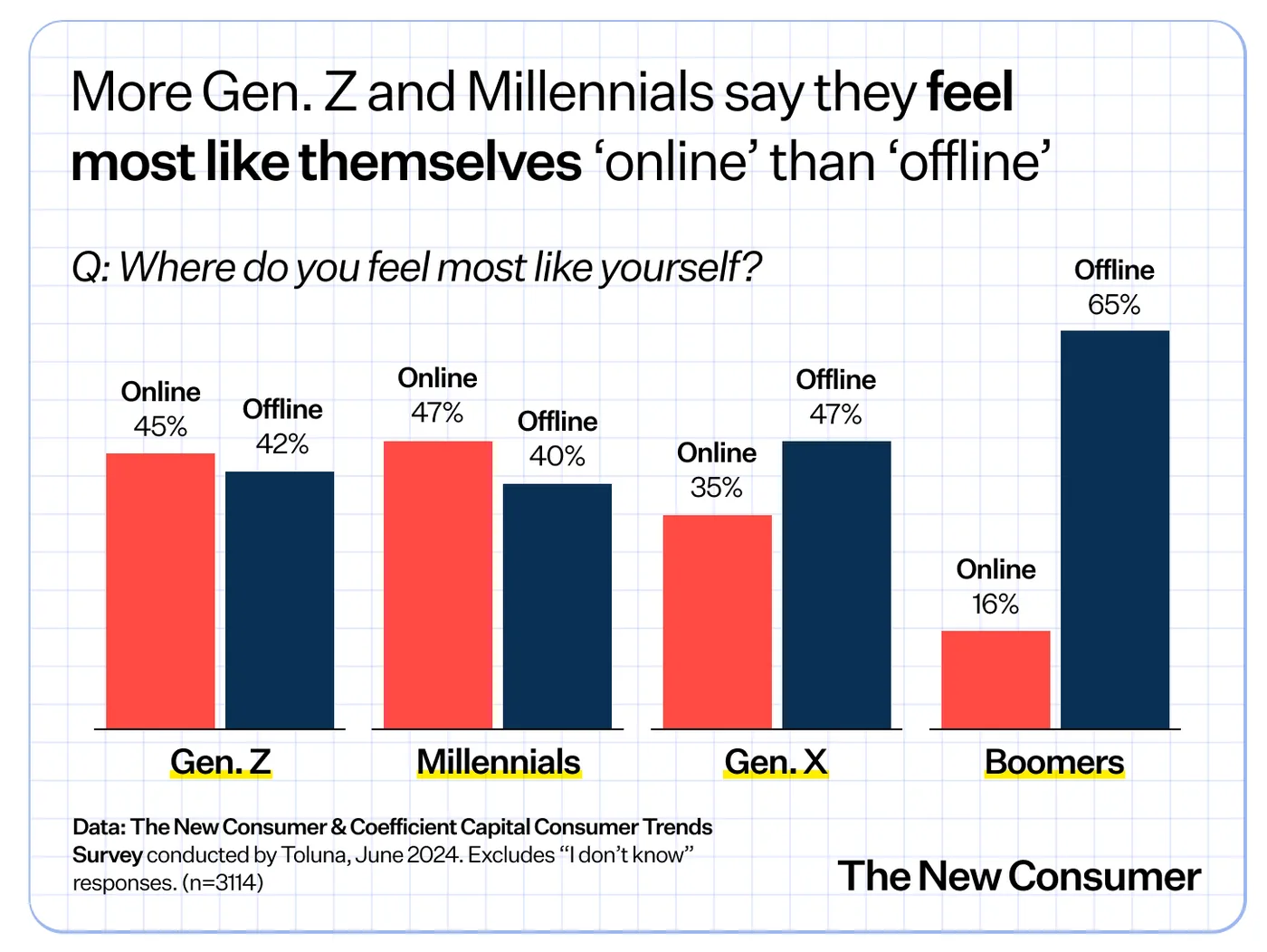
In our features this week, find two pieces connected to adolescence and mobile devices: a survey from the New Consumer about how adolescents feel online versus offline and a reflection by David Brooks on pleasure versus addiction as they relate to the everyday interactions we have with mobile devices. (Find this complicated just a bit in the Learning Science section.).
As a third feature this week, you might examine an interesting post in EdWeek about how leaders can engage polarizing conversations and facilitate the finding of common ground.
Also this week: some good new about e-cigarettes (surprise!), some complicating news about the impact of anti-DEI efforts, some provocative and wide ranging news in both Humanities and STEM, and more. For fun, enjoy the AI generated Faux French Film trailer about the US government and Silicon Valley.
And don’t miss updates in the AI section, below.
These and more, enjoy!
Peter
PS. My thanks to the over 50(!) people I’ve spoken with so far. If you’re a teacher or school leader willing to share 20 minutes of your time to talk with me about your professional development interests, please sign up here at a time that works for you. Thank you!
“First, warring factions must agree that some polarizing conflicts are “wicked problems,” which don’t have any easy solutions. A wicked problem is a tug-of-war between competing priorities and values… Second, school systems hurting from polarization need leaders who can skillfully listen and mediate conflicts… Moving opposing viewpoints into the groan zone is a messy process. The facilitator must take polarizing views head on and bring the opposing sides to the same discussion table. The facilitator should engage the tensions and push back on simplistic us-versus-them arguments.”
“Dopamine can sometimes sound like the bad guy in this conversation, but all in all, it’s an awesome neurotransmitter. It’s what drives us to create, to learn, to build, to improve. Dopamine pushes us to boldly go where no person has gone before… The problem with our culture today is not too much desire but the miniaturization of desire, settling for these small, short-term hits. Our culture used to be full of institutions that sought to arouse people’s higher desires — the love of God, the love of country, the love of learning, the love of being excellent at a craft.”
“Younger consumers are also more likely to say they feel “more valued for their talents” online than offline, feel “more appreciated” online, and feel “more creative” online, than older consumers.”
“When the Supreme Court ruled against race-conscious admissions, the expectation — based on statistical modeling presented in court — was that the proportion of Black students at highly selective schools would go down and the proportion of Asian American students would rise. That is what happened at many colleges and universities. But as schools have released data over the last few weeks, there have been some striking outliers.”
“Readers of this journal will know how, since the crises of 2020–21, classical education in grades K-12 has been growing by leaps and bounds as an alternative to the sclerosis affecting Big Education… There are now more than a million American children and young adults being educated using the same traditional methods and texts that have been discarded by district public schools and elite private schools.”
“Americans aren’t facing an addiction crisis because we get too much dopamine from overabundant cheap thrills. Our problem, instead, is a lack of connection, community and purpose.”
“Consider in vitro gametogenesis, or I.V.G., a technology under development that would allow the creation of eggs or sperm from ordinary body tissue, like skin cells. Men could become genetic mothers, women could be fathers, and people could be the offspring of one, three, four or any number of parents. The first baby born via I.V.G. is most likely still a ways off — one researcher predicts it will be five to 10 years until the first fertilization attempt, although timelines for new biotech are often optimistic.”
“A 2023 UNESCO study looked at how 80 countries around the world approach climate change education, including preparation for teachers. Overall, one-third of the countries did not emphasise climate change in their teacher training plans.”
“We surveyed over 1,600 educators to uncover the top trends redefining education. From the AI revolution to the demand for inclusive instruction, this report delivers essential insights to drive teaching and learning forward this school year and beyond.”
“A new study by Columbia archaeologist Dylan Davis challenges this narrative, claiming that the Rapa Nui people did not overpopulate the island but rather maintained a small and stable settlement right up until the Europeans arrived. The evidence: a comprehensive survey of the island’s farmland that indicates that its inhabitants grew only enough crops to feed four thousand people at any given time.“
New models, GenAI's impact on learning, AI social impact, and more
The first feature this week offers a fascinating look at the effect of conversation with chatbots on conspiracy theories. I shared research on this earlier in the year, but this post dives a little further and shares potential future strategies for leveraging this effect at larger scale.
Also in the features is some early research on the impact of genAI on learning. The report indicates, perhaps as expected, that students with generic AI tools complete work much faster, but then perform worse on assessments without AI, clearly showing that they used AI to circumvent learning. But less reported is that the students who used a generative AI tool that was prepared to act as a tutor (not giving answers directly, for example) performed equally well on assessments later on, but also were significantly more productive when using the tool. This might be an early indicator that generative AI that is properly prepared for learning can aid with student productivity without inhibiting learning, even if it doesn’t enhance learning.
Also this week, enjoy Charles Fadel’s fascinating presentation from the IB conference I referenced several weeks ago, and also, for the philosophers out there, explore the Industry Development piece on “Diverse Intelligence.” We do need to rethink, in an age of AI, what intelligence might mean when it can manifest in so many new ways.
These and more, enjoy!
(See more about this in the Education section, below.)
“High school students who had access to ChatGPT while doing practice math problems did worse on a math test compared with students who didn’t have access to ChatGPT. Those with ChatGPT solved 48 percent more of the practice problems correctly, but they ultimately scored 17 percent worse on a test of the topic that the students were learning. A third group of students had access to a revised version of ChatGPT that functioned more like a tutor. This chatbot was programmed to provide hints without directly divulging the answer. The students who used it did spectacularly better on the practice problems, solving 127 percent more of them correctly compared with students who did their practice work without any high-tech aids. But on a test afterwards, these AI-tutored students did no better. Students who just did their practice problems the old fashioned way — on their own — matched their test scores.”
“After three exchanges, which lasted about eight minutes on average, participants rated how strongly they felt about their beliefs again. On average, their ratings dropped by about 20 percent; about a quarter of participants no longer believed the falsehood. The effect also spilled into their attitudes toward other poorly supported theories, making the participants slightly less conspiratorial in general.”
“Hybridization of life with technology is scary when you can’t quite lose the unspoken belief that current humans are somehow an ideal, crafted, chosen form (including their lower back pain, susceptibility to infections and degenerative brain disease, astigmatism, limited life span and IQ, etc.).”
“NaNoWriMo has had a slew of criticisms thrown its way due to its statement on the use of generative A.I. in writing that was released last week.. At the time of reporting, the page has been updated a third time, removing the initial verbiage, keeping the text of the first edit, and linking to a letter to “speak to those mistakes.””