Knowledge curricula, new Frost poem, AI's future in the present, and more
An excellent week.
In this week’s features, find a truly excellent video introduction to Bloom’s Taxonomy. Bloom is probably one of the most referenced tools for evaluating teaching & learning, so it’s worth it to know it well and deeply. This short video introduction offers an excellent starting point. Also, I’ve bumped an AI article to the main section this week. The New York Times feature about what software engineering looks like today offers an early example of how AI is already integrated in some workplaces and is likely to take shape in other workplaces in the knowledge sector. The closing line of the article, featured in the pull quote here, reminds us that all of our present skills remain entirely relevant, and that they are and will be practiced in partnership with AI, not replaced by AI. Last in the features, Austin Kleon’s delightful post on reading like an artist is a crisp celebration of all of our unique reading habits.
Also this week: a robust humanities section. First, A. O. Scott in the New York Times offers an excellent example of how to close read a poem. The NYT interactive team made the post delightfully interactive, showing how Scott explicates Gwendolyn Brooks’ work. Also: a newly found poem by Robert Frost. The past is coming back: The Beatles are winning Grammies, tombs of pharaohs are being discovered, a new poem by Frost… Who knew? (Who new?)
Also this week, logic puzzles for resilience, a helpful overview of Bloom’s Taxonomy, and a super short video of NBA phenom Victor Wembanyama with a book in the locker room sharing that he reads before every game.
These and more, enjoy!
Peter
PS. See you at NAIS and/or SXSWedu this week and next!
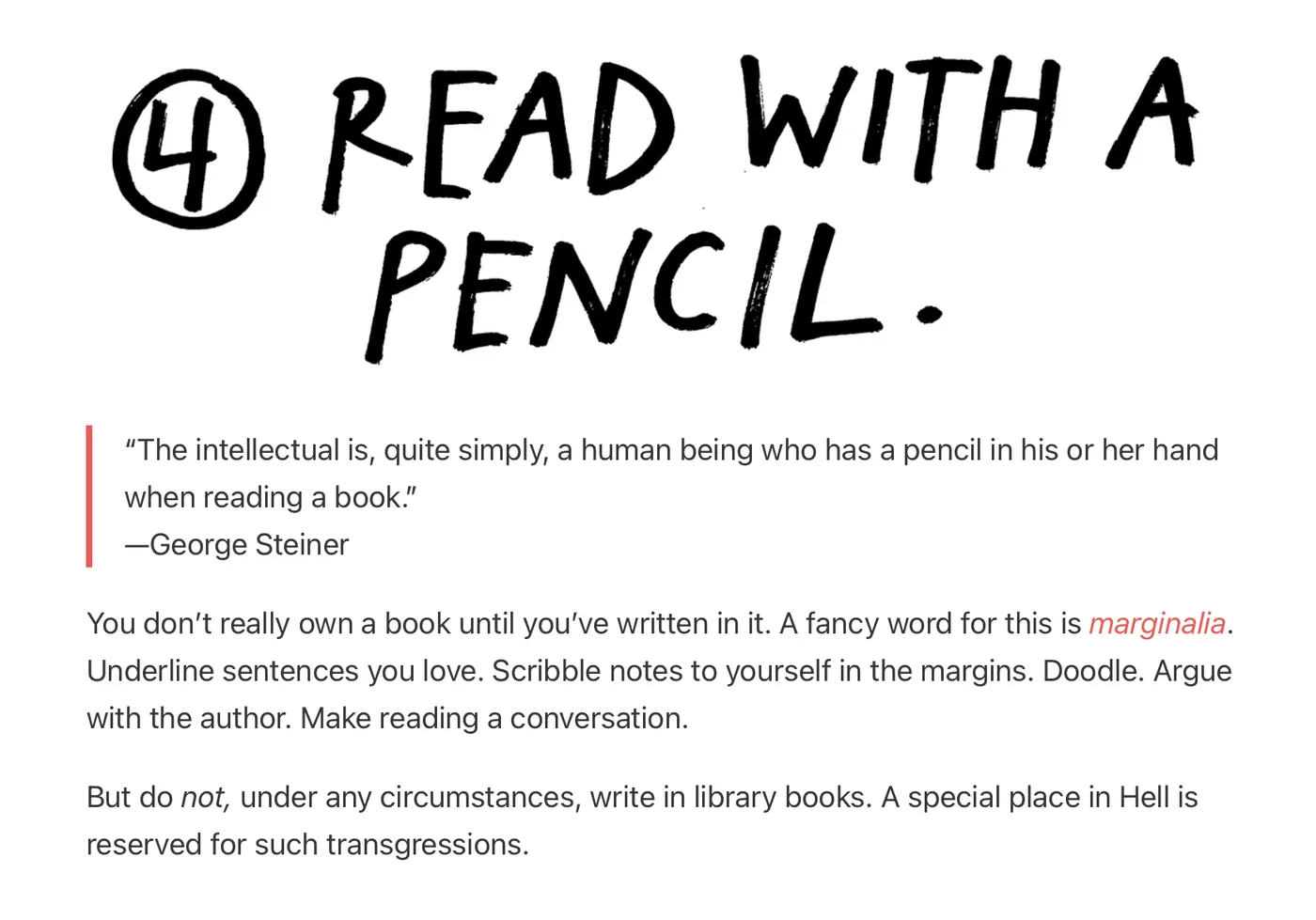
Austin Kleon’s short, delightful list of how to read like an artist. See it in the features.
“We all love things that other people think are garbage. You have to have the courage to keep loving your garbage. What makes us unique is the diversity and breadth of our influences, the unique ways in which we mix up the parts of the culture others have deemed “high” and “low.” When you find something you genuinely enjoy, don’t let anyone make you feel bad about it. Love what you love.”
“Bloom’s Taxonomy gets thrown around a lot in instructional design, but it’s often misunderstood. Especially by those new to the field or fresh out of college. Two things to know about it: It’s not a checklist, and it’s definitely NOT A PYRAMID. In this video I break down what Bloom’s actually does—helping us analyze learning objectives, spot gaps, and refine alignment.”
“Art is not policy. It does not, at least as normally constituted, feed the hungry, shelter the unhoused, or clothe the indigent. To complain, as some do, that because art doesn’t fulfill these necessary social obligations it’s little more than a disposable frivolity, is to completely miss the point: art is not meant to do any of these things.”
“One simple idea: give young people who’ve faced displacement a space to share their stories. These workshops aren’t just about learning theatre techniques. They’re about giving a voice to those who have lived through loss, migration, and unimaginable challenges.”
“The book argues for a coherent curriculum that systematically builds students’ background knowledge to facilitate deeper understanding and better reading comprehension. This aligns with decades of research in cognitive science demonstrating that comprehension is not a transferable skill but is largely dependent on prior knowledge.”
“We are tracking 123 bills in 29 states and the US Congress. Since 2023, 123 have been introduced. 15 have final legislative approval. 15 have become law. 71 have been tabled, failed to pass, or been vetoed.”
“As a legal and education scholar over the last 15 years, I have played a leading role in litigation on race-conscious admissions as counsel of record in “friend of the court” briefs filed before the U.S. Supreme Court. And I have examined the role of past guidance from OCR, which has historically served as a valuable resource for researchers, educators, and advocates. The current “Dear Colleague” letter deviates significantly from this tradition in several critical ways, which are important for higher-education leaders to understand… Specifically, the court noted that “nothing in [the] opinion should be construed as prohibiting universities from considering an applicant’s discussion of how race affected his or her life, be it through discrimination, inspiration, or otherwise.””
“Teacher quality impacts student success more than any other factor in school. As a non-profit, nonpartisan research organization, the National Council on Teacher Quality (NCTQ) exists to ensure all students have access to effective teachers… Without the data, we have no light, and the result will be policymaking that happens in the dark—uninformed, disconnected from the best available evidence, stumbling without light. We will be unable to answer our most basic questions about schools and teachers.”
“Consider a graph where each vertex represents a Member of Congress. Now draw an edge between members each time they vote the same way on an issue. The resulting multigraph has hundreds of edges between members of the same party, and fewer edges between members of different parties. In the case of the current Congress (the 117th) graph looks something like this:”
“I opened “Nothing New” on my laptop, seeing at once that it was indeed something new. It was originally inscribed inside a copy of Frost’s second collection, “North of Boston,” that was found in a retired educator’s home library by a family friend, a book dealer, following the educator’s death. It’s a good poem, short and aphoristic, from a period when Frost, writing at the height of his powers, had a special affection for poems of this kind: brief, rueful, tight, focussed.”
“Here’s a poem about patience, about self-control, about the need to conserve your energy and constrain your desire. Fittingly enough, it’s a proper old-school sonnet, orderly and elegant: 14 lines of iambic pentameter, crisply punctuated, with syllables cut to measure.”
“Employees whose psychological needs are met are intrinsically motivated by finding meaning and enjoyment in their work, which leads to not only better performance but also improved well-being. Using self-determination theory to manage employees can promote ethical behavior, innovation, and long-term commitment.”
“Many college presidents and deans are issuing mealymouthed statements, ending long-standing programs, removing content from websites and otherwise cowering in the face of… attacks on higher education. Then there’s Michael S. Roth… “Leaders in higher educational institutions should stand up for their values.” Roth told me in an interview last week. “We should stand up for our values because we’ve said we believed in them for the last many decades now… I don’t look for trouble. But I would feel ashamed if I didn’t speak up for the values that have guided my institution and many others.””
“Ms. Schamis committed herself to staying at Marjory Stoneman Douglas until every surviving student from Room 1214 graduated in the spring of 2019. It was not easy.”
“The median number of views for a YouTube videos is just 41 views. 4% of YouTube videos haven't been watched a single time. 74% of YouTube videos have 0 comments. Around 89% of YouTube videos have 0 likes. The median YouTube video is only 64 seconds long.”
“For Sacchetti, who teaches precalculus and applied math, puzzles are powerful tools for developing resilience and flexibility—characteristics essential for success in math and life. "Students who enjoy puzzles tend to be more flexible in their thinking," he explained. "Even if they only know one piece, they’re willing to experiment and figure out the rest.”"
A.I. Update
AI's future in the present, the NYT goes all in on AI, remarkable releases from Anthropic and OpenAI, and more
Four features this week!
* For the first time, I’ve listed an article as a feature in both the main section and the AI Update. The description of how software engineers are using AI for their coding is concrete description of how AI is likely to play into knowledge-based workplaces. It should be reassuring to those who fear the obsolescence of the work they hold fast to: core skills still matter, mechanics still matter, knowing how to write (code) is still relevant. It’s an integrated future. Risks remain that people will take shortcuts, but it will be as obvious as shortcuts people take today.
* Also in a surprise: the NYT acknowledges and fully embraces the use of AI in its workplace. Note that it specifies when and for what purposes use of AI is appropriate and acceptable. And when it is unacceptable.
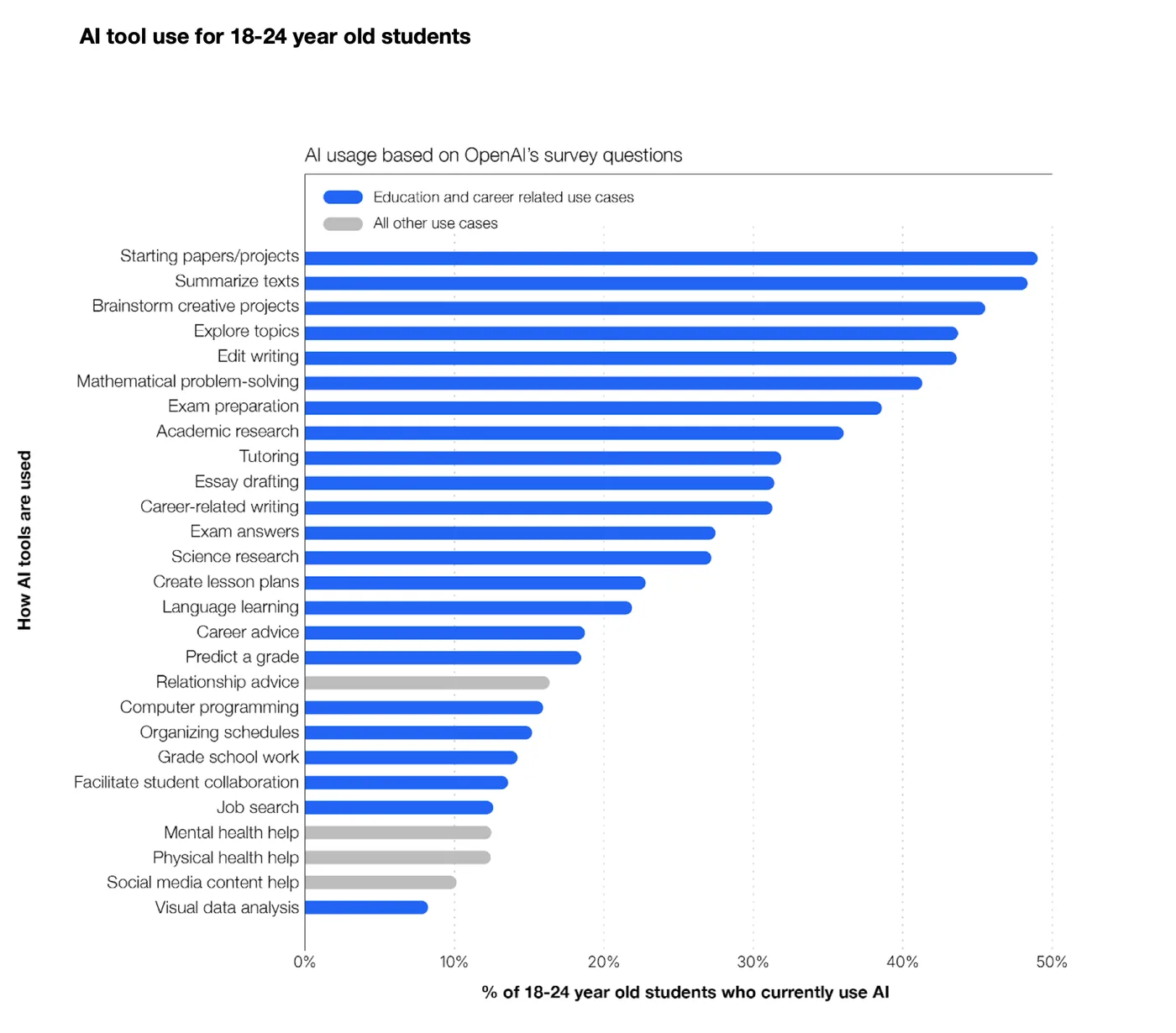
* For the last two: both OpenAI and Anthropic have released reports on how their products are being used. OpenAI highlights use of their tools among 18-24 year olds in higher education, and the use cases are deeply focused on school. See the graph below for a preview. As a partner report, Anthropic’s report is on the workplace, and it shows that the type of tasks that people are using Claude for match the types of tasks that we ask students to perform in schools. It’s worth digging through the academic paper for details.
Also, see in the Education and the Uses and Applications sections posts on how principals and managers are using AI in the workplace.
These and more, enjoy!
Peter
Looks a lot like school…! From the OpenAI report on how 18-24 years olds are using ChatGPT. See the feature for more.
“John Giorgi uses artificial intelligence to make artificial intelligence. The 29-year-old computer scientist creates software for a health care start-up that records and summarizes patient visits for doctors, freeing them from hours spent typing up clinical notes. To do so, Mr. Giorgi has his own timesaving helper: an A.I. coding assistant. He taps a few keys and the software tool suggests the rest of the line of code. It can also recommend changes, fetch data, identify bugs and run basic tests. Even though the A.I. makes some mistakes, it saves him up to an hour many days. “I can’t imagine working without it now,” Mr. Giorgi said.”
“Cognitive skills such as Critical Thinking, Reading Comprehension, Programming, and Writing had the highest prevalence. However, our analysis captures only whether a skill was exhibited in Claude’s responses, not whether that skill was central to the user’s purpose or was performed at an expert level. For instance, while Active Listening appears as the second most common skill, this likely reflects Claude’s default conversational behaviors—such as rephrasing user inputs and asking clarifying questions—rather than users specifically seeking out listening-focused interactions.”
“College-aged students aged 18-24 primarily use AI tools for starting papers and projects, summarizing texts, exploring topics, and brainstorming creative ideas, according to our recent survey. For ChatGPT users who belong to this age group, just over a quarter of all messages are education- or learning-related (which means those messages are tagged as tutoring- or teaching-related by our internal classifiers), followed by writing assistance, one-off questions, computer programming support, and how-to advice.”
“In a series of training documents, editorial guidelines laid out possible use cases for journalists, including prompts such as: How many times was Al mentioned in these episodes of Hard Fork? Can you revise this paragraph to make it tighter? Pretend you are posting this Times article to Facebook. How would you promote it? Summarize this Times article in a concise, conversational voice for a newsletter. Can you propose five search-optimized headlines for this Times article? Can you summarize this play written by Shakespeare? Can you summarize this federal government report in layman’s terms? Still, the company has bracketed its AI use, noting the potential risks for copyright infringement and exposure of sources. The company told editorial staff they should not use AI to draft or significantly revise an article, input third party copyrighted materials (particularly confidential source information), use AI to circumvent a paywall, or publish machine-generated images or videos, except to demonstrate the technology and with proper labeling.”
“The five most common ways principals said they used AI tools include drafting and enhancing school communications, supporting school administrator tasks, assisting with teacher hiring, supporting evaluation and professional development, bolstering instruction or demonstrating how teachers can use AI in their lessons, and researching job-related topics.”
“There are many legitimate reasons to resist using AI in education, and we should not be silencing them. There are also some real reasons why some people are very optimistic; concrete ones separate from the hype. As long as they’re not uncritical hype.”
“Research shows that, in general, AI feedback on written work is “in the range” of human feedback, said Tamara Tate, the associate director of the Digital Learning Lab at the University of California, Irvine. AI likely wouldn’t be as accurate or insightful as veteran teachers, but it might go toe-to-toe with a newer, less experienced educator, she said.”