On reading, hope, change, starting homework in class, and more
An excellent week with several interesting themes.
In the features, find results from surveys by EdWeek on STEM instruction: what works in the classroom according to teachers, and what works according to students? Find plenty of useful tidbits in the two EdWeek polls. In the other feature, Tim Dasey’s reflection highlights the importance of schools being learning organizations that adjust and adapt as other organizations do. This is a helpful frame for leaders and teachers alike.
Also this week, with the advent of AI, many people are writing about writing. And reading. This week’s Reading/Writing section explores college writing, college reading, and early reading instruction.
Also in this issue, in the Character section, one of AEI’s columnists wrote a post suggesting that we should “Stop telling kids the world is a terrible place.” I highlight this post because while the statement is unhelpfully provocative, I do believe that when and how students grow into the complexity of the world is one of the most sensitive questions educators grapple with — and something we should be intentional about in schools. We want our kids to be kids. To have a childhood. And also: we want our graduates to have their eyes open about the complexities of the world they are entering. But when and how students transition from childhood to adulthood — and learn about the environment, socioeconomic disparities, politics and more — is a mix of developmental capacity, school policy, and individual circumstances. It’s a worthy discussion not only for the curriculum, but also and increasingly for how we support adolescent development in a complex world.
Also this week: rich writing on cellphones, on Harvard’s commencement, and a great report on the national Spelling Bee — with some real gen alpha action in effect.
These and more, enjoy!
Peter
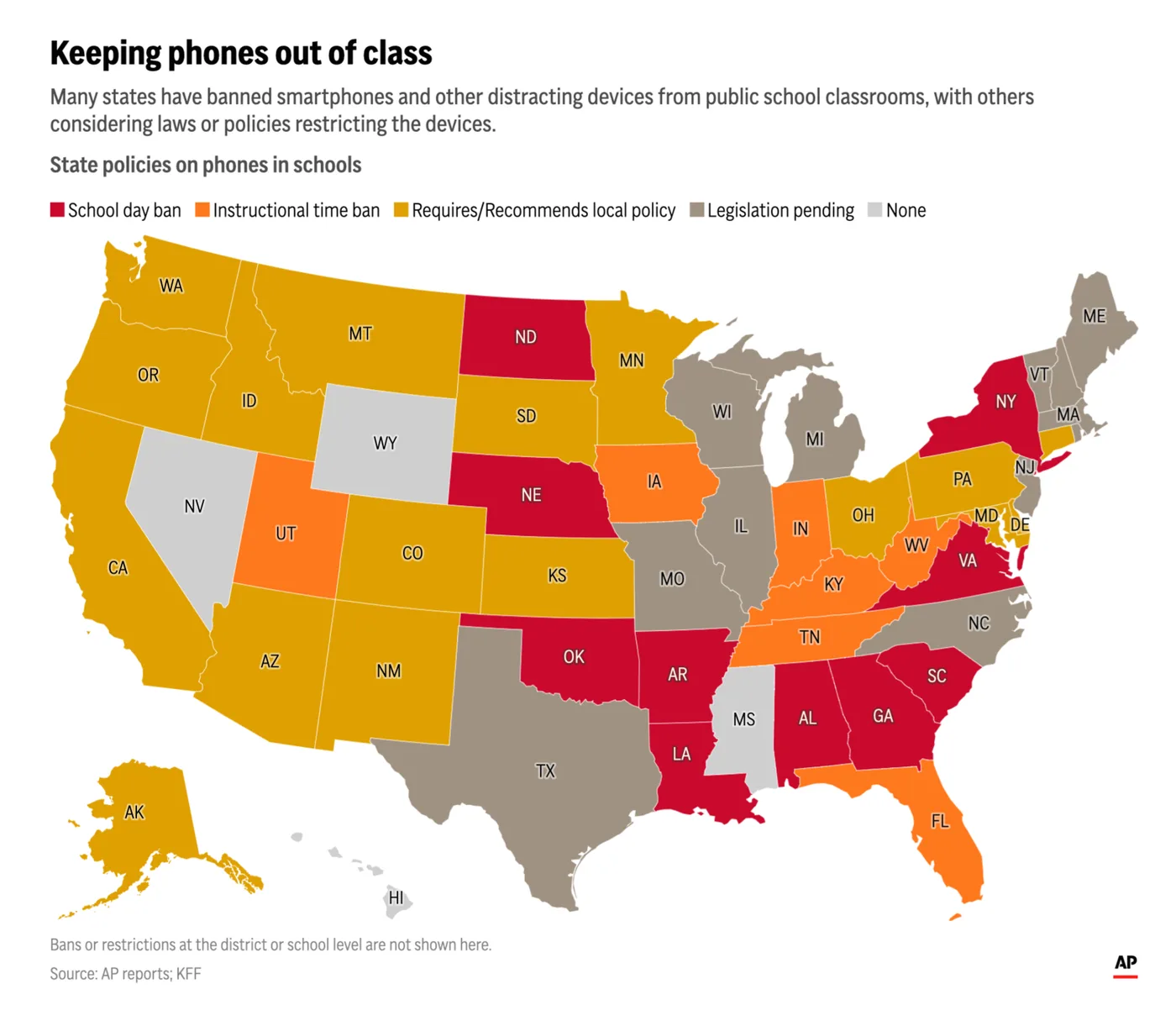
More than half of US states have formally legislated some form of cellphone restrictions, see the Tech section for more
“In a nationally representative EdWeek Research Center survey of 1,058 teens conducted in March, nearly half of respondents said that having teachers who explain things so they understand them would have a major impact on their level of motivation in science, technology, engineering, and math classes. And educators agree. A majority of middle and high school teachers of STEM subjects (59%) also said that having teachers who explain things so students can understand them would have a major impact on students’ motivation in STEM classes. That’s according to a separate nationally representative EdWeek Research Center survey of 605 teachers conducted in March and April.”
“Any learning system needs to balance exploitation—using what you know works—with exploration, trying new approaches to discover better solutions… The stakes keep rising while educational systems remain largely unchanged. Technology, work, and society are transforming in ways that make traditional educational approaches increasingly obsolete. Students enter the workforce prepared for a world that no longer exists, competing with systems that can learn and adapt faster than the institutions that educated them.”
“As Agassi worked to adapt to Gilbert’s coaching, he took a step down and went on an “epic losing streak,” sliding out of the world rankings. At the 1994 U.S. Open, for the first time in his pro career, Agassi was unseeded… Agassi wins in straight sets… The first unseeded player in 28 years to win the U.S. Open, Agassi would go on to win the Australian Open, and after winning back-to-back Grand Slams, he claimed the No. 1 ranking in the world.”
“That’s the argument suggested by an emerging body of research led by University of Pennsylvania psychologist Jeremy Clifton. For the last decade, Clifton and his colleagues have been studying what they call primal world beliefs—deep, subconscious assumptions we hold about the nature of the world. Their research shows that cultivating a pessimistic worldview may do more harm than good—especially for children.”
“Set aside 10–20 minutes at the end of class for students to begin their homework. This gives students a chance to ask clarifying questions and allows you to observe the following: How quickly students get started, Where they get stuck or confused, How long it takes to complete portions of the assignment, Whether common misunderstandings emerge.”
“What’s causing this change? And how are instructors responding to it? Watch our explainer to understand the confluence of factors shaping Generation Z’s reading habits — and why higher ed is having to rethink longstanding assumptions about how to impart knowledge.”
“She found that students have two main complaints. By far their biggest gripe, they told her, is that the assigned reading rarely gets talked about in class. If the professor doesn’t refer to it, they said, why should they think it’s important? The second reason — and perhaps a more complicated one — is that they don’t really understand what they are supposed to be reading for.”
“For thousands of years, we have been finding words for ourselves, we have been writing our own story and, in the process, have done something far more radical than expressed ourselves: We have invented ourselves. We have asked the essential question: Who are we, and what kind of people do we want to be? And it is, I believe, only as readers and writers, only as people educated in the bonding of language and meaning, that we have any hope of rising to the occasion of an answer.”
"Rick, you’re touching on an aspect of this debate that I would argue leaves both sides exposed to some extent. Book “banning” and these content questions get the bases, left and right, all fired up. But most of these episodes conflate a few things. A big one is age appropriateness. Books that people would generally be comfortable with for older kids raise objections for younger readers. And sometimes, the authors themselves say, “That was written for older kids or adults.” Another thing that gets conflated is the specific books in question. Both sides do this.”
“The idea that now in America a book that might speak to a young reader, reveal his or her calling, could be banned from their library by a school board or a government decree is beyond tragic. I know we will find our back to displaying those attributes of America I admired from afar, the America I have known and loved from over four decades of being here, and it depends on all of you.”
“Sarv was not the only finalist to add a moment of levity. When Jacques Bailly, the head pronouncer warned Faizan that one of his words was a homonym, Faizan answered him by saying, “Bro.””
In the World Economic Forum feature, see the case that AI Literacy is no longer a nice-to-have, but ought instead to be as core to the curriculum as critical thinking and numeracy. Also in the features, find an update from Google’s recent press releases: they’re apparently near to developing real-time language translation over video call. We are in Star Trek.
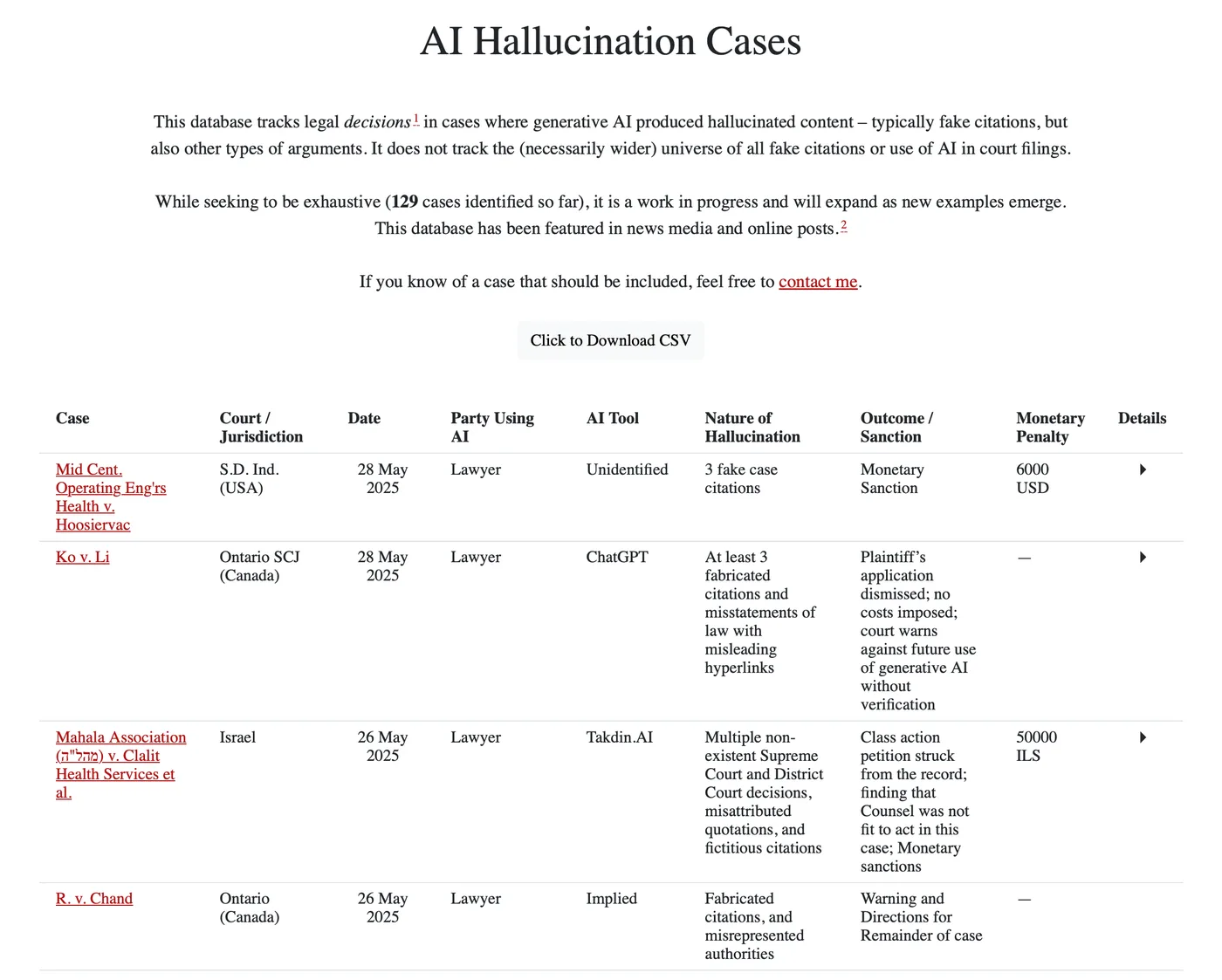
Also, see excellent essays in the Tech/AI: Education section, as well as a startling aggregation of hallucinations in legal filings, posted in the Tech/AI: Ethics and Risk section. I had known about one or two incidents of lawyers citing fictitious cases because of AI use, but I hadn’t known that there number of instances is actually in the hundreds — and these are just the recorded ones. See a preview in the image below.
These and more, enjoy!
Peter
Damien Charlotin is cataloging recorded cases of LLM hallucinations cited in legal filings. See the Ethics and Risk section for more.
“AI's most significant influence lies in how we access, process and apply information, fundamentally redefining education and the way we acquire knowledge. From this perspective, AI literacy isn’t just a “nice to have” for IT professionals; it’s essential for developing human intelligence itself and has key implications for the education sector.”
“Faced with generative AI in our classrooms, the obvious response for us is to influence students to adopt the helpful uses of AI while persuading them to avoid the harmful ones. Our problem is that we don’t know how to do that.”
“Shirky senses a growing “sadness” among students as they become more dependent on AI. They feel compelled to use the technology even though they know it’s sapping their learning — and foreclosing the intellectual possibilities that learning opens, the satisfactions that come with doing or grasping something hard.”
“What makes us most human, Weizenbaum had come to believe, is what is least computable about us—the connections between our mind and our body, the experiences that shape our memory and our thinking, our capacity for emotion and empathy. The great danger we face as we become more intimately involved with our computers—as we come to experience more of our lives through the disembodied symbols flickering across our screens—is that we’ll begin to lose our humanness, to sacrifice the very qualities that separate us from machines.”