Humanities and AI, Perceptions of Higher Ed, Building Student Motivation, and more
An excellent week!
In the features this week, find an excellent PD opportunity for humanities teachers who may be interested in joining discussion with other humanities teachers about what it means to teach the humanities in an age of AI. Also this week, find an excellent extended report on the presence/absence of high quality research in teaching and learning.
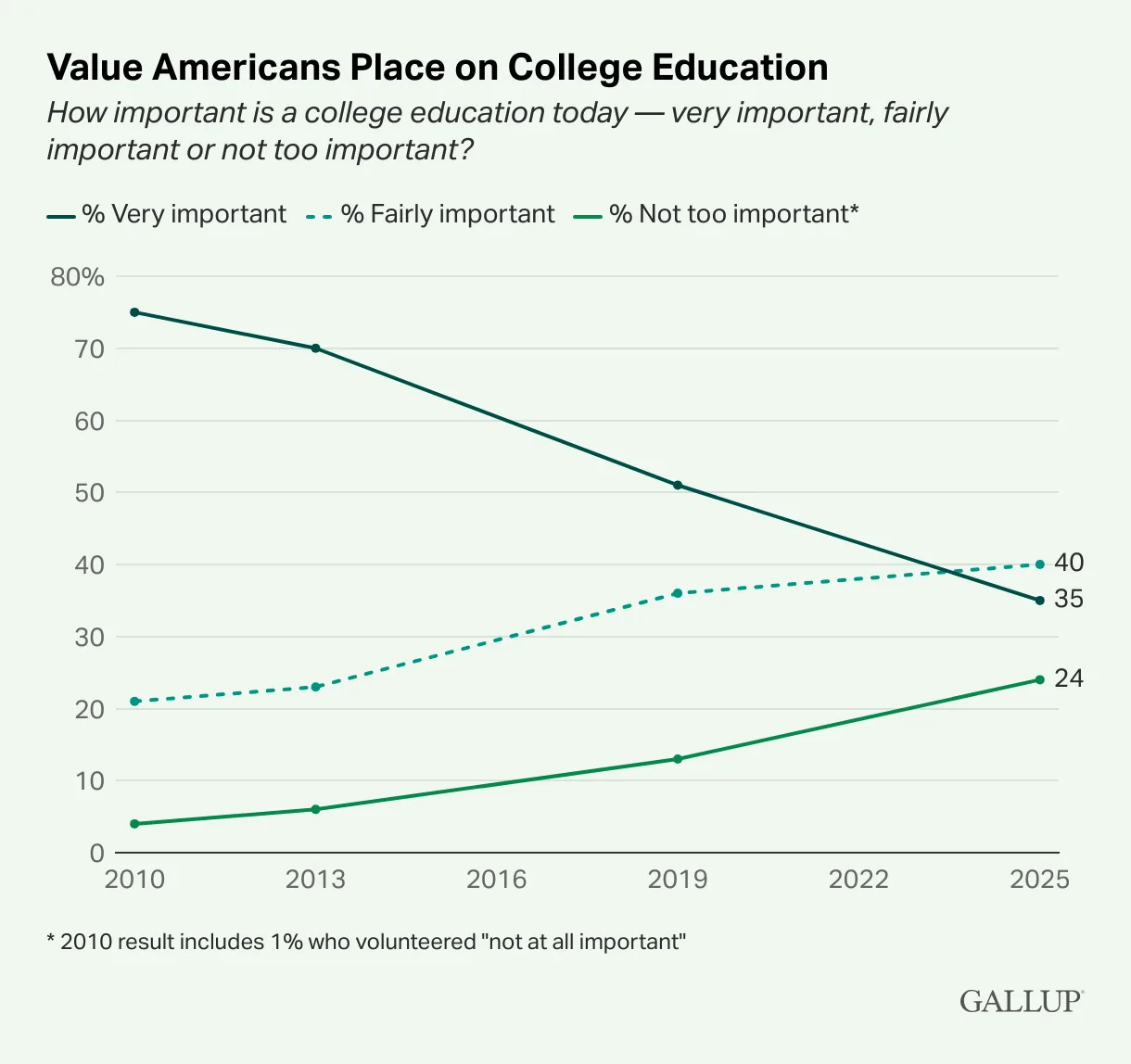
Also this week: from the creators of the film “Most Likely to Succeed” now find a new film: “Multiple Choice: What if schools prepared kids for life?” Learn more at the link in the Curriculum section. Also, in the Higher Ed section, see the data from Gallup on perceptions of higher ed. The graph below previews the data.
Also this week find a number of good practical posts on building motivation for students, elevating student voice, using thought experiments in science classes, integrating creative writing across the curriculum, and more.
These, plus an excellent AI Update at the end, enjoy!
Peter
Americans value higher ed less than ever before. See the Gallup poll for the breakdown.
“This Fall, we are launching a new program to investigate existential questions facing humanities educators today. This unique Collaborative will bring together the brightest minds in K-12 Humanities education to discuss big questions, reflect on their spheres of influence, and contribute to a framework that can guide the direction of Humanities instruction in an AI World.”
“To address a specific challenge, district and school leaders should empower and support front-line educators in implementing continuous improvement. Under this approach, local improvement teams begin by understanding the problem they are trying to solve and identifying potential solutions.”
“For most of the 20th century, scores on IQ tests steadily increased. This trend was termed the Flynn effect, after James Flynn, who described it. But in developed countries, this increase appears to have stopped and even reversed for cohorts born in the latter decades of the 20th century.”
“I started high school in 2003… The SAT had analogies then. Since topics trickled down, these exercises were everywhere. (I actually enjoying them!) But the College Board eliminated SAT’s in 2005, converting “verbal reasoning” to “critical reading.” Since this was the year before I took the test, I was none the wiser. I had already benefited from years of preparation.”
“The more you become “somebody” in your chosen field (recognized, accomplished, authoritative), the more your thinking tends to calcify, limiting your flexibility and creativity. The management scholar Erik Dane has called this problem “cognitive entrenchment,” and the researchers Huy Phan and Bing Hiong Ngu have documented it widely across professions. The antidote to this problem is surprisingly simple: Consistently put yourself in situations where you are a complete beginner.”
“For decades, America’s data-driven college-for-all agenda has created a no-win choice for most high school graduates: take on the risk and expense of college or work a low-wage job. But in an economically-challenged Virginia community, one superintendent is demonstrating the immense power of career-based learning—not as a last-chance resort for some, but as foundational for all. The film Multiple Choice immerses viewers in the district’s Innovation Center, where all students explore diverse careers, collaborate, and master traditional and new-economy skills. Amid political turmoil and tech upheaval, Multiple Choice offers an inspiring vision of kids finding purposeful paths, with a community united toward the goal of prosperity for all.”
“Something else has happened in my courses over the past two years. I’m unsure how to describe it, except to say that I feel a newfound sense of urgency or intensity. Absences are down. Students who complete the readings—a growing number—engage with a degree of focus that sometimes puts me to shame. I’ve long had a ban on screens in my classroom, but I now find little need to enforce that rule: the devices don’t creep in like they used to. Class discussions are so lively I lose track of time.”
Fighting sycophancy, designing successful pilots, and more
In the features this week, an HBR article offers guidance on how to run successful AI pilots. Effective practices with AI aren’t yet defined, so individuals and organizations need to build systems to foster the discovery and development of new practices. This takes time and intention. The HBR articles helps us get there.
Also in the features, check out the most recent post from the Rithm Project: about how (and why) to get past the AI sycophancy problem. A helpful read.
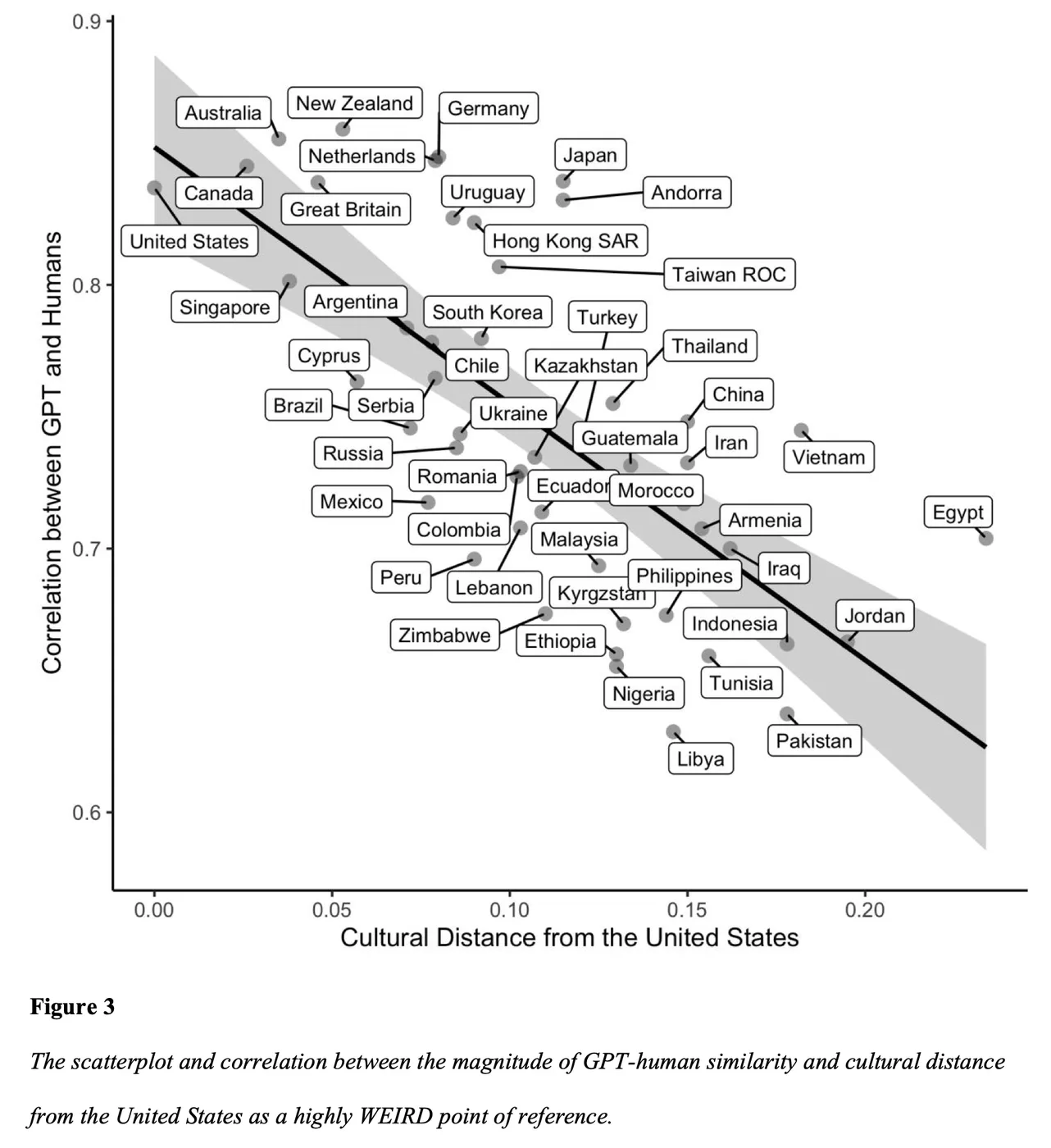
Also this week: research from Harvard demonstrates how much AI behavior emulates the behavior of different cultural communities in the world. It’s a helpful study that quantifies the cultural bias we see in LLMs. See also the image below for a visual representation.
These and more, enjoy!
Peter
On the X axis is the cultural distance from the US on a series of values scales. On the Y axis is the correlation between ChatGPT and survey responses. The result: an understanding of which cultures ChatGPT represents in its answers. See the Ethics and Risk section for more.
“The 5% of companies succeeding with AI aren’t necessarily those with the most impressive technical rosters. They’re the ones that have developed organizational capabilities to amplify their technical talent in ways that are aligned with the core strategy. And how have they done that? By recognizing the need for business leaders who can translate the technical possibilities into value—by embedding AI into workflows and strategies, building trust across the organization, and driving adoption at scale. We call these people the AI shapers.”
“How we assess teaching—by its intentionality, its inventiveness, its understanding of people and content and pedagogy—should be a model for how we assess learning. If generative AI requires us to question, or at least be clearer, about the criteria by which we assess our work, then it has done us a favor. Reflective practice is good teaching.”
“Technical reports often compare LLMs’ outputs with “human” performance on various tests. Here, we ask, “Which humans?” Much of the existing literature largely ignores the fact that humans are a cultural species with substantial psychological diversity around the globe that is not fully captured by the textual data on which current LLMs have been trained. We show that LLMs’ responses to psychological measures are an outlier compared with large-scale cross-cultural data, and that their performance on cognitive psychological tasks most resembles that of people from Western, Educated, Industrialized, Rich, and Democratic (WEIRD) societies but declines rapidly as we move away from these populations.”
“We offer three ideas for how educators can help students reclaim and strengthen human connections in an AI-driven world and foster responsible tech literacy.”
“In addition to these AI usage techniques, perhaps the most critical practice we can utilize is deeper self-awareness of the affirmations and challenges that occur in our relationships and interactions. The next time you receive feedback or are presented with new ideas by a human or a bot, see if you can take a beat to note the level of friction present and what it feels like in your body and mind.”
“In 1229, the priest Johannes Myronas found no better medium for writing his prayers than a 300-year-old parchment filled with Greek texts and formulations that meant nothing to him. At the time, any writing material was a luxury. He erased the content — which had been written by an anonymous scribe in present-day Istanbul — trimmed the pages, folded them in half and added them to other parchments to write down his prayers. In the year 2000, a team of more than 80 experts from the Walters Art Museum in Baltimore set out to decipher what was originally inscribed on this palimpsest — an ancient manuscript with traces of writing that have been erased. And, after five years of effort, they revealed a copy of Archimedes’ treatises, including The Method of Mechanical Theorems, which is fundamental to classical and modern mathematics."