Thanksgiving, AI Developments, Leadership Stories, and More
Happy Thanksgiving week to those in the US.
In the features this week, find a surprising report that suggests that tweens with smartphones have… higher wellbeing? Digging in reveals some nuance that is clarifying, but the interpretation from the author of the post (not the research) is helpful for understanding the difference between the impact of technology and the impact of the culture we build around technology. Also in the features, find an informative video about the biology of stress, how it affects us in the modern world, and what we can do to mitigate its effects.
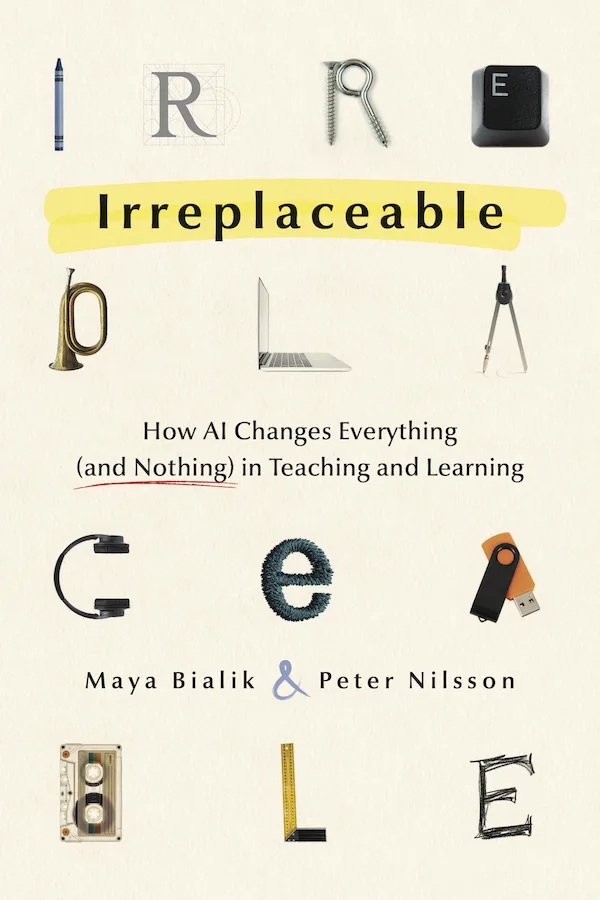
Also this week, find in the leadership section a review of an excellent book on school leadership. I had a chance to see an advance copy of this book, and it captures well and with good humor the unpredictable nature of leading a school. You have to be unflappable to navigate everything that comes at you at the helm of an institution. This book offers dozens (scores? hundreds?) of stories that illustrate the experience.
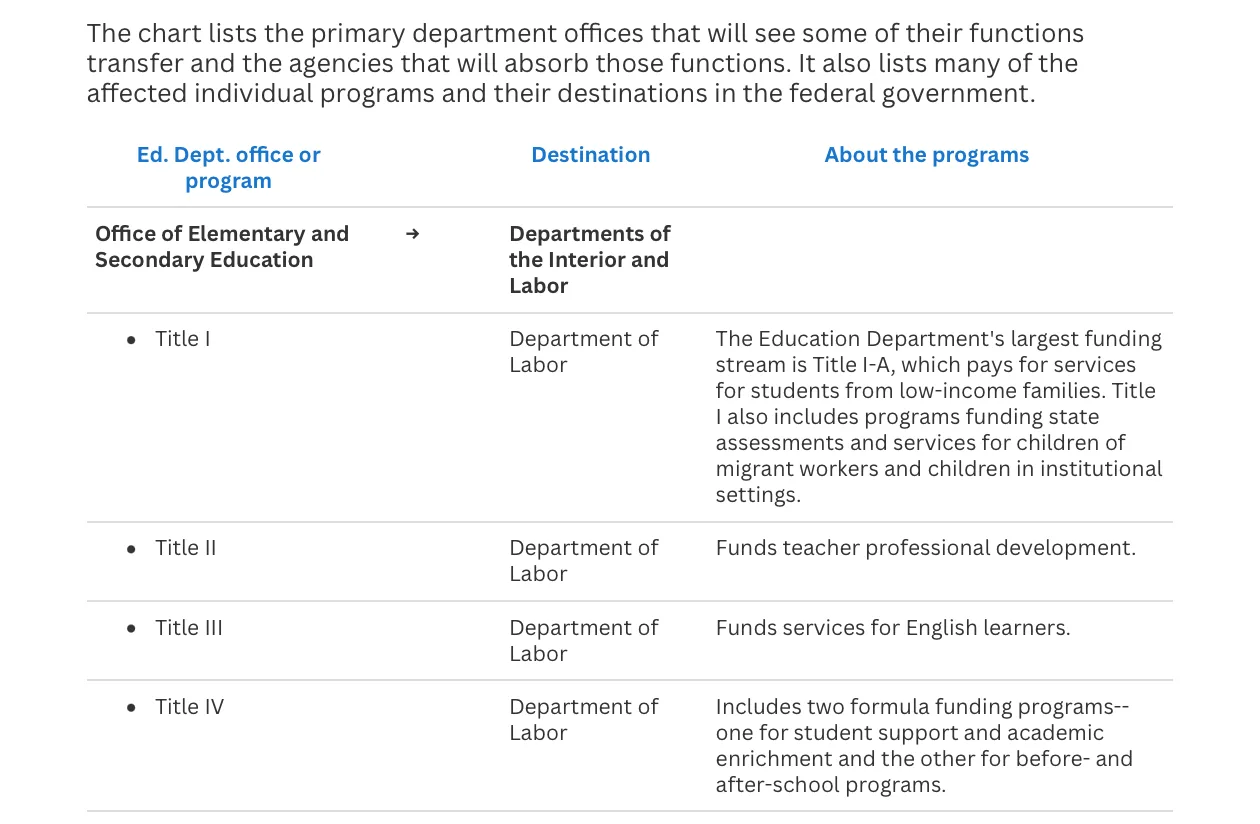
This week I’ve also included a piece from EdWeek about the dissolution of the Education Department, as well as the image below showing where some of the Education Department’s functions are being directed. In the article and image, you’ll see that most of the ED’s functions are going to the Department of Labor. But education is more than just preparation for the workforce. I wrote more than a decade ago that, according to historical documents in the United States, education has three purposes: to prepare us for the workforce, to prepare us for participation in civic life (like juries and voting), and to help us live a fulfilling life. By placing the majority of functions in the Department Labor, two out of three of these functions are overlooked. These various resources may be helpful to you as you have discussions at your school about mission and the purposes of education.
Also this week, find a thoughtful discussion of what is needed to build sustainable, ongoing improvement in a community. This is in the PD section.
These and more, including an excellent AI section, enjoy!
Peter
PS. More places where you can find me or my work:
* January 11-14 – FETC (Orlando, FL)
* January 16 — Book release!
* February 18 — NAIS Webinar (online, member schools)
* February 25-27 – NAIS (Seattle, WA)
* March 9-12 – SXSW EDU (Austin, TX)
* March 18 — NAIS Webinar (online, member schools)
The Education Department is being dissolved. Where are its functions going? See the post in Government for more.
“Our world has changed so quickly and profoundly that our biology couldn’t keep up. Stress is still the same it was fifty thousand years ago: Sense a stressor. React immediately and with full force. Prioritize present moment survival, make sacrifices if necessary. That works well when you have to jump out of the way of a car. But most stressors we encounter nowadays are abstract, acute and more numerous, often intangible, persist for much longer and usually don’t even require physical action. The tigers of the past are now angry emails, deadlines, online dating, rush hour traffic or doom scrolling the news and social media.”
“The study, called The Life in Media Survey, was conducted by researchers at the University of South Florida in collaboration with the Harris Poll (Martin et al., 2025). The study surveyed 1,510 children, ages 11 to 13, in Florida… Kids with smartphones were less likely than kids without smartphones to agree with the statement, “Life often feels meaningless” (18% vs. 26%). Kids with smartphones were less likely than kids without smartphones to agree with the statement “I get very angry and often lose my temper” (23% vs. 34%).”
“First, learn “What Happened?” and intentionally build knowledge about a coherent story from history… Second, focus on the important actors in that story and ask, “What Were They Thinking?””
Nano Banana, AI Tutors, and AI's Mental Health Risks
The field continues apace.
But first, who names an AI tool “Nano Banana”? Apparently Google does. “Nano Banana Pro” is the recently released version of their AI image generator and editor. See more below.
This week — and in the features — creative uses of AI abound. In the features, find an excellent guide to creating an AI reference tutor based on a document, and also a remarkably creative approach to putting survey feedback to good use. Also in the features, see a history of OpenAI’s efforts to address mental health in users — and the pressures OpenAI is under that compromise mental health.
Also this week: ChatGPT for teachers, dueling perspectives on AI literacy, how AI is changing career and technical education, and diverse perspectives on whether/how AI should be involved in writing. We live in interesting times!
Many other good ones this week, including a lengthy write up the efforts at Yale to manage AI use by students. It shares stories of members of the community arriving at different points: some have the students leverage AI to go beyond what they could do before. Others restrict AI at times to ensure students can do work on their own.
Also this week: an excellent post in the industry development section. Members of the teams that wrote divergent projections for the near future of AI have joined together to write about what they agree on. This is a practice more people should do. Here, it leads to helpful and more reliable information about what to expect in the years ahead.
These and more, enjoy!
Peter
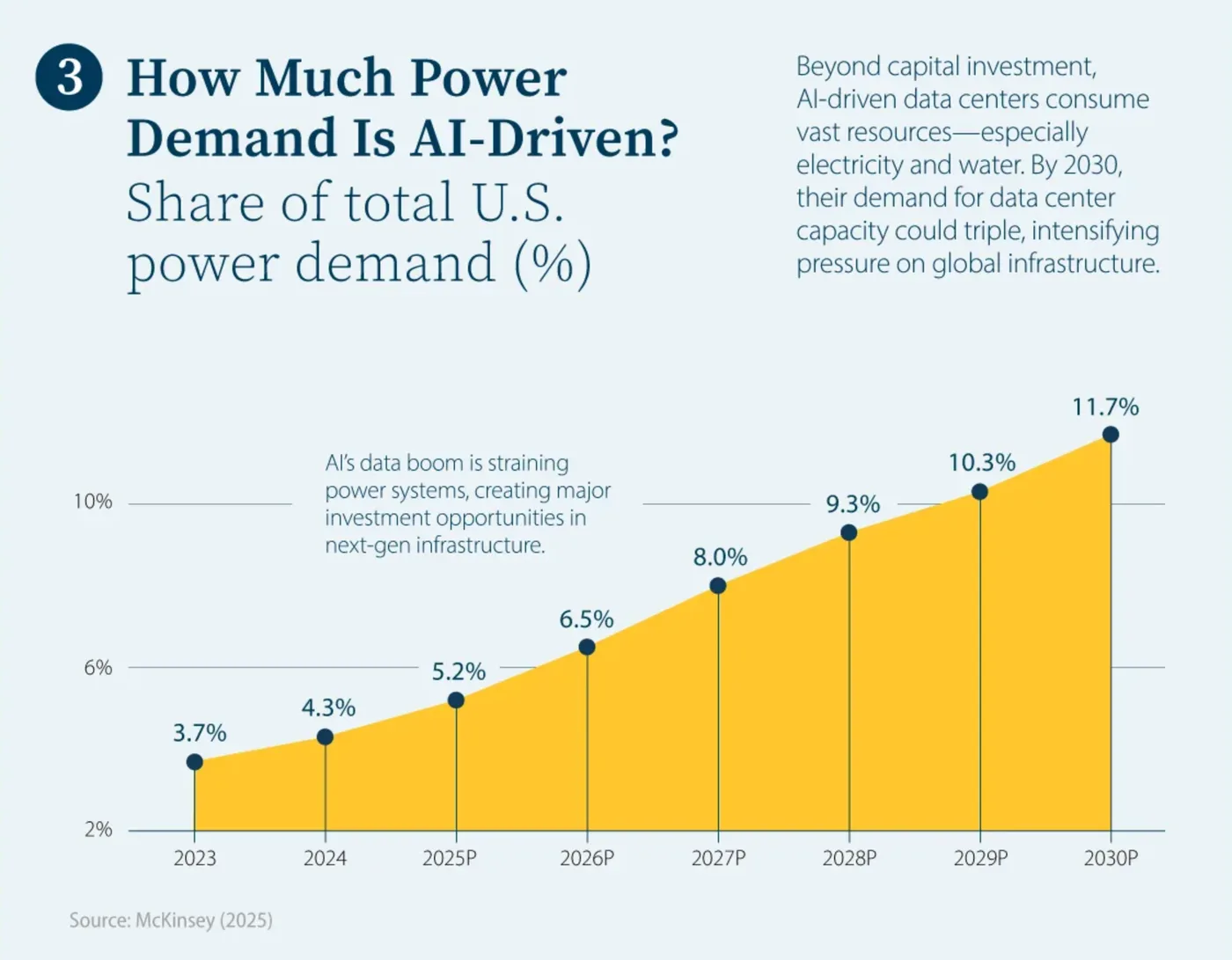
Energy consumption by AI data centers is real. Details on the infographic are in the Ethics and Risk section.
“In October, Mr. Turley, who runs ChatGPT, made an urgent announcement to all employees. He declared a “Code Orange.” OpenAI was facing “the greatest competitive pressure we’ve ever seen,” he wrote, according to four employees with access to OpenAI’s Slack. The new, safer version of the chatbot wasn’t connecting with users, he said. The message linked to a memo with goals. One of them was to increase daily active users by 5 percent by the end of the year.”
“I was reading through a set of open-ended survey responses from faculty members regarding their feelings, experiences, and desires as it pertained to AI in their classroom… The responses were so nuanced that shifting in any one direction might shift away from the sentiment of another audience member. Reaching out to one person might mean alienating another. I wish I could talk to one of them, I thought. Then, it dawned on me. I could. I could ask an AI system to embody this data. So I did. I uploaded the survey responses (anonymized) to Claude and tasked it with synthesizing them into a composite character. Someone with a name, a backstory, professional experience, communication style, even catchphrases. Then I told it to become that character and review my slide deck from that perspective.”
“Most AI tutors fail because they: Hallucinate content… Have un-curated knowledge bases.. Are answer machines… Don’t manage cognitive load… Built using FRAME, this prompt manages all four of these risks: No hallucinations… Curated content… Tutoring expertise… No cognitive overload”
“Zhong made this class much harder after AI emerged. Students are supposed to have AI do simple tasks that they previously would have done themselves. With this new power, Zhong said, students attempt problems that used to be reserved for more advanced students. “You have to design the curriculum so that students are forced to learn, right?” he said.”
“In this piece, I’ll start at the foundations of the question, exploring whether there is some intrinsic, essential metacognitive value in the literal act of writing that cannot be replaced by AI. After establishing a positive statement about the importance of writing, I’ll step back and address the normative dimension: should we encourage the use of AI to write, and if so, how?”
“The future remains uncertain. But, at least in the next few years, we all agree more than we disagree on how progress in AI is likely to proceed. We hope that by being explicit about our agreements here it will help others better understand our differing positions, and the confidence with which we hold them.”
“Governments should classify these chatbots not simply as another form of media, but as a dependency-fostering product with known psychological risks, like gambling or tobacco. Regulation would start with universal laws for A.I. companions, including clear warning labels, time limits, 18-plus age verification and, most important, a new framework for liability that places the burden on companies to prove their products are safe, not on users to show harm. Absent swift legislation, some of the largest A.I. companies are poised to repeat the sins of social media on a more devastating scale.”