In this issue’s features, learn about Isabelle Hau’s description of our arriving age as one of “Relational Intelligence,” one in which human connection and presence are increasingly important. Her post seems an answer to the other feature, which is a good study of what skills matter more in a time of AI, based on assessments of needed workforce skills. Two thoughtful interpretations of this moment.
Much more also this week, including surveys of student perceptions of AI, posts on building essential character habits, whether/how teachers are self-censoring for political reasons, histories of the effects of innovation and technology, and more.
Several schools have reached out to tell me they’ve selected Irreplaceable: How AI Changes Everything (and Nothing) in Teaching and Learning as a summer read for the faculty. If you’re interested in a summer read that gives your faculty common language and practical approaches for exploring AI’s role in teaching and learning, I’ll gladly connect you to our publisher’s purchasing lead. Bulk orders receive substantial discounts.
“AI is reshaping which skills matter for professional success—and, therefore, what students need to learn. This report provides a data-driven framework for K-12 educators to navigate this shift, analyzing AI’s impact on 1,000 workforce skills and mapping the implications for 140 high school learning objectives. It offers a clear method for identifying where and how curriculum needs to be rebalanced.
“As artificial intelligence grabs headlines and investment dollars, Ms. Ricks and Celeste are practicing an intelligence that cannot be automated. It’s the intelligence of attunement, of care, of knowing, and knowing how to know, each other. We might call it relational intelligence (RQ), the deeply human ability to build trust, navigate tension, repair ruptures, and create meaning with others. And it may be quietly rising as the defining skill of our age, the essence of what it means to remain fully human in a world increasingly governed by algorithms and automation.”
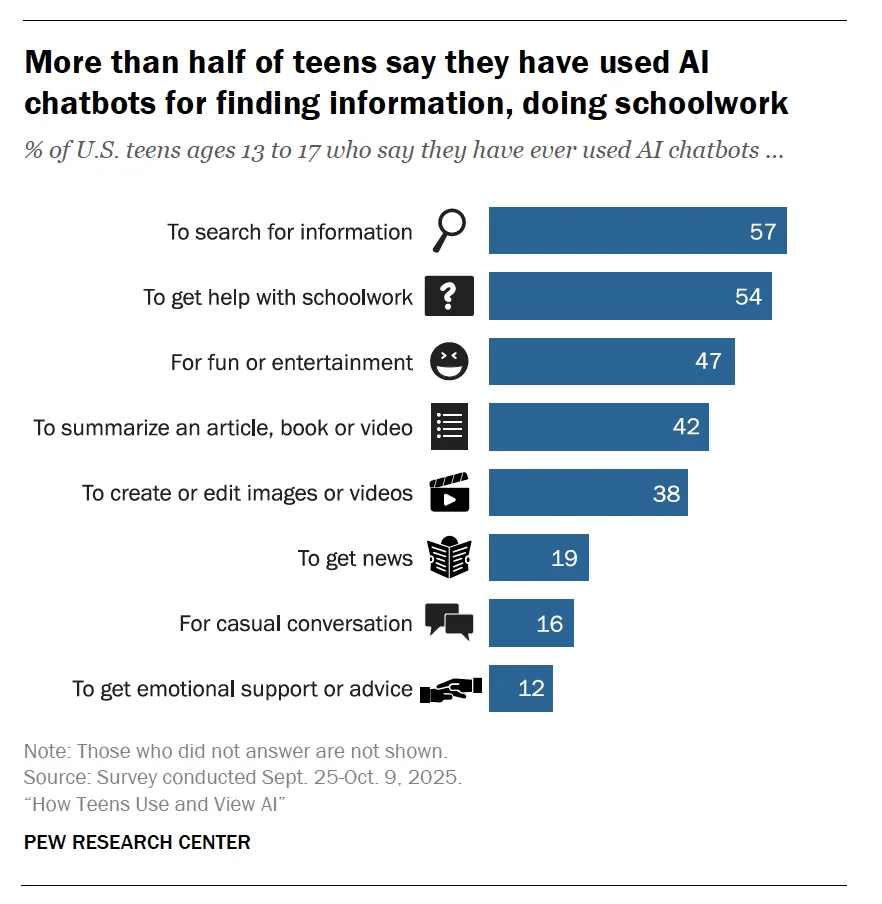
“Just over half of U.S. teens say they have used chatbots for help with schoolwork, and 12% say they’ve gotten emotional support. More teens think AI will be positive for them than negative.”
“In particular, he thinks we’ve become too focused on what is good for individuals instead of what is good for communities. He thinks everything has become commodified, hollowing out civic life. He thinks we have misguided ideas about merit, and that we should acknowledge luck more. Finally, he thinks modern politics has failed to prioritize meaningful conversations about morality.”
“Technological innovations have repeatedly transformed human cognition by externalizing, amplifying, and reorganizing knowledge and skills. While the economic and institutional consequences of technological change have been extensively studied, its long-term cognitive and epistemic effects remain underexamined. This paper conceptualizes technology as an epistemic change agent. It examines how successive technological innovations—from writing and printing to digital media, smartphones, and artificial intelligence—have altered human cognitive capabilities and the conditions for learning.”
“Fifty-four percent of respondents said that their morale would improve a lot if they had more time to plan during the work day. That is a relatively affordable area that district leaders and principals can work to preserve. By contrast, other shifts, such as increasing pay or decreasing class size tend to be far more pricey.”
“As hundreds of thousands of veteran educators retire over the next five years, the nation’s most educationally, ethnically, and linguistically diverse group of teachers to date is stepping in to replace them. These young and aspiring teachers are reshaping the K-12 conversation around technology use, mental health, and student engagement in schools.”
“A simple example of “binding” is the baseball rule about player pitch counts (a pitcher can only throw a certain number of pitches each week, for example). This is a great rule because it protects the development of players’ throwing arms. Without this "binding” rule, coaches would still have the “Molochian offer” to make the pitchers throw too many pitches, thus sacrificing their long-term, healthy development, for the sake of winning in the short term. But this rule closes the offer, as Scott Alexander argues we’ll have to do to get released from this trap. Coaches are held accountable by athletic associations, athletic directors, and parents, and are now bound to make good decisions for young players.”
“"CEO said a thing!" journalism generally involves a press outlet parroting the claims of a CEO or billionaire utterly mindlessly without any sort of useful historical context as to whether anything being said is factually correct.”
In the features, see how AI’s social and emotional functions continue to expand into our human experience. Find out more — especially a more nuanced way to understand how adolescents are engaging with AI socially — in the Tech/AI: Social section. Also in the features, see Anthropic’s report on how AI is being used in education. It’s a helpful breakdown of the kinds of tasks people are using it for.
But there’s more, as ever: Many posts are describing how software engineering has been entirely upended. Notably: computer science skills are still in demand, but they are being applied differently. Engineers still decompose problems, think through solutions, review outcomes, and more — but they are operating at different levels now. This brings gains and losses, and it offers insight into other ways AI is — and will be — used in other settings.
I’m reminded time and again (as also echoed in Leon Furze’s essay) that few of AI’s growing capacities replace the need for human expertise. Instead, they make human expertise more and more important. It is only through our expertise that we will have the imagination to both ask better questions and effectively review the outputs that come AI.
See these and more — and enjoy!
Peter
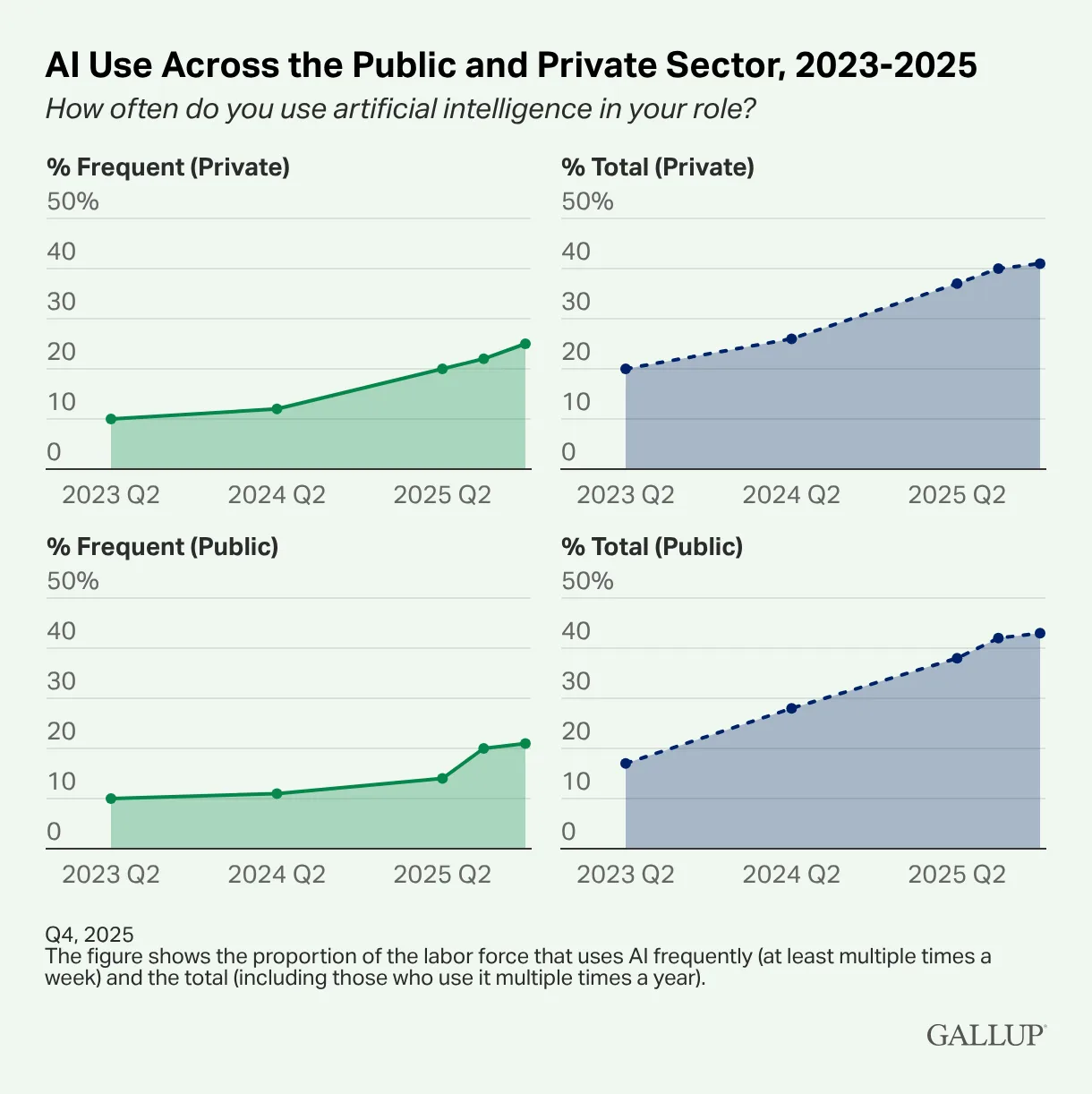
Frequent AI use is increasing in both public and private sectors.
“Iteration and refinement is the single strongest correlate of all other fluency behaviors in our data. So, when you get an initial response, it’s worth treating it as only a starting point: ask follow-up questions, push back on any parts that don’t feel right, and refine what you’re looking for.”
“The full range of human desire is incalculable, a cosmic mystery. There are many reasons that one might want to talk to a computer: meaning-making, dominance, privacy, fantasy, confession. There is also the appeal of pushing the boundaries of consciousness, and the simple fact that there is no greater pleasure than good chat.”
“This is why I don’t believe AI is a terminal threat to critical and creative thinking or to expertise. But I do think there’s a paradigm shift happening. AI will increasingly become part of how we acquire domain expertise, the techne, the codifiable knowledge. What it can’t provide is the situated, contextual, deeply human metis that makes that knowledge meaningful.”
“Amanda Askell knew from the age of 14 that she wanted to teach philosophy. What she didn’t know then was that her only pupil would be an artificial-intelligence chatbot named Claude.”
“The sole intent of this piece is modeling a scenario that’s been relatively underexplored. Our friend Alap Shah posed the question, and together we brainstormed the answer. We wrote this part, and he’s written two others you can find here. Hopefully, reading this leaves you more prepared for potential left tail risks as AI makes the economy increasingly weird. This is the CitriniResearch Macro Memo from June 2028, detailing the progression and fallout of the Global Intelligence Crisis.”