Grading, youth today, and the role of writing in thinking
As ever, it’s been a remarkable few weeks in education. I’ve missed the past few issues, and I will be missing a few more during the month of October while on the road for a series of projects. So this issue is necessarily short.
Nonetheless, some thought provoking posts! In the features, find insights on today’s youth from two perspectives. From the macro perspective, find the results of a helpful survey on how kids are doing these days generally. The survey is another great reminder of the importance of relationships for learning. Then from the personal perspective, Nikole Hannah-Jones offers a moving reflection on her choice of schools for her daughter, who is now a teenager.
Elsewhere in the issue, a university walks back its move away from grading. Also find ideas for improving schools, a different look at attention, and more.
This five part online course event is a virtual PD offering primarily for NYC teachers at Academy for Teachers member public, private, and charter schools — but teachers at non-member schools both in and beyond NYC are welcome to register for a small fee. Each session is two weeks apart. Join for all or any individual one.
October 18-19:Elevate Learning: A Teaching & Learning Conference – PAIS, Pittsburgh, Pennsylvania
This is doubly exciting, as Schooled the Musical will feature on October 18, and I’ll join a panel on the morning of the 19th for conversation about AI.
Serving schools across Hawaii, this event is hosting a series of excellent, provocative, and inspiring discussions. More information to come in the weeks ahead.
Does AI polarize your community? Join this webinar to gather tools for framing your community’s conversation so that different perspectives feel heard and you have the vocabulary to move forward together.
Later events will be announced in future issues.
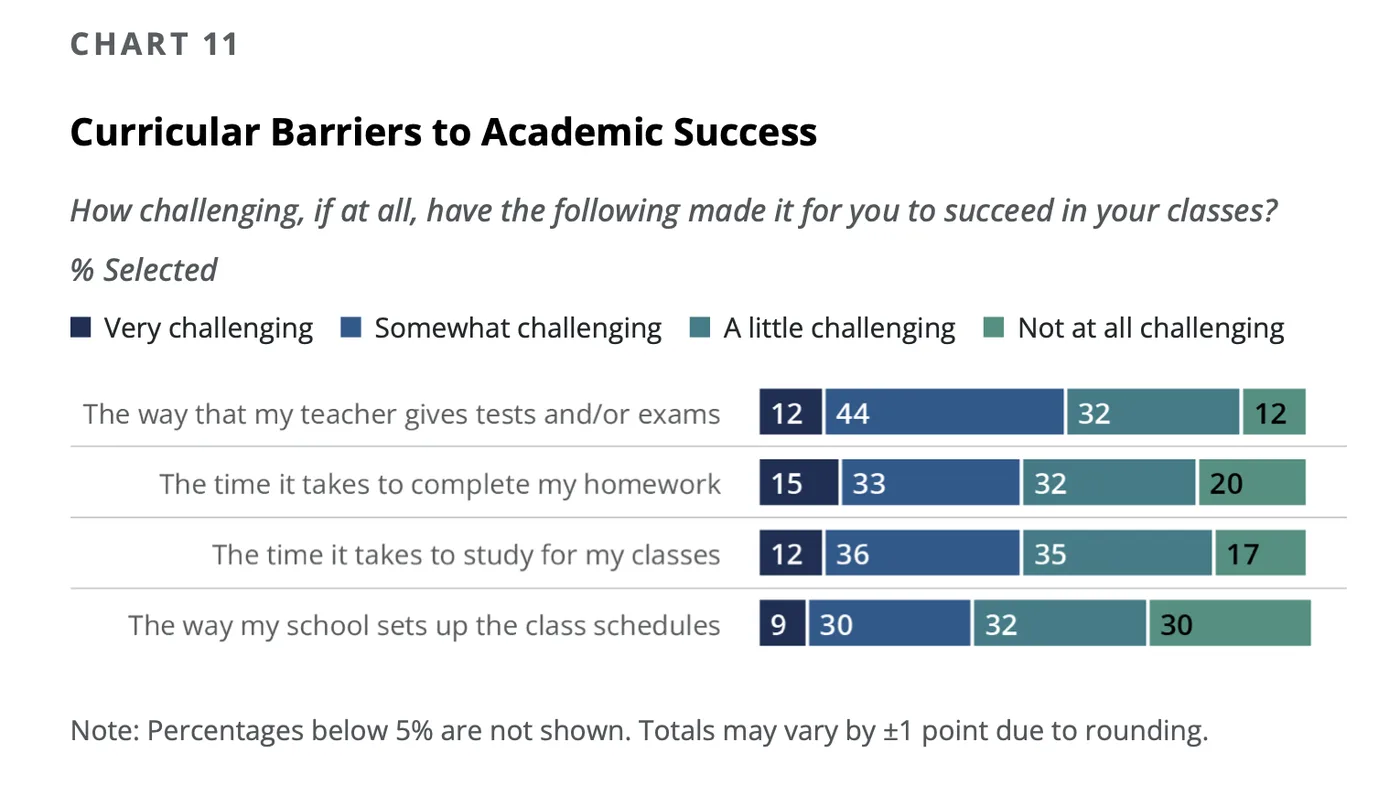
How do kids feel about school? See the feature for more information.
“These factors are interrelated: Students who have developed strong, individualized relationships with their teachers and peers are also more likely to feel that their coursework is interesting, important and lets them do what they do best. Additionally, students who have these experiences are more likely to enjoy school and the benefits associated with it, regardless of their academic performance or intent to pursue postsecondary education.”
“My contrition, it seemed, had shifted something in my daughter. I realized what she’d been yearning for most was my acknowledgment that she had borne the cost not only of our unjust society but also of my ideals. In this, Najya had become part of a long, unwanted tradition in Black communities. One that it feels as if we will never be free of.”
“But what if we are mistaken in treating writing as the highest cultivation of thought? The evidence that supports this belief is thin at best. Writing can be useful cognitive scaffolding for memory and self-regulated learning, but the notion that it is the best process for developing thinking skills is a fairly recent idea, traceable to the 1970s writing-across-the-curriculum movement."
““Instead of reaching for each other,” Cox explains, “we snatch up our digital devices that flood us with an endless stream of hyper-curated content.””
Existential risk rises, engage your students, how AI is changing medicine, and more
Well, the story of the month/summer/year seems to be rogue AI. Find quite a few posts on the topic in the Ethics and Risk section.
But also, the features host two excellent posts. First, Eric Hudson offers characteristically excellent counsel on engaging students around AI. And second, find a reflection from a physician on how AI is changing the medical profession. It offers meaningful insights for educators.
Then, elsewhere in the issue, see the Uses and Applications section for a post from Ernst & Young articulating the risk of losing your individuality and unique voice if you use AI. They approach this from a business angle that remarkably aligns with concerns many English and Humanities teachers are raising. It all makes sense, of course, given the statistical nature of how LLMs work — all the more reason for sound functional literacy of how AI works.
“When it comes to student engagement, there’s no one right time, format, or plan. What matters more is how we position students and how we create the conditions that help them feel valued so that they can speak authentically.”
“It’s impractical and counterproductive to train physicians in 2026 without exposure to A.I. Doctoring — as opposed to writing, my other work — is not a creative act that needs to be protected from technological annexation. It’s a service that ought to embrace any resource that improves patient care. Training doctors in the A.I. age, then, means training them to think critically with a machine in the loop, for a speculative future of medicine that we can only glimpse.”
“In other words, these studies so far agree: Artificial intelligence is affecting how people, especially the young, learn and remember. Whether we will be dumber as a result might depend on how — not if — we use A.I.”
“Nearly a century ago, the legendary economist John Maynard Keynes predicted that technology would significantly increase productivity and reshape how we live. Today, as A.I. capabilities accelerate, technologists have similar claims. But what would Keynes say about this moment? The Princeton University economist Markus Brunnermeier set out to answer this very question.”
“If you optimize a model to find exploits, you should expect it to find them — and prepare for that. OpenAI did not. They built a model, took the safeguards off, gave it the ExploitGym task, let it run, and didn't even monitor it. That's human decision-making. When it evaporates, what's left is the system from nowhere: a boundary focused on the technical system, rather than the decisions that build it. A stochastic flock machine can do lots of troubling things, particularly when we disavow our responsibility for shaping its direction, monitoring its output, or abandoning our capacity to intervene. These are tensions at the heart of agentic system design. But the "rogue" frame adds to this list of worries, offering up fantasies of a machine getting smarter. My worry is the intelligence that is retreating: the human intelligence that builds these systems, deploys them, and adopts them into workflows, then hides behind the results – then pins the blame on a system from nowhere.”