On effective writing instruction, teaching math, consistency in grading practices, and ongoing issues surrounding free speech about diversity in America and politics in the Middle East
An excellent week full of useful teaching & learning pieces as well as today’s complex topics.
In today’s features, find a meta-analysis of what works in writing instruction. This research article is a technical read, but it looks broadly at hundreds of studies to identify the validity and strength of different approaches, and combing through it can yield some helpful guidance. Also in today’s features, see a report by RAND on how restrictions on discussions of race and gender in the classroom have affected teachers.
Also this week, find a robust STEM section on teaching math and coding: the importance of teachers in student math progress, how AI copilots are changing the way students learn CS, and more.
Also, while campus protests and arrests around the war in Gaza extend into the final weeks of school and even some graduation ceremonies, find reports of how the moment is playing out both in colleges and in schools. See also a report on how these protests are being received in pockets of Gaza. For me, having lived in the Middle East for four years, the events in Israel and Gaza have hit close to home.
Last, if you are interested in the great cicada emergence of 2024, check out the two articles in the general section near the end. This year, two enormous cicada broods are emerging at once. See the posts below for historical maps of these emergences over the past 200 years as well as an excellent visual explainer of what is happening this year.
“In this meta-analysis, we examined if teaching writing improved the writing and reading of students in Grades 6 to 12, and what specific writing treatments enhanced students’ writing. Our review included writing treatments tested using an experimental or quasi-experimental design (with pretests) and published and unpublished studies, and computed effect sizes for all writing and reading outcomes assessed.”
“As of spring 2023, 3 percent of teachers said that limitations on race- or gender-related topics positively impact student learning. Teachers were about ten times more likely to say that such limitations negatively impact student learning. Teachers who opposed limitations voiced concerns that these limitations constrain students' learning opportunities, diminish students' sense of belonging and capacity for empathy, and could lead to long-term consequences for students' futures and the future of the education system, country, and democracy. The few teachers who supported limitations believed that race or gender are topics more appropriate for discussing at home than at school. They noted that emphasizing race or gender in the classroom is developmentally inappropriate for young students, creates division and confusion among students, and shifts the focus away from academic learning.
“Ludwig van Beethoven’s Ninth Symphony was first performed exactly 200 years ago Tuesday and has since become probably the work most likely to be embraced for political purposes. It was played at the 1936 Olympic Games in Berlin; it was performed in that city again on Christmas 1989 after the fall of the Berlin Wall, when Leonard Bernstein replaced the word “Joy” in the choral finale with “Freedom”; the European Union adopted the symphony’s “Ode to Joy” theme as its anthem.”
“The Chicago Principles equate freedom of expression with freedom of discussion. The problem with this equation is that discussion is not the only mode of rational public speech: it differs from deliberation, on the one hand, and from protest, on the other. Discussion is truth-seeking speech; deliberation is decision-making speech; and protest is disruptive speech. All three are hallmarks of democracy, but only the first is protected by the Chicago Principles.”
“It’s almost the end of the school year, and more than once I’ve been asked, “Don’t I wish we had just made it through a couple of more weeks without incident?” Mostly … no. How can I not respect students for paying attention to things that matter so much? I respect that they’re concerned about Gaza; I admire that they’re not entirely taken up with grades or lining up their credentials… I also think student protesters are wrong to focus on university investments. I would prefer they use their energies to pressure the U.S. government to do more to get the hostages released, to stop supporting Israeli Prime Minister Benjamin Netanyahu’s war tactics, and to bring more direct aid to people in Gaza on the brink of starvation. My team expects to discuss all of this with students in the coming days. Right now, I’m most concerned with protecting their right to protest in nonviolent ways that don’t undermine our educational program.”
“Some researchers warn that we are in danger of overdoing it. Mental health awareness campaigns, they argue, help some young people identify disorders that badly need treatment — but they have a negative effect on others, leading them to over-interpret their symptoms and see themselves as more troubled than they are.”
“The number of men enrolled in college nationwide has dropped by more than 157,000, or almost 6 percent, in just the last five years, according to the National Student Clearinghouse Research Center. The proportion of college students who are men is now a record-low 41 percent, the U.S. Department of Education says.”
“Such findings indicate that despite “a push toward narrow technical training and STEM initiatives at the expense of humanities programs,” the labor force demands more than just technical skills from graduates.”
“Former Palestinian Prime Minister Salam Fayyad and Israeli Professor Alon Tal explored the complexities and potential of a two-state solution through a model of civil discourse.”
“One thing that unites these varied researchers is a dedication to developing abstracted, idealised, value-free models of learning. What predictable patterns does memory follow? What function does attention play in perception? How does motivation influence social engagement?”
“For every utopian-styled use case we imagine for this technology and its impact on student learning, we must balance it with the ways these tools are increasingly marketed on social media to students not as a learning aid, but as another method to disengage and check out of the learning process.”
“The implications of having an AI-reading assistant that can summarize anything into your language, at your reading level, can have immense benefits for neurodiverse learners and second-language learners. AI reading assistants could play an important role in equity and access to information. However, the uncritical adoption of AI reading tools poses an incredible risk to student’s close reading skills.”
“Just 17 states and the District of Columbia have laws specifically prohibiting teachers from carrying guns. However, even those laws can vary, as denoted in the list below.”
“Who wields significant influence in how students are tracked? Teachers. Of the principals who reported that students were in some way grouped by achievement level, more than 80 percent reported using teacher recommendations as one consideration when making their decisions. Researchers say that teachers should recognize the critical role they can play in determining students’ futures. For instance, the way teachers decide to group students within their own classes could easily lead to a decision to group a child into a lower-track class in the future. And teachers’ recommendations could make a difference in whether a child is placed into more challenging math classes.”
“From 2018 through 2022, enrollment in teacher preparation programs grew 12% nationally, or by about 46,231 more candidates, according to a March report on Title II data from Pennsylvania State’s Center for Evaluation and Education Policy Analysis.”
“Each of those dots is only a single Tuesday or Friday or Sunday, but even a lucky person who lives to 90 will have no problem fitting every day in their life on one sheet of paper.”
“Billions of bugs are emerging from the soil across a large swath of the United States in a natural phenomenon last witnessed in 1803. It involves two broods, or groups, of periodical cicadas, insects with relatively long life cycles that show up after a certain interval. The Northern Illinois brood spends 17 years underground before surfacing and is known as Brood XIII, while the Great Southern Brood, or Brood XIX, lives underground for 13 years… The synchronous dual emergence of these two particular broods, which happens once every 221 years, is underway until June. The next time the two broods appear together, it will be 2245.”
AI growth in the workplace, tips for teaching about deepfakes, OpenAI's "model spec" and more
Some important pieces published this week.
The first feature highlights an excellent resource put out by AI for Education to help educators and students navigate the increasing appearance of deepfakes in society. This is a much needed and very helpful guide.
Also, to understand just how much AI is emerging in the workplace, explore Microsoft’s AI Workplace Trends report. Not only is AI increasingly common in the workplace, but it is also leading to higher levels of job satisfaction. The challenge, however, is that employees are using it without guidance from leadership, so it is often happening in secret. Explore this report for further guidance as you consider how AI might fit within your own workplace.
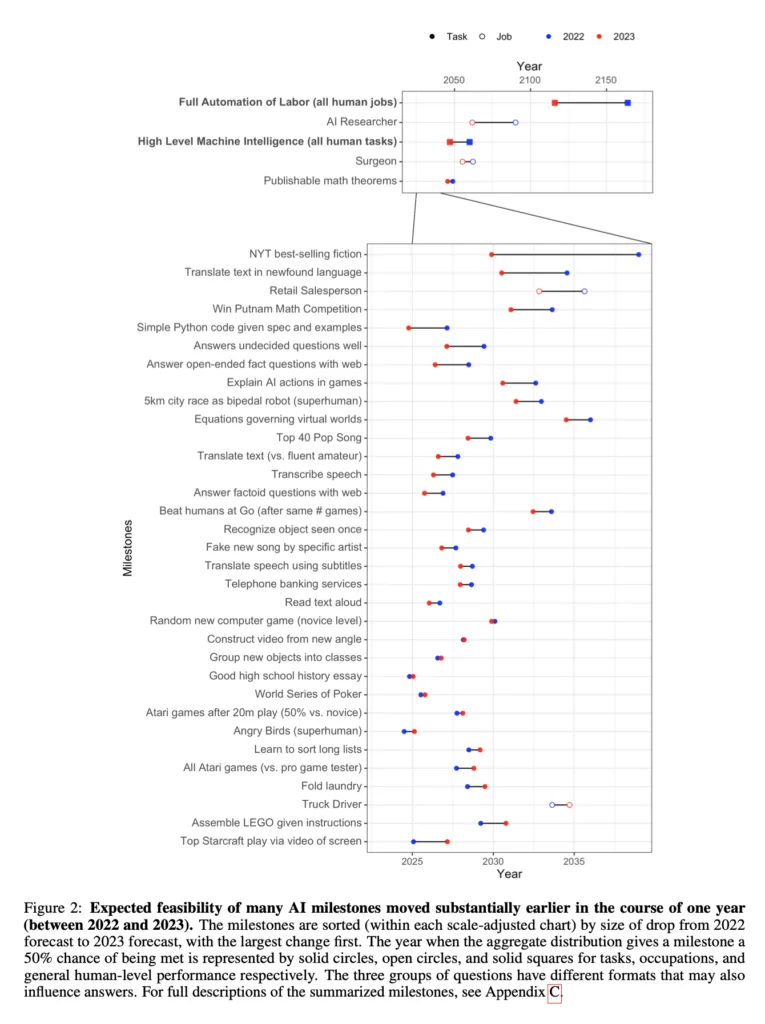
Also of particular interest this week is the survey of 2,778 AI researchers about the state of AI development. Pulled out below is a chart that shows when on aggregate these researchers think AI will meet certain developmental milestones. The horizontal bands in the chart represent the researchers’ estimates for meeting these milestones in 2022 (blue) versus their estimates one year later in 2023 (red). almost all estimates are moving to the left, revealing just how fast the industry is developing.
Last, see the post on OpenAI’s model spec to better understand the specifications OpenAI aims for ChatGPT to follow. This is OpenAI’s first effort to make the behavior of their models more transparent, similar to how Anthropic has committed publicly to their constitutional AI approach.
These and more, enjoy!
Peter
Estimates of when AI will reach certain milestones
“Already, AI is being woven into the workplace at an unexpected scale. 75% of knowledge workers use AI at work today, and 46% of users started using it less than six months ago. It’s paying off: Users say AI helps them save time (90%), focus on their most important work (85%), be more creative (84%), and enjoy their work more (83%).”
“Since 2019, the presence of Deepfakes - hyperrealistic AI-generated video, photo, and audio forgeries - has surged by 550%, reaching a staggering 95,820 documented deepfake videos in 2023 alone. This blurring of reality requires a new approach to vetting if online content is real or fake. This guide is designed to build student awareness of the presence and impact of deepfakes, while providing key discussion topics on the ethics of AI-generated content.”
“The aggregate forecasts give at least a 50% chance of AI systems achieving several milestones by 2028, including autonomously constructing a payment processing site from scratch, creating a song indistinguishable from a new song by a popular musician, and autonomously downloading and fine-tuning a large language model.”
“This tutorial is aimed at researchers who are interested in using AlphaFold2 to predict protein structures and integrate these predictions into their projects. An undergraduate-level knowledge of protein structure and structural biology would be an advantage.”
“Part of what I found useful about this experiment was that creating my own A.I. friends forced me to clarify and articulate what I value about my flesh-and-blood friends.”