Evolution and competencies, de-tracking math, principled PD, and more
Holiday weeks are typically quiet — not so this week. Much to explore:
In the features, take a look at the new report from the Center for Curriculum Redesign that explores evolutionary antecedents for the competencies that we teach in schools. Where does collaboration exist in nature? What does communication look like in different species? How can these examples offer insight into our own condition? There’s a natural link here with one of the feature articles in the AI section on Copernican moments that show how humans may be less at the center of things than we think. How does this all help foster humility in our actions?
See also the second feature on de-tracking math. Discover in the article how de-tracking can play out in different ways.
In professional development, find an article on excellent approaches PD. Don’t be misled by the title invoking “principled resistance.”
Elsewhere: excellent pieces on the friction needed for good writing and learning, on more risks of social media, on how to listen better in complex moments, and on the Rubik’s Cube turning 50.
These and more, enjoy!
Peter
PS. Are you a teacher open to sharing with me how you plan your classes? Or a leader working on supporting teacher development? Or an organization that provides curriculum or fosters communities of teachers? I’d love to hear about your work. Please consider signing up for a 20 minute call to share more.
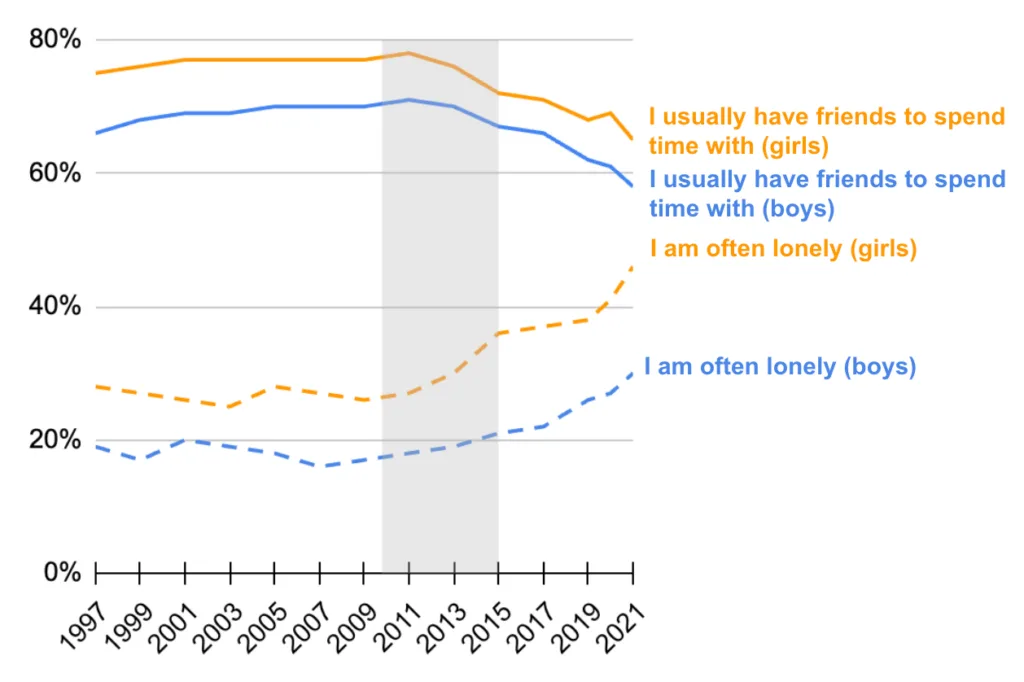
Loneliness in a social media age. (see After Babel, in Social Media, below)
“While there’s been ample research on tracking’s negative effects, studies of positive effects resulting from detracking are scant. In perhaps the only attempt to summarize the detracking literature, a 2009 summary of 15 studies from 1972 to 2006 concluded that detracking improved academic outcomes for lower-ability students, but had no effect on average and high-ability students… But some places have changed their math classes with minimal backlash, and also ensured course rigor and improved academic outcomes. That’s often because they moved slowly.”
“Evolutionary zoology provides a framework to understand the emergence of human competencies such as creativity, curiosity, resilience and pro-social, even ethical, behaviors. Organic life forms of diverse species exhibit behaviors and traits that share common threads with these human capacities developed throughout the eras, and ongoing research provides insights into the evolutionary foundations of these traits. It follows that there are few aptitudes that we consider “human” that are not found in one form or another in other higher vertebrates and some invertebrates. This conception, already theorized about by Darwin, is increasingly found to be true in current research.”
“Female managers are more adept at building rapport among mixed-gender teams, which can improve an organization’s performance, says research by Jorge Tamayo.”
“Day 68 of sharing our daily routine in war zone. Sorry guys for not posting the last two days and that’s because Omar was searching for a place for his family to evacuate.”
“The Lancet publishes the best science from the best scientists worldwide, providing an unparalleled global reach and impact on health… Collecting data is becoming increasingly difficult for the Gaza Health Ministry due to the destruction of much of the infrastructure… Some officials and news agencies have used this development, designed to improve data quality, to undermine the veracity of the data. However, the number of reported deaths is likely an underestimate… Armed conflicts have indirect health implications beyond the direct harm from violence… In recent conflicts, such indirect deaths range from three to 15 times the number of direct deaths.”
“How can we reimagine PD to be a space for teachers to (re)discover their agency and find purpose in their work? By organizing PD in accordance with the tenets of principled resistance, schools and districts can help teachers feel in charge of their own development and confident to act in service of their educational convictions.”
“Just as John Warner argues that writing is thinking, Marc Watkins suggests on his substack that learning is friction. He makes the point that education stands at odds with technology in the pursuit of frictionless experiences, and argues that in order to fully appreciate what we learn, we need to slow down and examine it closely.”
“When phone-based social media platforms emerged in the early 2010s they did not just take time away from real-life friendships. They redefined friendship for an entire generation. They gutted it. They removed the requirements of effort, of loyalty, even of meeting up, and replaced them with following each other back, exchanging a #likeforlike, and posing for selfies together. Facebook made becoming friends as easy as clicking a button. Snapchat reduced staying in touch to sending a black screen with the word STREAK. They took teenage friendship—which used to be full of friction, thrills and adventure—and made it another joyless thing to do on a screen. Another thing to be performed and marketed and publicly measured."
“Some eighth graders at her public school had set up fake TikTok accounts impersonating teachers… The middle schoolers’ attack also reflects broader concerns in schools about how students’ use, and abuse, of popular online tools is intruding on the classroom. Some states and districts have recently restricted or banned student cellphone use in schools, in part to limit peer harassment and cyberbullying on Instagram, Snap, TikTok and other apps.”
Stages of AI grief, equity and AI, lesson planning with AI, and more
Excellent resources this week.
The first feature offers an extraordinary look at how we process the arrival of generative AI. It’s absolutely worth the long read. You’ll recognize the perspectives and behaviors — positive and negative — of colleagues. Also in the features, find a helpful explainer on equity issues related to AI, specific to schools.
Elsewhere this week, Justin Cerenzia’s post (The Academic DJ) includes a helpful breakdown of where people and AI have specific strengths, drawn from Lee Shulman’s work. Leon Furze offers a helpful scale of how AI can support lesson planning at three different levels. And Lance Eaton shares all of his resources from all of his talks. Great resources all around.
And don’t miss the McSweeney’s humor piece on how generative AI may soon be comparable to PhD’s.
These and more, enjoy!
Peter
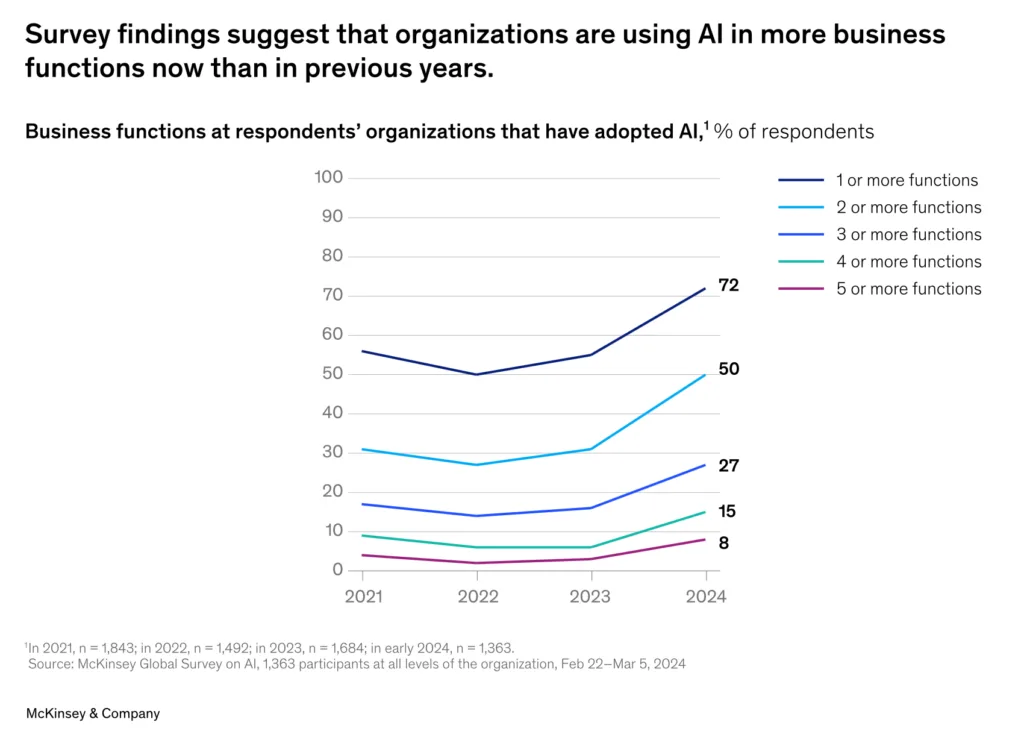
How many ways are organizations incorporating AI? (See McKinsey in Uses and Applications, below)
“As AI transforms K-12 education—providing everything from lesson planning assistance for overworked teachers to chatbot tutors for students— educators must be aware of how societal biases reflected in the data that underpins AI can shape its responses, experts say.”
“Sigmund Freud used the term “Copernican” to describe modern decenterings of the human from a place of intuitive privilege. After Nicolaus Copernicus and Charles Darwin, he nominated psychoanalysis as the third such revolution. He also characterized the response to such decenterings as “traumas.”… We should add to Freud’s list… What is today called “artificial intelligence” should be counted as a Copernican Trauma in the making. It reveals that intelligence, cognition, even mind (definitions of these historical terms are clearly up for debate) are not what they seem to be, not what they feel like, and not unique to the human condition. Obviously, the creative and technological sapience necessary to artificialize intelligence is a human accomplishment, but now, that sapience is remaking itself. Since the paleolithic cognitive revolution, human intelligence has artificialized many things — shelter, heat, food, energy, images, sounds, even life itself — but now, that intelligence itself is artificializable."
“Congress should establish a dedicated program within the National Science Foundation (NSF) to provide ongoing AI literacy training specifically for K-12 teachers and pre-service teachers. The proposed program would ensure that all teachers have the necessary knowledge and skills to integrate AI into their teaching practices effectively.”
“Q: Will it steal jobs? A: GPT-5 is unlikely to destabilize the job market, as it is overqualified for most positions while at the same time lacking any marketable skills. Its main option is adjunct work, but here its chances of taking over jobs are also doubtful; GPT-5 Plus will cost around twenty dollars a month, whereas most human adjuncts work for nothing.”
“I’ve ordered these experiments into three levels, ranging from the simple Practical Strategies prompts, through file uploads, and onto custom GPTs and projects.”
“We use Lee Shulman's work on "teacher expertise" (see image above) as a kind of foundational stance here in the CTL. AI can do many of the things on the right side of the circle (in dark) really well. It can't do any of the things on the left side (in orange) very well, yet. And these are the things that make education inherently worthwhile, in my opinion. They're human.”