Inspiration, polarization, habit stacking in schools, and more
An excellent week.
I remember a faculty meeting after the Charlottesville “Unite the Right” rally in which discussion centered on the growing polarization we saw in students and society. How might we navigate this polarization as a school, we asked. During the meeting, someone recalled the essay in the Washington Post “The white flight of Derek Black,” in which a white nationalist student at a Florida university, through invitations to and participation in a series of Shabbat dinners, came to build meaningful relationships across difference and eventually renounce his white nationalism. It was the building of relationships through stories that changed him.
Stories and shared experiences, time and again, have seemed the essence of how to build bridges across difference. When I worked briefly in politics, in the time leading up to an election, we were guided not to argue for our candidate when talking to undecided voters, but simply to tell the story of when we decided we would support that candidate. That would be enough. And now, in this week’s features, find more about the recent work of StoryCorps and how the organization behind the archive of 350,000 conversations is building conversational experiences intentionally designed to break down the barriers we have built in our culture. How can we build more opportunities in our schools for students to share experiences together and tell their stories?
Also in the features this week, enjoy a light and lively video about how the principles of game design might be leveraged to shape learning experiences.
Elsewhere in this issue: A baseball fan explores the nature and value of inspiration, a “new” composition by teenage Mozart is found in a library (230+ years later!), a teacher makes the case for how educators might intentionally build “habit stacking” into classes, the social media landscape for adolescents continues to undergo corrections and convulsions, and much more.
Plus, in the AI update, find further astonishing developments and a helpful dive into Bloom’s Taxonomy in the AI era.
These and more, enjoy!
Peter
StoryCorps brings people together to depolarize culture (in Features)
“Game designers are exceptionally good at not just keeping you entertained, but also teaching you how to play the game in the first place. So how do they do it? How do game designers analyze different learning curves, scaffold their information, and have you learn a huge amount of information without making you feel like you’ve learned anything at all? And how much of this, if any, can be used by schools and educators?”
“Its humble format — two people of opposite politics, chatting in a room with a moderator — belies an ambitious goal. Dave Isay, the founder of StoryCorps, hopes to scale experiences like Mr. Russell’s and Mr. Hailes’s into a kind of wave of national reconciliation that will help heal our political polarization, on the theory that two people from opposing groups who engage in an unguarded conversation about their lives will usually grow to like each other.”
“A 12-minute piece of music composed by Wolfgang Amadeus Mozart has been discovered in a library in Germany. Researchers think the composer wrote the previously unknown piece—called Serenade in C—when he was a young teenager."
“Human inspiration has long been a subject of investigation. A study a decade ago co-written by the psychologists Victoria Oleynick and Todd Thrash divided how humans perceive inspiration into two categories: inspired by and inspired to. In layperson’s terms, we can find ourselves inspired by a peak performer like Ohtani, and then we can use that inspiration as motivation to strive for our own goals and get the best out of ourselves. That means even if we never pick up a baseball, let alone run 90 feet anywhere close to as fast as Ohtani, observing an athlete like him at the height of his ability can take us out of our day-to-day and remind us of what is possible. It’s akin to tasting the creation of a master chef, walking around a celebrated architect’s stunning building or hearing a genre-bending singer’s perfect pitch. In all these instances we feel greatness and we are reminded of an impulse to create, to make progress and to flourish.”
“While AI’s ability to analyze complex data sets and iterate rapidly could revolutionize corporate strategy, it lacks the intuition and foresight required to navigate black swan events. Rather than fully replacing human CEOs, AI is poised to augment leadership by enhancing data analysis and operational efficiency, leaving humans to focus on long-term vision, ethics, and adaptability in dynamic markets. The future of leadership will likely be a hybrid model where AI complements human decision-making.”
““It’s a punishing job in normal times,” Holloway, a scholar of African American history, told me when I spoke to him last week. “But the standards we’re being held to are impossible. I had to ask myself, ‘What is it I want to do, how can I do it, and is this the right position?’”
“For me, the shared dreaming of tabletop RPGs have acted as the bridge between play and literature, between the promise of endless adventure and the endless demands of storytelling as craft and vocation. Sometimes writing is a less lonely process as a result.”
“Instagram said the accounts of users younger than 18 will be made private by default in the coming weeks, which means that only followers approved by an account-holder may see their posts. The app, owned by Meta, also plans to stop notifications to minors from 10 p.m. to 7 a.m. to promote sleep. In addition, Instagram will introduce more supervision tools for adults, including a feature that allows parents to see the accounts that their teenager recently messaged.”
“How one of 1994’s biggest flops became a cinematic classic. The producers wanted Tom Cruise. The creek in its most famous scene was toxic. And barely anyone saw it upon release. So why, Tom Fordy asks, did Frank Darabont’s seemingly doomed Stephen King adaptation grow into one of the most celebrated films of all time?”
Innovation catapults onward, pedagogy continues to evolve
The story of wonder this week seems to be NotebookLM’s ability to create a full podcast from a source document. What does that mean? Upload source material, and the model will create a dialog-driven podcast in which hosts talk to each other about the topic you’ve designated. Find this and many more surprising use cases at Google Labs, and read more about it in Marc Watkins’ post in this week’s features.
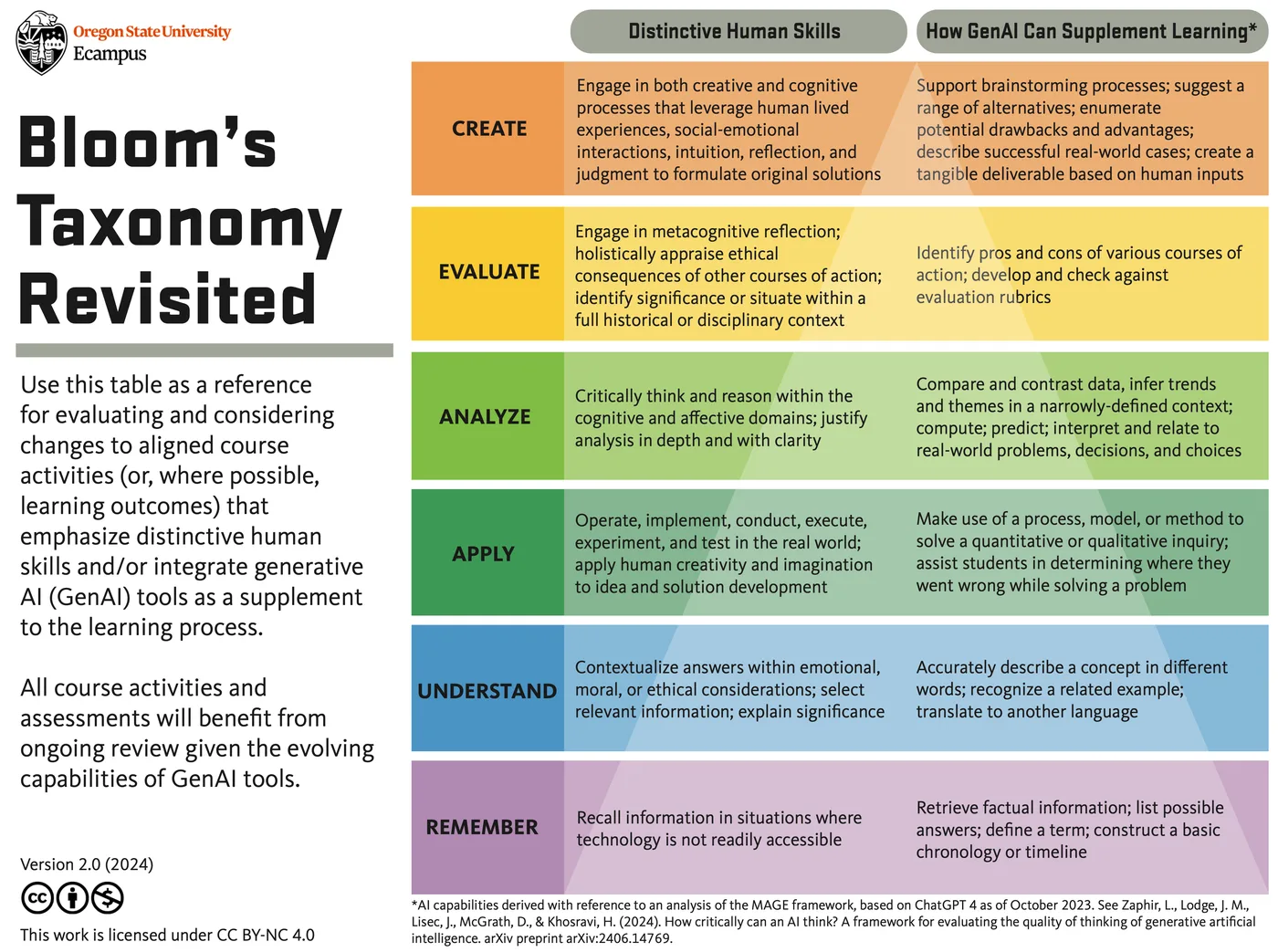
Also in the features, find the education warhorse Bloom’s Taxonomy with a helpful breakdown of how it might be intentionally engaged in an age of AI. Elsewhere in this issue, find how some people are using deepfakes for constructive purposes (in Education), while others are using it for harmful purposes (in Ethics and Risk).
Last, while reading one essay about how researchers are trying to reduce hallucinations by tethering AI to the natural world, I recalled Emerson’s essay “Language.” In it, he reflects on the idea that words are signs of natural fact, that even when describing abstract ideas, words draw their meaning from their representation of relationships in the natural world. Today, new generative AI technology extends this kind of thinking. Generative AI tools draw their power from the “models” that map relationships between words. How might Emerson’s ideas help ground discussions today about the ways AI represents reality?
“Everyone started talking about Google’s NotebookLM because of their recent podcast update, but the real story is about how Google is using its AI experiments to push our understanding about how people will use generative AI as tools for thought.”
“Use this table as a reference for evaluating and considering changes to aligned course activities (or, where possible, learning outcomes) that emphasize distinctive human skills and/or integrate generative AI (GenAI) tools as a supplement to the learning process.”
“Clearly, part of the appeal of these videos is that they are genuinely useful. The “script” is clearly written by a human, and the math concepts depicted are illustrated beautifully. But, there’s no denying that the gimmick of having AI celebrities, like Jenna Ortega and Barack Obama, explain the concepts, is core to the appeal on social media.”
“Since 2020, CDT has conducted annual or semi-annual surveys with students, teachers, and/or parents. The surveys measure and track changes in perceptions, experiences, training, engagement, and concerns about student data privacy, student activity monitoring, content filtering and blocking software, generative AI, NCII, and deepfakes in schools.”
“There are verifiable truths in the real world. A rock is a rock. Sound travels at 343 meters per second. The sun sets in the west. If A.I. systems pull information from physical reality, it can verify these truths, too. “Truth can come from the world,” Dr. Silver said. “If you can get feedback from world, you can improve and improve and improve.””