Student initiatives, habits of successful schools, anniversary of October 7, and more
Great posts this week.
In the features, find a dive into the characteristics of schools that bring students who are behind grade level up to level. This is a valuable examination of what makes the most successful schools. Also in the features, find an opportunity for students to present their work on a national stage.
Elsewhere this week, see in the humanities section two posts on the anniversary of October 7. What should schools do at this time? Should they make any statement or host events signifying the anniversary? See a report about different approaches at the college level.
Also this week, some excellent posts on pedagogy, a very important article on education technology, a remarkable (and easy) illustration of physics principles involving water bottles, and, for admissions offices, an important precedent related to legacy admissions.
These and more, enjoy!
Peter
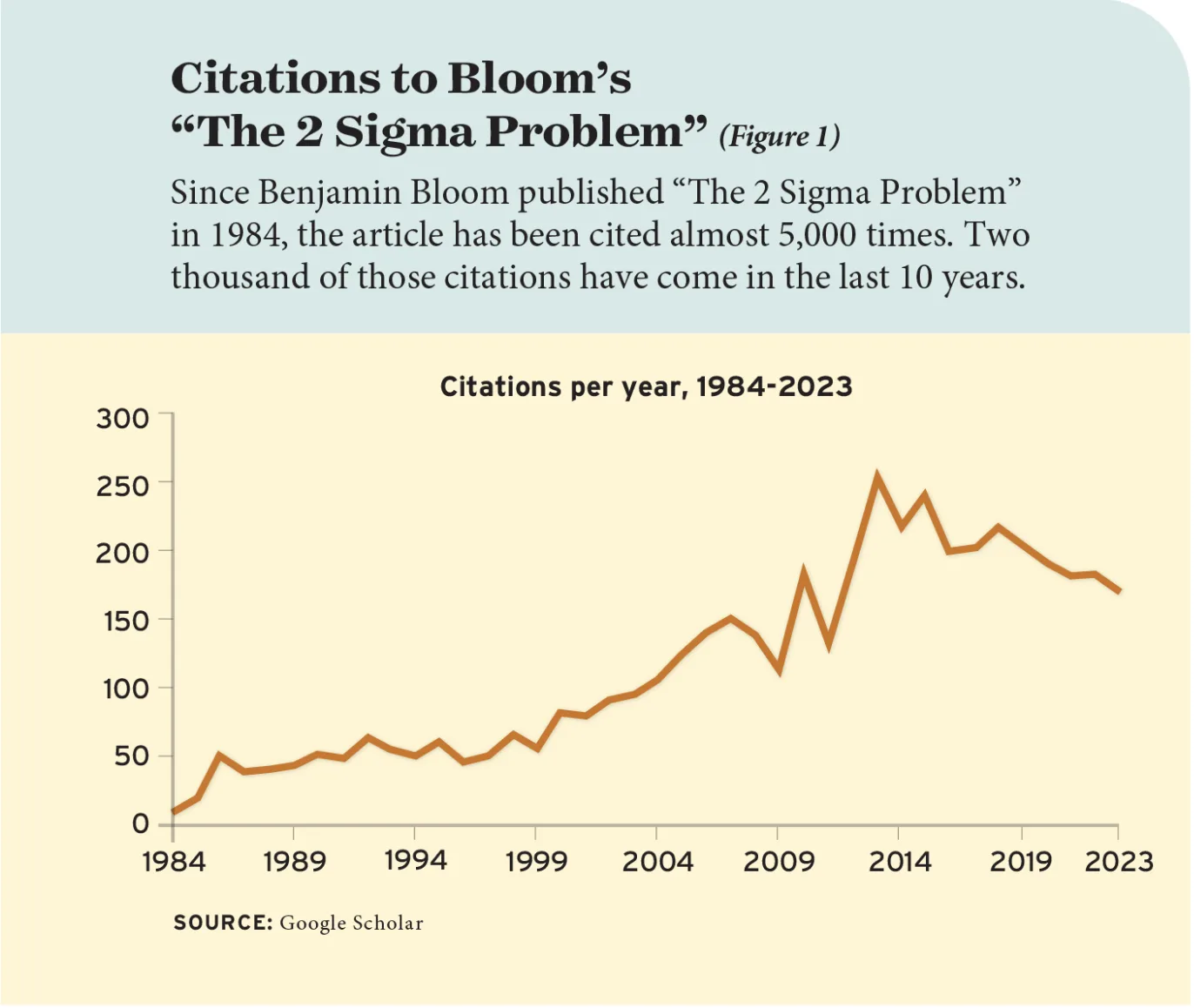
How do we weigh Bloom’s 2 Sigma conclusion? (See Pedagogy for more)
“Are you a high school student with an idea for a current project that will make an impact in your community? Apply to have your innovative project or initiative considered for the Student Impact Challenge at SXSW EDU, March 3-6, 2025. The Student Impact Challenge celebrates student achievement and agency in solving the most pressing social, economic, and environmental challenges by providing a platform for high school students to showcase their innovative ideas. Students, both nationally and internationally, are invited to apply. Application Opens: August 6, 2024 - Application Closes: October 25, 2024”
““What we found was not a silver-bullet solution, a perfect curriculum, or a rockstar principal,” the report said. “Instead, these schools shared a commitment to doing three core things well: they create a culture of belonging, deliver consistent grade-level instruction, and build a coherent instructional program.”
“California will ban private colleges and universities, including some of the nation’s most selective institutions, from giving special consideration to applicants who have family or other connections to the schools, a practice known as legacy preferences.”
“The novelist Zadie Smith talks about how we often think of freedom as simply doing whatever we want, whenever we want. “But there’s many other forms of freedom that are actually quite valuable,” she says. “Much of life can feel like a performance, where you’re trying to fit in, impress, or meet expectations. Even close friendships sometimes have this performative aspect where you’re not fully yourself. So anywhere you can go where you’re not on stage, where you’re not having to keep up someone else’s idea of you, where you can just be yourself—that is freedom. For me, at least—that’s a form of being free that is really valuable to me.””
“While most colleges either didn’t reply or said their president was unable to talk, a few made their executives available for interviews or explained their plans for the anniversary.”
“In August 2022, three researchers at Khan Academy, a popular math practice website, published the results of a massive, 99-district study of students. It showed an effect size of 0.26 standard deviations (SD)—equivalent to several months of additional schooling—for students who used the program as recommended… A clue is in those wiggle words “students who used the program as recommended.” Just how many students do use these programs as recommended—at least 30 minutes per week in the case of Khan Academy? The answer is usually buried in a footnote, if it’s reported at all. In the case of the Khan study, it is 4.7 percent of students. The percentage of students using the other products as prescribed is similarly low.”
On AI and writing, simulating students, bias, Meta's smart glasses, and more
Just another paradigm-busting week of technological breakthroughs…
In one of this week’s features, Dr. Philippa Hartman asks the question: what if AI could simulate students to inform and test out learning design? This is a fascinating question. I had seen examples of organizations exploring AI simulations of students for the purpose of allowing teachers to practice lessons live, but I hadn’t yet seen posts exploring the idea that an instructional designer could take a lesson idea and ask a generative AI to imagine classrooms of different sizes and composition experiencing that lesson, thereby creating something like a weather forecast for your lesson plan.
Also this week, see Maha Bali’s exploration of cultural hallucination bias. It is widely understood by now that the nature of AI’s training set leads to inherent biases within AI models, but many people may not yet understand the lived experience of this. Maha explores a few direct experiences of what this means.
Elsewhere this week, find excellent articles in the Education section: Eric Hudson checks in on where AI is helpful for writing and where it isn’t. Dan Meyer explores the disconnect between the edtech sector and teachers, and the Center for Curriculum Redesign offers a self-paced course on AI literacy specifically designed for educators.
For lighter (or perhaps more existential?) fare, enjoy the two minute podcast created by NotebookLM in which two AI podcast hosts are informed that they are not human.
These and more, enjoy!
Peter
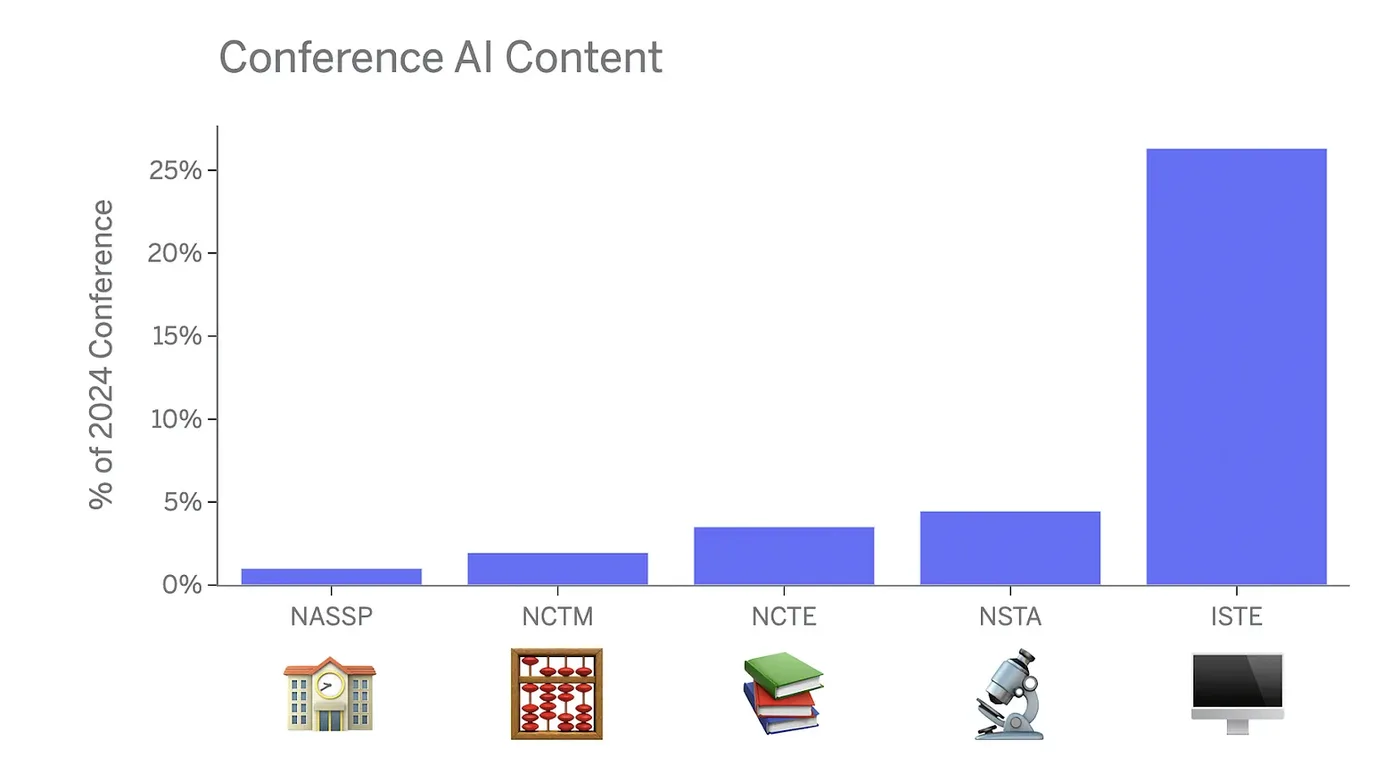
What does it mean if tech conferences are talking about AI more than disciplinary conferences are talking about AI? (See Education for more)
“Imagine the possibilities if we could use AI to simulate learner responses during the instructional design process. What if you didn’t need to conduct endless interviews, waiting for learner feedback that sometimes never arrives? What if you could have instant conversations with virtual learners and rapidly generate reliable data to inform your design?”
“For example, would YOU notice that QuickDraw expects a cross on hospital buildings, rather than a crescent? Would YOU try to draw a crescent on the hospital building and see if it understands you (hint: it doesn’t)."
“As a former English teacher, I think about the core writing and thinking skills of 1) selecting, integrating, and analyzing textual evidence in a meaningful way, 2) having a good idea (and knowing when it’s good) and composing an interesting expression of that idea, and 3) sustaining an argument over multiple paragraphs in a way that reflects a distinct point of view. I don’t trust generative AI to do any of these things on its own, but if I were in the classroom now, I’d be showing my students this experiment and having an open, honest conversation about what it means to think for ourselves and express ourselves, and what role AI should or shouldn’t play in those processes.”
“Two Harvard students have created an eerie demo of how smart glasses can use facial recognition tech to instantly dox people’s identities, phone numbers, and addresses. The most unsettling part is the demo uses current, widely available technology like the Ray-Ban Meta smart glasses and public databases.”
“Generative tools are increasingly impacting how we access and view information in our digital spaces. As Alison Gopnik argues, “these models are “cultural technologies” like writing, print, pictures, libraries, internet search engines, and Wikipedia.” Cultural technologies increase our access to information but also transform how we view technology in our daily lives. Put simply, generative AI is changing how we think and increasing feel about our world. Newer multimodal models allow us to access areas of data about the world and ourselves that we’ve never been able to before at a scale only possible because of machine learning.”