Making Kids The Curriculum, Reconciling the DEI wars, Gatsby at 100, and more
Two weeks since the last issue, and they’ve been packed with helpful posts.
Three features to kick it off. First, the video from several weeks ago about Bloom’s Taxonomy was one of the most visited posts in recent memory, and the author has now posted it on YouTube. It’s easier to share there, so I’ve re-linked it as a feature in this issue. If you reference Bloom’s Taxonomy, or if you would like your faculty to best understand its intended purpose, check out that feature. Also, find an excellently analyzed survey about the state of belonging among adolescents today. The substantial sample size (n=21,468) is from independent schools, but my read is that it is applicable to students broadly. Truly a must-visit for anyone focused on student life today.
Finally, the crossfire around DEI is unavoidable these days, but that doesn’t mean there isn’t a path through it. See this week’s feature for a detailed and thorough proposal for reconciling the DEI wars. It address the shortcomings of multiple perspectives, but then, critically, offers concrete (if high level) paths forward, ultimately advancing the crucial work of caring for and supporting every student without the divisive language of the recent past. As an interesting followup, the New York Times recently published an interview between Christopher Rufo (one of the architects of the anti-DEI backlash) and Ross Douthat. For insight into the agreements and disagreements among the center right and the far right, this interview offers much.
Also this week, Isabelle Hau’s just-out book “Love to Learn” explores the centrality of loving relationships for the development of the brain in young children. Hau, the executive director of Stanford’s Accelerator for Learning, offers a deep well of research to draw on. Read more about the book and its ideas in the early childhood section. But it’s also worth thinking about how her research is applicable to older students, too — which she occasionally touches on in the text. For them to truly flourish, kids need to know we care.
Also, whether you’re a STEM teacher or not, Dan Meyer’s post on making kids the curriculum is an excellent look at pedagogical decisions that will help make classes engaging and relevant to kids’ lives. When they see themselves and their peers in their learning, they pay a lot more attention. Meyer offers excellent concrete approaches for how to do this.
And so much more: a student forecasting competition, pi day, writing techniques, myths about professional learning, a March Madness bracket for literary villains, higher ed wrestling with politicization, etc…
These and more, enjoy!
Peter
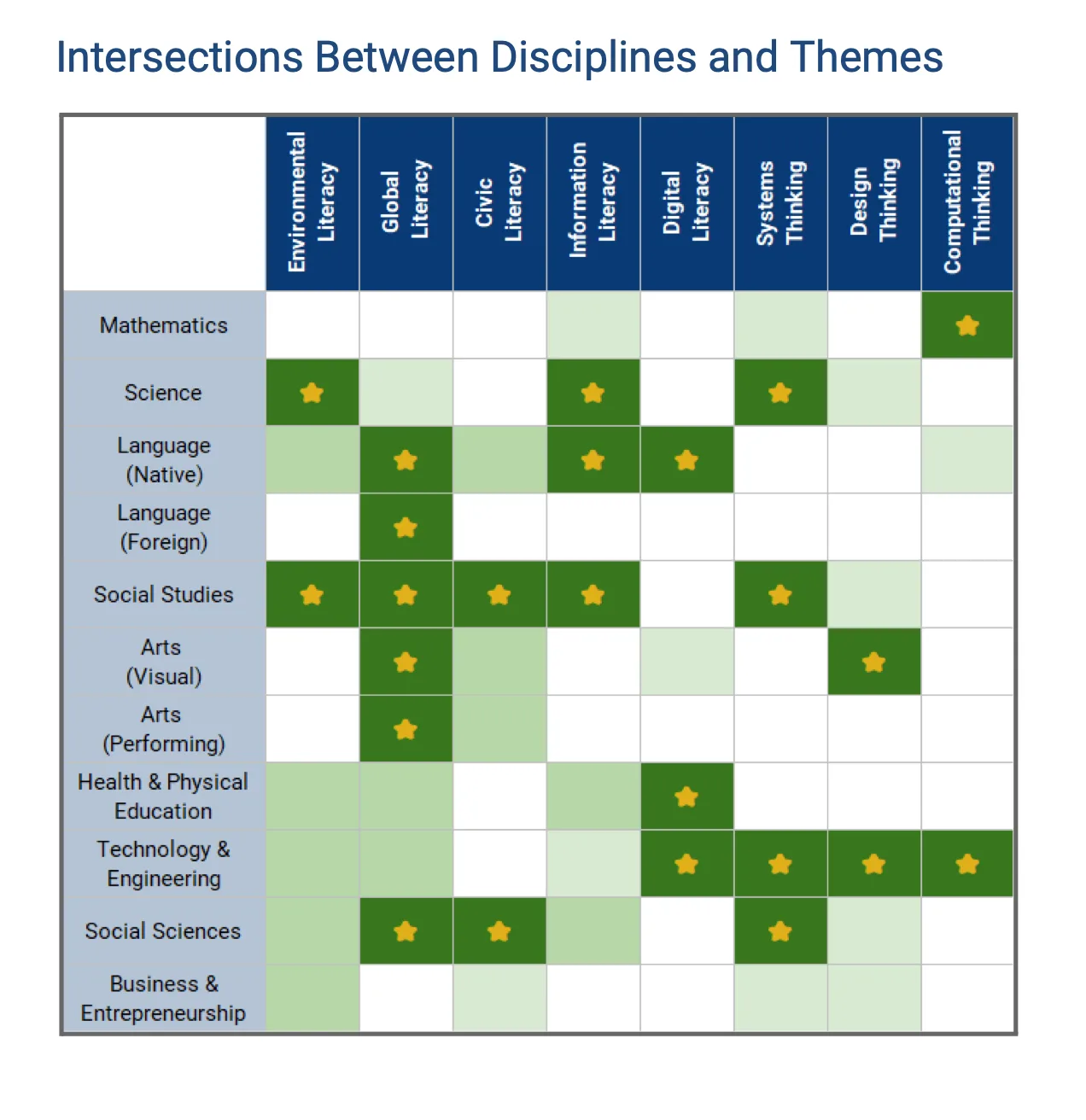
How interdisciplinary themes connect the disciplinary curriculum. See the post in the curriculum section for more detail and explanation.
“The DEI wars are a mess. Divisive DEI policies are being challenged by a divisive president in a divisive way… The good news is that there is a clear way out of this morass. DEI proponents are right that America’s history of racial discrimination requires a remedy, but that response must be consistent with enduring Constitutional values that have stood the test of time. Robust policies to help the disadvantaged of all races recognize history without repeating its mistakes. The path out of the DEI wars must restore the Fourteenth Amendment’s commitment to treating Americans of all races with dignity, and the First Amendment’s commitment to free speech, robust discussion, and the freedom to think for oneself.”
“After watching this video, I encourage you to read the source material. Bloom's Taxonomy is one of the most cited but least read resources in instructional design. A neglect to read the source material is what leads to major misconceptions and misapplication.”
“Associations with inadequate sleep are both wide-sweeping and profoundly negative… From all measures in this survey, there are no positive associations with greater time spent on social media, only negative…”
“One in 8 young people aged 13 to 20—and 1 in 10 teenagers aged 13 to 17—said they “personally know someone” who has been the target of deepfake nude imagery, and 1 in 17 have been targets themselves.“
“Decades of research, at all levels of education, has demonstrated that grades can promote short-term performance rather than long-term understanding, encourage both superficial studying and outright cheating, and can undermine a student’s intrinsic interest in the material.”
"The most recognisable change, as my intuition returned, was my attitude toward doubt… As I grew comfortable again living and practising medicine with doubt at my side, I felt the tide of self-consciousness flowing out of me, like a child at play.”
“These diverse interdisciplinary themes and forms of literacy provide a solid framework for education, making learning relevant, real-world-oriented, motivating, and purpose-and-action-driven. Each equips students with crucial abilities and perspectives that are essential in a rapidly evolving world.”
“Some high schools that once pushed nearly all students toward four-year colleges are now guiding teenagers toward a wider range of choices, including trade schools, apprenticeships, two-year degrees or the military. Among them are schools that are part of KIPP, the nation’s largest charter school network… At KIPP Academy Lynn, Nicholas Pinho, an 18-year-old senior, is also weighing whether a four-year college is worth it. He might go for a bachelor’s degree in electrical engineering, but he is also thinking about a trade program to become an electrician… He was once interested in law school. But during the Covid-19 school closures, when he was chained to a laptop for remote learning, he had trouble focusing. That experience, he said, made him realize “I like to do more hands-on work.”
“School programs, classes, and events focused on particular cultures don’t automatically run afoul of federal civil rights law, the Trump administration said over the weekend.”
“Rufo: So what should happen at the Department of Education is a U.S.A.I.D.-style dismantling… Douthat: Here’s what I don’t understand about this plan… Why wouldn’t you want to just run the actual bureaucracy?”
“Most parents and educators intuitively know that nurturing relationships matter. What they may not know is that relationships drive brain development and later academic and social emotional outcomes in children. Research has shown that children who experience nurturing relationships tend to have a larger hippocampus, a brain region critical for memory, learning, and emotional regulation. Relationships – or the absence of them – shape a child’s ability to learn, connect, and thrive for life.”
“Here’s a look at what Trump can and cannot legally do when it comes to education, according to an Education Week review of published statutes and court rulings, and consultations with experts on federal law.”
“Some universities have exacerbated the situation by drifting from their core purposes of education and research to take official positions on political and social issues. This has led many to see universities as just another ideological combatant in the daily political struggle… With so much at stake, universities must return to their foundational purpose and recommit to the core principles that sustain them.”
“The authors of [the Kalven Report] note that there is an important exception to the general stance of institutional neutrality: “From time to time instances will arise in which the society, or segments of it, threaten the very mission of the university and its value of free inquiry. In such a crisis, it becomes the obligation of the university as an institution to oppose such measures and actively to defend its interests and its values.” The word used here is “obligation,” not “option,” and it seems almost impossible to deny that the crisis imagined by the authors of the Kalven Report is upon us.”
“If you're going to [go to college], I think liberal liberal arts is a really good choice because I feel like the best talent moving forward, the people with the most agency are gonna have elements of philosophy, psychology, sociology, history, science, business, fine arts, political science, computer science….all of that helps, a diversity of experience and perspective.”
“Today, we begin with an initial, ignoble group of 64 (selected by our editors after much hand-wringing), and over the next week, we will be narrowing the field until we get to the dastardly winner. Who will it be? Iago or Annie Wilkes? Captain Ahab or Captain Hook? There’s only one way to find out.”
“It took World War II for Gatsby to become an institution, when the US government began shipping small paperback editions of popular novels out to the troops for morale. Gatsby was one of the books chosen for the program, with 155,000 copies distributed across the armed services. Now, the book was not just well-regarded but also inescapable. It would take decades more, however, before Gatsby reached the place where most people meet it today: the classroom.”
“Our species, Homo sapiens, is about 230,000 years old. Estimates of when language originated vary widely, based on different forms of evidence, from fossils to cultural artifacts. The authors of the new analysis took a different approach. They reasoned that since all human languages likely have a common origin — as the researchers strongly think — the key question is how far back in time regional groups began spreading around the world.”
“Heifetz defines the productive zone of disequilibrium as the optimal range of distress within which the urgency in the system motivates people to engage in adaptive work. In other words, this is the place where people are creative and come up with solutions. Move too high in the Productive Zone of Disequilibrium, and people panic or lock up. Go too low, and people become complacent.”
“Myth 5: Teacher Improvement Begins With Proven Practices Implemented With Fidelity… When we involve teachers in developing their professional learning, when change agents have a deep understanding of the strategies they share, when we stop labeling teachers as resistant and start creating the conditions for teachers to set goals that they care about and—above all—when we start with kids, we should expect greater success.
“From classroom teachers to well-paid consultants, philanthropists to activists, investors to brand-new operators, the crowd, speakers, and content were a cross-section of the education landscape at every level… SXSW EDU delivered pretty deeply across key challenges, innovations and opinions affecting the sector. Though we didn’t see former Presidents, current Secretaries of Education, or billionaire philanthropists on the schedule this year, the depth and value of the content was as strong or stronger than previous years.”
“Right now, periodic reading tests prompt students to “find the main idea” or identify a “point of view” — discrete standards and skills that don’t add up to reading comprehension. They are misaligned with the research on how kids learn to read well and ignore the foundational role of knowledge in reading comprehension… Assessments should focus students on the most challenging sections of a text and pose questions that can determine whether students navigated the passage for meaning. Questions also should address what world knowledge can be learned from reading the text carefully. And, questions should focus on challenging vocabulary or phrases to see if students understand the contributions that vocabulary makes to meaning.”
“Mr. Harrison, an Australian who died last month at 88, was one of the most prolific donors in history, extending his arm 1,173 times. He may have also been one of the most important: Scientists used a rare antibody in his plasma to make a medication that helped protect an estimated 2.4 million babies in Australia from possible disease or death, medical experts say.”
“Teachers often respond to students in a couple of common ways here: 1. They talk about the right answers. 2. They ask students to share their answers. Both responses risk brain death. Neither one necessarily tells students, “There is a task for you here beyond listening.” Neither one necessarily sets up a shelf in a kid’s mind to help them structure the ideas they’re hearing. Matchy Match is a different option. What I did was pretty simple. I grabbed work from four students—the equation they chose and the tape diagram they sketched. Then I mixed them up and asked students to unmix them up—to match them together. “Tell your neighbor how you think the equations and diagrams match up,” I said, and please believe me, reader, when I say the class buzzed with ideas and debate.”
“The first digital divide: The rich have technology, while the poor do not. The second digital divide: The rich have technology and the skills to use it effectively, while the poor have technology but lack skills to use it effectively. The third digital divide?: The rich have access to both technology and people to help them use it, while the poor have access to technology only.”
“When you watch teachers working within the dominant edtech paradigm, you see their relationship with students transformed from nurturing to supervisory. What more can those teachers do but patrol the rows of desks, making sure kids are staying on the right tab and staying off of Retro Bowl.”
“I couldn’t help but notice how I would mold my word choice around the spacing of the page lines; how the graphite imprints bled through the paper in a way that gave me pause to think; how the freedom to scrawl in the margins allowed me to caret in ideas that otherwise might not have been written the same way. The medium undoubtedly had its own constraints, but in a way that circularly reinforced the way I ultimately wrote.”
“Teachers and parents – your students can join Forecasting the Future, a fun, interactive online tournament in which middle and high school students across the country compete by making predictions (forecasts) on real-world questions about music, sports, movies, and more!”
This week’s features section highlights “vibe-coding” — which is the experience many non-programmers are having working with generative AI tools to simply dream up app ideas and then having AI program them on the spot. See the Alitu piece for examples. What this means, though, is critical. Literacy with how to do this — how to think of the right questions, identify the desired processes, determine the right outcomes — will be all that separates those who can take advantage of this new future and those who can’t. What’s most striking to me is that these are the skills of a liberal arts curriculum: critical thinking, creativity, and problem solving in generalist ways that can be applied to specific settings. Our emerging future calls for a deepening of our commitment to liberal arts skills.
Also in the feature, find A16z’s 4th release of the top 100 consumer GenAI apps. I will highlight that CharacterAI remains in the top three as a reminder that the largest shift in this turning point in human history will not be the writing or the code that GenAI can produce, but the way that we shift our attention as human beings to digital companions, the way that synthetic AI affects us socially and spiritually. It’s not a science fiction future. As you’ve already seen in previous issues, adolescents and churches and retirees and married couples and more are all turning to generative AI companions for friendship, therapy, romance, intellectual companionship, and more. It’s worth taking the time to think intentionally with student life leaders about how this might play out for adolescents.
Lastly, the past few weeks have also included some of our shrewdest technology critics suggesting that AGI (artificial general intelligence — the idea that AI can surpass human intelligence) is imminent. See Ezra Klein and Kevin Roose for reflections on this. And it’s a reminder that some may nitpick about the things AI can’t do, but the current reality is that AI is already much more capable than humans at a enormous variety of tasks that we used to think belonged solely to the purview of human intelligence. What matters now is not fighting it, but finding the most prosocial, constructive way to engage it.
These and more, enjoy!
Peter
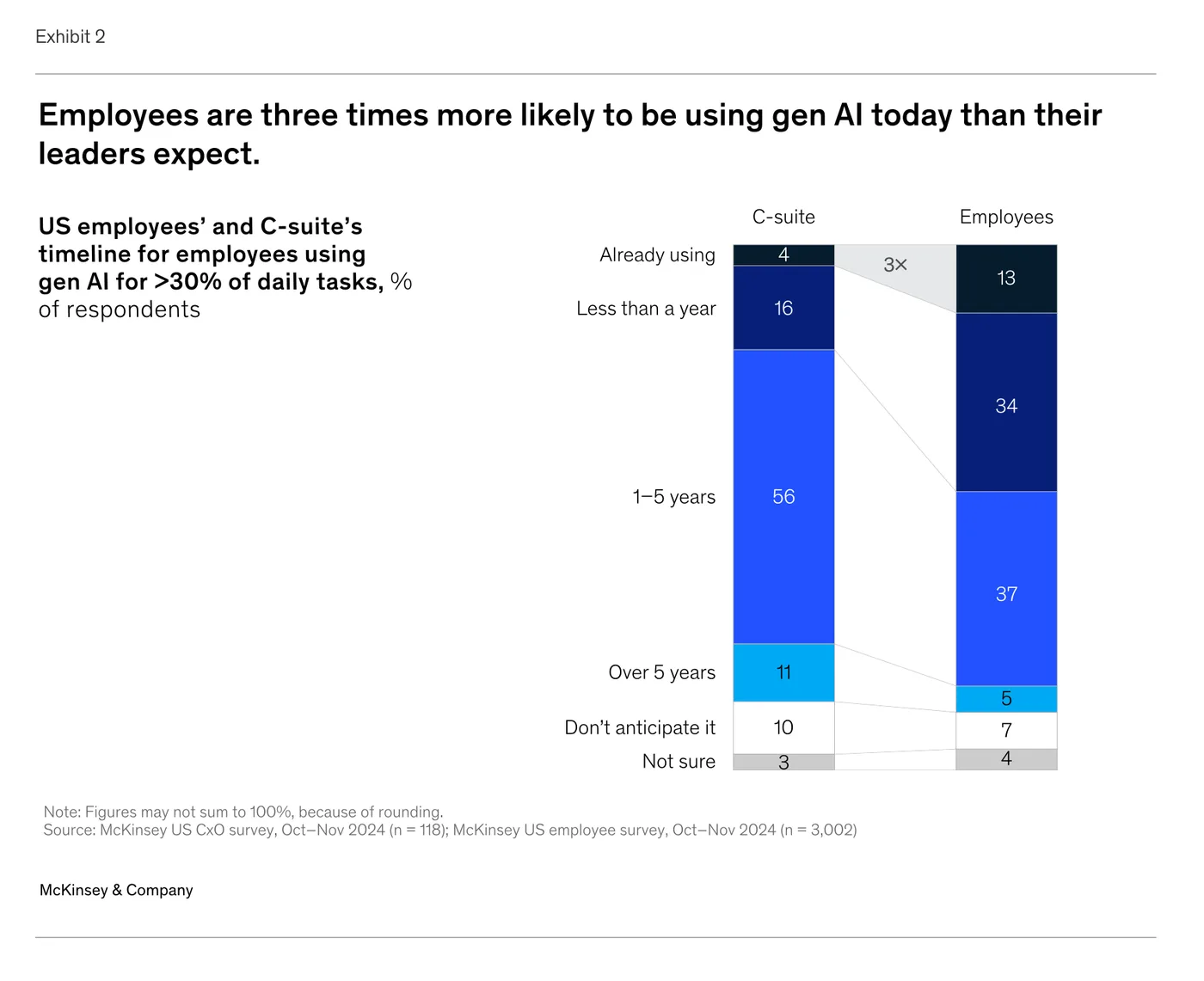
Employee and leadership timelines for when employees will use genAI for 30% of their tasks. See the McKinsey report on strategy in the Uses and Applications section for more.
“Vibe coding is an AI-assisted approach where you describe your software idea in plain language and the AI writes the code for you. It's that simple, and this guide will show you how.”
“In just six months, the consumer AI landscape has been redrawn. Some products surged, others stalled, and a few unexpected players rewrote the leaderboard overnight. Deepseek rocketed from obscurity to a leading ChatGPT challenger. AI video models advanced from experimental to fairly dependable (at least for short clips!). And so-called “vibecoding” is changing who can create with AI, not just who can use it. The competition is tighter, the stakes are higher, and the winners aren’t just launching, they’re sticking.”
“Reich and his colleagues recommend that teachers encourage students to think of AI tools as helping with small portions of their work rather than assisting with the whole of their work. “So if you get stuck, don’t ask machines to do your assignment. Ask the machine to give you some help with what the next step is,” he said.”
“But a metaphor of hallucination reinforces the misconception that AI is conscious; it implies that AI experiences reality and sometimes becomes delirious… Ultimately, we chose a more fitting term: AI mirage. Just as a desert mirage is an artifact of physical conditions, an AI mirage is an artifact of how systems process training data and prompts. In both cases, a human can mistake a mirage for reality or see it for what it really is.”
“This is the first of a series of short reports that seek to help business, education, and policy leaders understand the technical details of working with AI through rigorous testing. In this report, we demonstrate two things: There is no single standard for measuring whether a Large Language Model (LLM) passes a benchmark, and that choosing a standard has a big impact on how well the LLM does on that benchmark. The standard you choose will depend on your goals for using an LLM in a particular case. It is hard to know in advance whether a particular prompting approach will help or harm the LLM's ability to answer any particular question. Specifically, we find that sometimes being polite to the LLM helps performance, and sometimes it lowers performance. We also find that constraining the AI’s answers helps performance in some cases, though it may lower performance in other cases.”
“Generative AI has made it absurdly easy to generate a lot of text or images. But it hasn’t made us any better at subtracting the useful, meaningful, or simply interesting stuff from text and images — isolating the gold from the fool’s gold.”
“Expertise clearly still matters in a world of creating things with words. After all, you have to know what you want to create; be able to judge whether the results are good or bad; and give appropriate feedback.”
“I didn’t arrive at these views as a starry-eyed futurist, an investor hyping my A.I. portfolio or a guy who took too many magic mushrooms and watched “Terminator 2.” I arrived at them as a journalist who has spent a lot of time talking to the engineers building powerful A.I. systems, the investors funding it and the researchers studying its effects. And I’ve come to believe that what’s happening in A.I. right now is bigger than most people understand.”
“A unified effort within the academic community is needed to ensure that AI in scientific writing is used responsibly to enhance critical thinking, not replace it. This concept aligns with the broader vision of augmented artificial intelligence, advocating for the collaboration between human judgment and AI toward ethical technology development and applying the same principles to scientific writing. Policies and frameworks must stay rooted in the fundamentals of scientific writing: advancing knowledge, prioritizing quality over quantity, and fostering transparency and accountability.”
“By far the top lot was Machine Hallucinations – ISS Dreams – A (2021) by Refik Anadol, the pioneering Turkish-American artist known for his large-scale immersive installations who plans to open the first AI arts museum, Dataland, in Los Angeles later this year. “