“10 Principles For School Leaders When DEI + Belonging Are Attacked”
“Through mission-focused leadership schools can navigate complexity and uncertainty with clarity for what’s most important for kids and their learning.”
A weekly collection of education-related news from around the web.
← Previous Issue · Next Issue →
Happy Monday, all!
First, I’ve been head down working for the past three weeks, so I’m behind on the newsletter. The result: the longest issue yet. Apologies for the length, but there was so much interesting writing — I hope you’ll find it’s worth the browse. This week’s AI section, in particular, is especially noteworthy.
Second, I’m so happy to share that the preoccupation has been something of a writing retreat during which my coauthor and I completed a first draft of a book that we aim to release later this year. It’s entering a rigorous production cycle now, so it will be a short spell before it surfaces again — and that’s all on the topic for now…
In the meantime, much in this issue to dive into. The two features focus on pedagogy and on holding on to school values in complex times. Then, in the issue, find several practical posts on pedagogy, a number of remarkable historical discoveries, good thinking on curriculum, and much more, including a new genre of film I had not heard of: “competence movies.” It would be interesting to explore that movie playlist and reflect on what the skills are that are demonstrated in the films that are deemed as characters showing competence.
And for AI: I’ve opened a new category of posts: “TECH/AI: SOCIAL”. As I’ve noted for about the past year, I believe AI companions and synthetic relationships are going to have a larger impact on humanity in the long run than job displacements and the fears some have about learning. Writing about AI companions is now accelerating. This week, three of the AI featured posts are on AI companions, including interviews with students. Kids are trying them out. Read about this if you haven’t yet.
And if you missed it last month, here are the final results of the “Literary Villains March Madness” bracket, shown below…!
These and more, enjoy!
Peter

“Through mission-focused leadership schools can navigate complexity and uncertainty with clarity for what’s most important for kids and their learning.”
“Two quick disclaimers on the research findings that I will discuss in this blog post. These studies concerned feedback on student-produced mathematical proofs, and much of the data came from clinical interviews that were not connected to a specific course. Although this specific research focused exclusively on student proofs, many of the findings could apply to other areas of mathematics and other subject matters.”
“I’m still standing by your desk. How could I have possibly graded your paper in thirty seconds? Do you think it’s all magic?”
“Often, it is not outright falsehoods that sow doubt online. Last year a study found that, among vaccine-related links viewed on Facebook during the spring 2021 Covid vaccine rollout, only 0.3% were flagged as false or out-of-context by factcheckers. Crucially, the posts that had the biggest overall impact on vaccine confidence were factually accurate, but potentially open to misinterpretation.”
“The government may not threaten funding cuts as a tool to pressure recipients into suppressing First Amendment–protected speech.“
“Maya Angelou’s “I Know Why the Caged Bird Sings” and books on the Holocaust were among the works removed in response to an order from the office of Defense Secretary Pete Hegseth.”
“He pointed out that the education secretary in President Trump’s first term, Betsy DeVos, once told staff that “diversity and inclusion are the cornerstones of high organizational performance.” She also said that “diversity and inclusion are key elements for success” for “building strong teams,” he wrote. “This is an abrupt shift,” Mr. Morton-Bentley said, adding that the federal government has “provided no explanation for how and why it changed positions.” The Trump administration’s memo included a certification letter confirming compliance that officials must sign and return to the Education Department within 10 days. New York indicated that it would treat the demand as a request rather than a requirement. “No further certification will be forthcoming,” the state’s letter said.”
“[James Baldwin:] “My relationship… to the language of Shakespeare revealed itself as nothing less than my relationship to myself and my past. Under this light, this revelation, both myself and my past began slowly to open, perhaps the way a flower opens at morning, but more probably the way an atrophied muscle begins to function, or frozen fingers to thaw.””
“Fragments of a rare Merlin manuscript from c. 1300 have been discovered and digitised in a ground-breaking three-year project at Cambridge University Library”
“Hundreds of administrative tablets – the earliest physical evidence of the first empire in recorded history – have been discovered by archaeologists from the British Museum and Iraq. These texts detail the minutiae of government and reveal a complex bureaucracy – the red tape of an ancient civilisation.”
“He became known for obscure word choices — some extremely so. He preferred perscrutation rather than a simpler synonym, scrutiny; inconcinnate (unsuitable); and rodomontade (boastful talk).”
“Today is a day. Let’s make it a good one.”
So, there are a few extra features this week — three weeks in AI news is an eon.
Mostly, I want to highlight the extraordinary acceleration in social and affective AI. This means that AI is racing to affect people socially and emotionally. This is a major development that, especially in schools, we need to be attentive to. If you are not keeping up, be sure that someone at your school is. Here are some headlines:
- From the Medium post by the Rithm Project: A majority of kids 14-18 have experimented with social AI companions or know someone who has. A majority approve of AI friendships. A majority disapprove of romantic relationships with AI, but a minority do approve of them.
- Writing in the New Yorker by Jaron Lanier anticipates that AI lovers will be common in the future. It explores the implications.
- OpenAI has begun intentionally testing affective (emotional) character traits in their voice mode conversations with users. They published the results in partnership with MIT. Of the many headlines: higher engagement with affective voice modes correlate with higher loneliness, dependence, problematic use, and lower socialization. It’s worth reading the difference in the write ups from MIT and OpenAI — and what that portends for the future.
My take: no one knows how exactly this will affect us, and we’ll all be figuring it out together in the years ahead. But time is important now while habits and policies are taking shape. Have conversations about it with your colleagues and with your students. Schools need to be actively working out how to support healthy socialization of this technology, because we can’t leave kids to their devices, as it were — we need to be moving at least as fast as commercial-driven AI companies that are seeking to monetize the hours people — including kids — are spending with AI companions.
There are other remarkable developments in this issue: more comparison of AI’s deep research capabilities (a feature I use weekly at least), breakthroughs in responsive image generation, helpful writing on AI in education, and the remarkable moment we’ve hit: now AI writes funnier memes, on average, than people.
The world is changing faster than ever. Hang on tight.
Peter
“The study comes with an important caveat. On average, fully AI-generated memes scored higher than those created by humans alone or humans collaborating with AI. But when researchers looked at the best individual memes, humans created the funniest examples, and human-AI collaborations produced the most creative and shareable memes. In other words, AI models consistently produced broadly appealing memes, but humans—with or without AI help—still made the most exceptional individual examples.”
“Results showed that while voice-based chatbots initially appeared beneficial in mitigating loneliness and dependence compared with text-based chatbots, these advantages diminished at high usage levels, especially with a neutral-voice chatbot. Conversation type also shaped outcomes: personal topics slightly increased loneliness but tended to lower emotional dependence compared with open-ended conversations, whereas non-personal topics were associated with greater dependence among heavy users. Overall, higher daily usage–across all modalities and conversation types–correlated with higher loneliness, dependence, and problematic use, and lower socialization.”
“I have proposed, in these pages, that the best moment when using virtual reality is when you take the headset off and perceive the world with fresh eyes. Maybe falling in love with A.I. and having A.I. yanked away will be how people learn to appreciate one another in the future.”
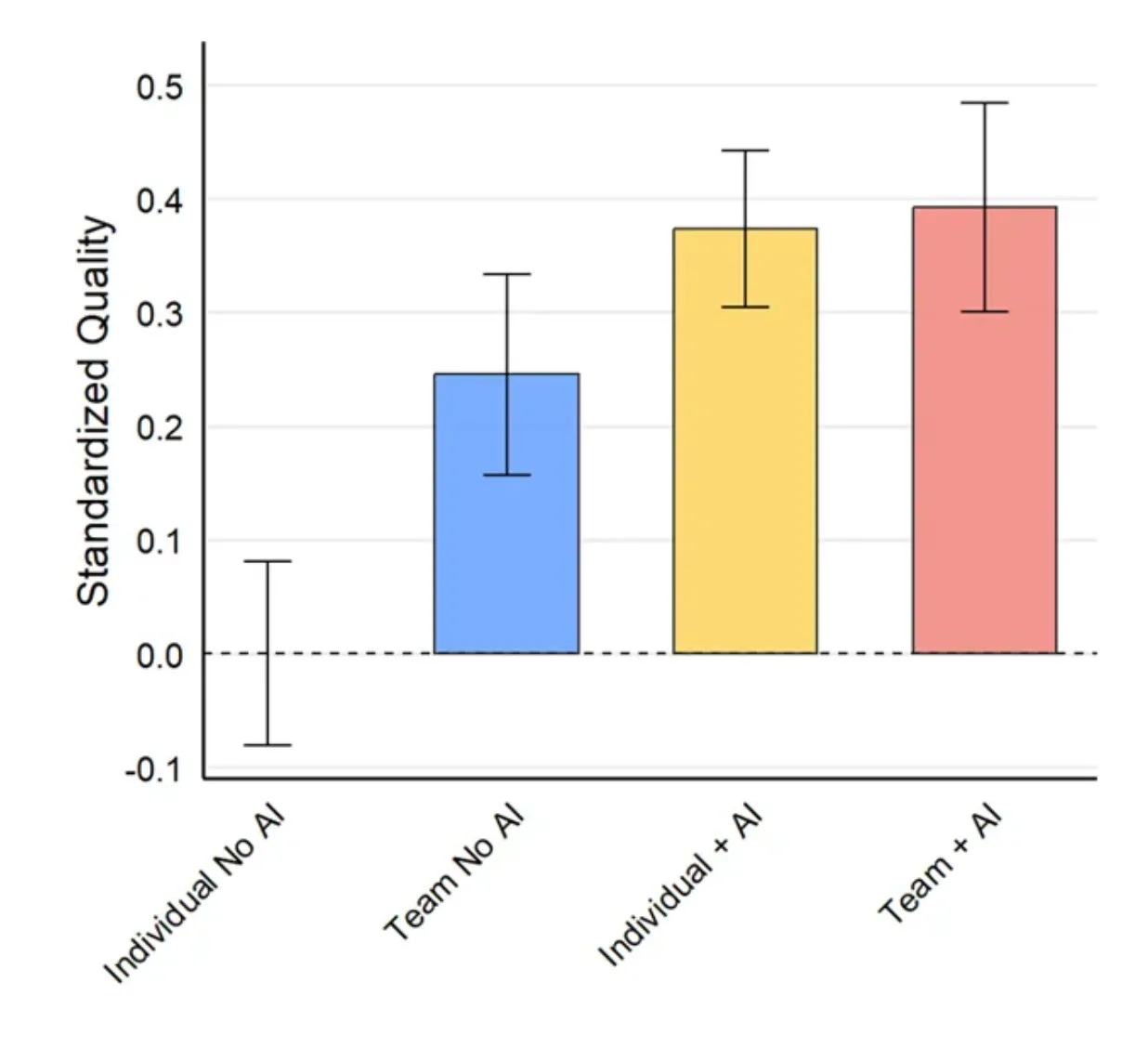
“When working without AI, teams outperformed individuals by a significant amount, 0.24 standard deviations (providing a sigh of relief for every teacher and manager who has pushed the value of teamwork). But the surprise came when we looked at AI-enabled participants. Individuals working with AI performed just as well as teams without AI, showing a 0.37 standard deviation improvement over the baseline. This suggests that AI effectively replicated the performance benefits of having a human teammate – one person with AI could match what previously required two-person collaboration.”
“We now have results. Our headline finding is that AI is very good at judging student writing and is a viable and time-saving alternative for many forms of school assessment. Here are the details… We have been running similar tasks since 2017 for students at primary and secondary, and have assessed nearly 3 million pieces of writing using human Comparative Judgement. The process typically delivers very high levels of inter-rater reliability, and is the gold standard of human judgement. The crucial difference with this assessment is that we did not just have human teachers making the judgements. We got an AI to make judgements, too… In total, our human judges made 3,640 decisions. Of these 3,640 decisions our AI agreed with 81% of them. On our most recent previous human-judged Year 7 assessment the human judges agreed with each other 87% of the time, which is fairly typical.”
““What, if at all, have you, your friends, and people your age used genAI for?” Over half of our 27 interviewees spontaneously named experimenting with AI characters specifically, unprompted. Interviewees were keenly aware that AI companions “were a thing”, with many naming either direct personal experimentation with sites like Character AI or by “hacking” ChatGPT to become a character, or knowing of at least one young person in their community who was engaging with AI companions on a regular basis.. A slim majority of our interviewees (19 of 27) thought AI friends were more acceptable than not, but nearly all of them had qualifications for whom, how, and under what conditions this acceptability might fall under.”
“Experts suggest limiting AI to help with brainstorming and checking for mistakes”
“Studies show that learners report higher satisfaction and stronger perceived learning when videos include visible instructors—whether human or synthetic (Garcia & Yousef, 2022; Sondermann & Merkt, 2022).”
“So these AI companies, out of sheer necessity, are essentially transforming into energy companies.”
“We observe that very high usage correlates with increased self-reported indicators of dependence. From our RCT, we find that the impact of voice-based interactions on emotional well-being to be highly nuanced, and influenced by factors such as the user’s initial emotional state and total usage duration”
“Interestingly, memes created entirely by AI performed better than both human-only and human-AI collaborative memes in all areas on average. However, when looking at the top-performing memes, human-created ones were better in humor, while human-AI collaborations stood out in creativity and shareability.”
“Reported use of AI increased in 2024. In the latest survey, 78 percent of respondents say their organizations use AI in at least one business function, up from 72 percent in early 2024 and 55 percent a year earlier.”
“But while the technology is advancing, a fundamental question remains: Should we build robots for our world, or adapt our spaces for simpler machines? The makers of these humanoid robots are pushing for the former. They argue the world is designed for human bodies, after all, with stairs, shelves at shoulder height, and important things located at eye level… They are fighting an uphill battle against the only successful robots so far, which are mostly non-humanoid robots in warehouses, where shelving systems are designed for wheeled picking robots or roped off areas that are only for robots.”
“Miles sounds incredibly real, and quickly adapted to the direction of our conversation and often adjusted its responses to agree with us.”
“It’s part of a growing market of A.I. products that promise users an experience that closely approximates the impossible: communicating and even "reuniting” with the deceased. Some of the representations — like those offered by HereAfter AI and StoryFile, which also frames its services as being of historical value — can be programmed with the person’s memories and voice to produce realistic holograms or chatbots with which family members or others can converse.”
“Since 1994, Karl Kerner has worked as a translator – between English, German and Norwegian – focusing on nonfiction scientific texts. This kind of translation, he said, required specialist knowledge and careful terminology. “I am now basically out of business,” said Kerner.”
“Based on insurance industry records, Waymo and Swiss Re estimate that human drivers in San Francisco and Phoenix would generate about 26 successful bodily injury claims over 25 million miles of driving. So even if both of the pending claims against Waymo succeed, two injuries represent a more than 90 percent reduction in successful injury claims relative to typical human drivers.”