Career and technical education, ethical innovation, and more
An excellent, if brief, week since the midweek update —
This week’s features both focus on the growing cultural narrative around career and technical education. See one feature about how a state is shifting requirements to allow different tracks in high school that will guide kids more toward college or CTE tracks. Interestingly, at the same time, see a feature on how a majority of Americans without a degree still see the value of a college degree.
Also this week, see the summary brief of major themes that emerged from SXSW in the Professional Development section. I’m boosting #4 here: “Digital Safety Is About Minds, Not Machines.” See the article below for more — and previous AI updates in the Educator’s Notebook.
These and more, including some interesting approaches to lesson planning, some new icebreakers, and a variety of notes on curriculum, enjoy!
Peter
Instructional design in the wild. See more in the article in Pedagogy.
“Alabama state law previously required students to take at least four years each of English, math, science and social studies to graduate from high school. The state is now calling that track the “Option A” diploma. The new “Option B” workforce diploma allows students to replace two math and two science classes with a sequence of three CTE courses of their choosing. The CTE courses do not have to be related to math or science, but they do have to be in the same career cluster.”
“While overall perceptions of the value of college degrees have dropped roughly 5% over the last year, the majority of the respondents, across all ages, races and political affiliations, said at least one degree — associate or bachelor’s — is valuable.”
“The founders believed that education was critical to the full experience of citizenship; it was where students learned arts, sciences, humanities and how to engage with one another. But putting that vision into place left the nation with a system where inequities — in content and classroom composition — were left in place. America began to undo those inequities, and the department protected that progress. Now, [in] less than three months… the administration has done everything in its power, and some things beyond its authority, to ensure we are equal no more.”
“All this helps to explain why the existence of “Homer”—the blind bard who, people thought for centuries, single-handedly composed both the Iliad and the Odyssey—is now questioned. Today, the name has become a convenient way of referring to all the obscure processes by means of which a loose collection of legends about the Trojan War and its aftermath were transformed, over time, into the two great epics we have today: masterpieces of astonishing structural complexity and coherence, great dramatic power, and profound insight into the human condition.”
“As AI, personalized algorithms, and immersive digital platforms accelerate, we’re not just facing threats from bad actors—we’re facing the reality that even well-intentioned innovation can manipulate choices, erode critical thinking, and alter societal norms in ways we don’t fully understand. The ethical risks of the digital era aren’t just about hacking systems—they’re about hacking human perception. The next frontier is about securing agency—making sure people remain in control of their choices, thoughts, and interactions in a hyper-digital world… There are many examples of amazing digital experiences, the answer to online risks is not to avoid going online or being shut away from the digital world. There is however the need to ensure digital experiences, particularly for children and teens, are safer, more oriented to the good of humanity, and designed to release the best of human potential. As innovation expands the reach of the impact of digital tools on humankind, the ethical innovation imperative rises.
“How do veterans approach planning? I reflected on past conversations. Some teachers scratch the daily topic in a blank book and just teach. Others write detailed plans year after year, filling shelves with binders. Everyone else falls between extremes. Each group started from precedent, but while some relied on internal memory, others externalized it. And if the best activities moved forward year after year, precedent meant patterns.”
“Since Caro graduated from Princeton in 1957, not a single further word of his fiction has been printed anywhere. But, as I researched Caro’s life and work, I discovered that this does not mean none was ever written. Occasionally I would stumble across fleeting mentions of a novel-in-progress.”
“High school teachers pay far more attention to their students as developing human beings than we do in the universities. One teacher after another has been able to supply me with details about a student’s personal problems and family background which have been most helpful. The counselors, principal, and vice principal, at least at Allderdice, seem to know every child in the school personally and to help them over innumerable hurdles. In coilege, we are more likely to let a student sink or swim unless he is in really serious trouble. Finally, high school instructors teach current events with great skill, while we tend to ignore them in the classroom.”
“Researchers analysed roughly 2,800 essay responses and identified 10 'supertopics'. The most common supertopic, appearing in nearly 60% of essays, was 'altruism', followed by 'intrinsic motivation'. Here's an overview of the results.”
AI Index Report 2025, how college students are using AI, and more
And the industry keeps moving…
Stanford’s Human-centered AI lab released the 2025 AI Index Report this week, and as usual, it is chock full of industry information. Find it in the features this week. Also in this week’s feature, the post in Astral Codex Ten offers a reflection on what it means that our technology increasingly makes plentiful what once was scarce. What does it mean when what was once sacred or rare is now mundane or common?
Also, in the Education section, see Anthropic’s report on how college students are using Claude.
These and more, enjoy!
Peter
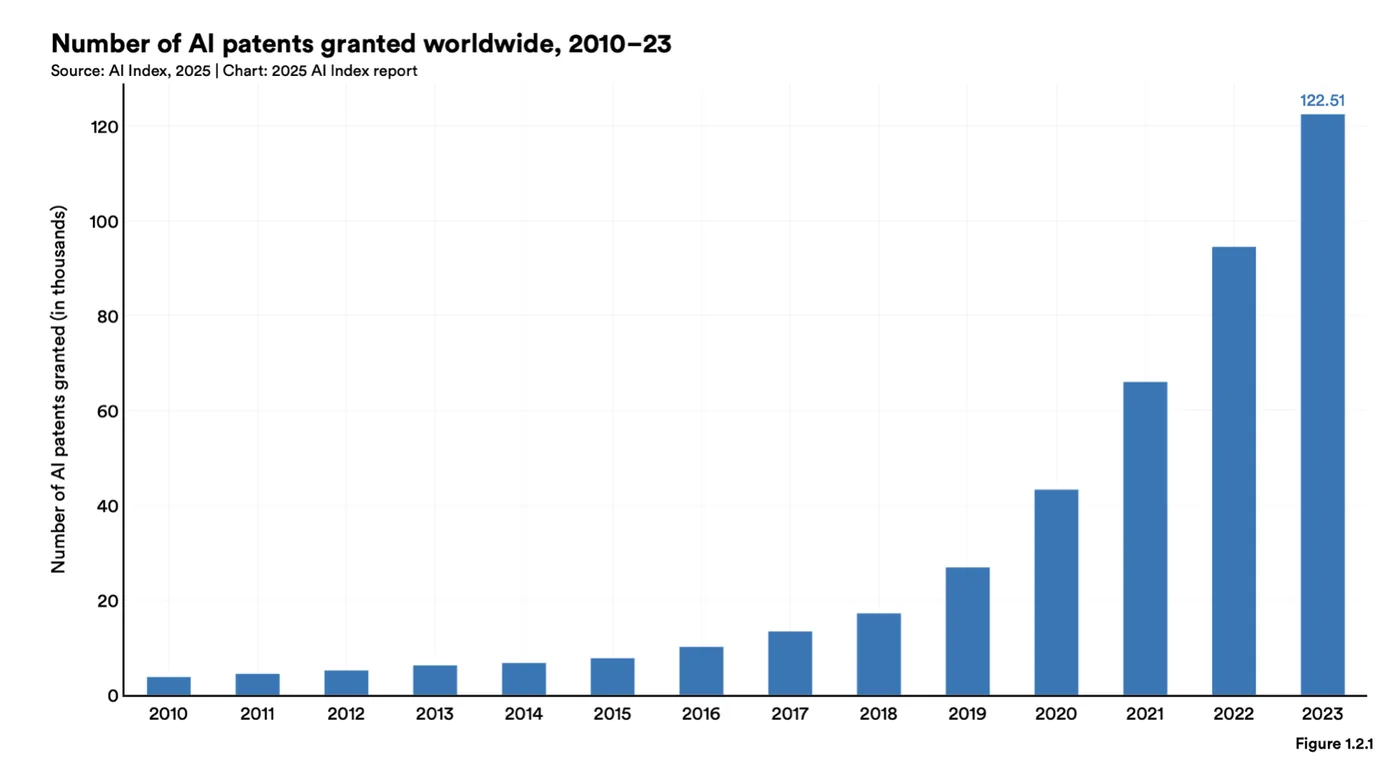
The number of new AI patents each year continues to grow. See the Stanford HAI AI Index Report for more.
“We have recontextualized the semantic apocalypse from a one-time problem with GPT-4 to a recurrent historical pattern of technology undermining the uniqueness of art. But maybe we should zoom out further. This isn’t just about art. Technology breeds hedonic adaptation, and hedonic adaptation undermines everything.”
“In 2024, the proportion of survey respondents reporting AI use by their organizations jumped to 78% from 55% in 2023. Similarly, the number of respondents who reported using generative AI in at least one business function more than doubled—from 33% in 2023 to 71% last year.”
“What are students using AI for? We found that students primarily use Claude to create and improve educational content across disciplines (39.3% of conversations). This often entailed designing practice questions, editing essays, or summarizing academic material. Students also frequently used Claude to provide technical explanations or solutions for academic assignments (33.5%)—working with AI to debug and fix errors in coding assignments, implement programming algorithms and data structures, and explain or solve mathematical problems. Some of this usage might also be cheating, which we discuss below. A smaller but still sizable portion of student usage was to analyze and visualize data (11.0%), support research design and tool development (6.5%), create technical diagrams (3.2%), and translate or proofread content between languages (2.4%).”