Learning science and pedagogy, music and emotions, legal interpretation of DEI law, and more
A good week.
The features this week start with a post that collects research on the emerging consensus around cognitive load theory. A key principle behind effective learning design, cognitive load theory offers insight into the mechanics of other pedagogical principles such as Vygotsky’s Zone of Proximal Development. And it’s not all theory — see the post for what this means in practice, such as why reading slides is unhelpful and what to do instead. Also in the features, see the Boston Globe op-ed by visiting Harvard Law Professor Michael Rebell interpreting case law around DEI policies in schools. It is a helpful and clarifying read.
On this Easter weekend, the NYT and WaPo have both run articles on religion in America. See several of these in the humanities section. These may be of particular interest to schools that include in their mission statements the spiritual development of their students.
This past week, I was part of a visiting committee to review a department at my high school. Also part of the committee were professors from Columbia and Harvard. They both described the impact of the current political moment on their universities. Research is abruptly ending, professorships are losing their funding, and graduate students are losing funding, too — not to mention the culture of fear among international students. Hearing these first hand stories made even more real the multi-pronged assault on education we are currently living through — and the importance of continuing to advocate for educational opportunities for all people at all grade levels. Learn more about courage in the face of conflict in the Character section, especially Stanley McChrystal’s op-ed about the importance of governance — personal and professional — in times of leadership failure.
If after that you’re in search of a feel-good piece, check out the post near the end about a town that came out to help a bookstore move. Picture below.
Also, this week, see an excellent report on the emotional-regulation effects of music, on different ways to think about the purpose of grades, and more.
These and more, enjoy!
Peter
Midwest town comes out to form human chain to help move 9,100 books to new bookstore location. See more in the General section near the end.
“While visual redundancy (image + text) supported learning, verbal redundancy (spoken + written text) actually increased cognitive load and hurt performance. The best outcomes came when visual support was used without overloading the same modality.”
“The Education Department claims the Supreme Court has held that promoting diversity is not a “compelling interest” that justifies state or school district actions. This is not true… On the contrary, the current state of the law regarding racial balance and diversity in K-12 education is that policies to promote diversity in school populations are a “compelling state interest” that justifies proactive governmental policies. That is what a 5-4 majority of justices held in the 2007 case of Parents Involved v. Seattle School District.”
“If the mainstream media isn’t bashing video games, they’re ignoring them entirely. In doing so they’ve missed one of the most powerful forces shaping the moral imagination of today’s youth. Young men, who are indeed in crisis, are left to absorb these narratives alone, unexamined and invalidated. Which is especially foolish since, far from being a loop of violence and misogyny, the games are vehicles for intimate moral dramas that have the potential to positively impact young men.”
““An emerging body of research allows us to take what had been anecdotes and place music on an equal footing with prescription drugs, surgeries, medical procedures, psychotherapy, and various forms of treatment that are mainstream and evidence-based,” writes Levitin, recently summing up the current science of music for Wired."
““The Bell Curve,” which argues that Black men and women are genetically less intelligent than white people, is still there. But a critique of the book was pulled… Two copies of “Mein Kampf” by Adolf Hitler are still on the shelves. Gone is “Memorializing the Holocaust,” Janet Jacobs’s 2010 examination of how female victims of the Holocaust have been portrayed and remembered.”
“Regardless of what you believe — or don’t believe — this is an author hoping to convince you of nothing but the “outburst of hope” conveyed by the multitudinous voices of Jesus’ early followers — voices that have too often been unfairly, ignorantly and sometimes violently misrepresented.”
“We group these findings into five key clusters of harms: 1. Addictive, Compulsive, and Problematic Use. 2. Drugs and Guns. 3. Child Sexual Abuse Material (CSAM), Sextortion, and In-person Sexual Predation and Assault. 4. Cyberbullying. 5. Knowledge of Harm and Underage Use, and Lack of Action. Similar to TikTok, we show that company insiders were aware of multiple widespread and serious harms, and in many cases did not act promptly or make substantial changes.”
“For a sample 19,032 U.S. respondents, we test whether citizens’ partisanship corresponds with their opinions on seven educational purposes. We observe that the public opinion represents a multifunctional view on education and that some but rather small differences relate to partisanship.”
“Volunteers formed two lines across from one another, leading all the way to the new store, about 350 feet away. They passed each individual book down the line until it reached the final person, who placed it on a shelf in its new home. Relocating all 9,100 books took just under two hours.”
This week’s features include further research into AI as a tool for supporting human social and emotional health. It’s a wide open field that is progressing rapidly. See how one effort is unfolding at Dartmouth.
Also in the features, Mike Caulfield shows how you can use AI as a fact checking tool. It’s a complicated sequence, but a remarkable research method. It still requires human judgment, but it’s a step in the direction of using AI as a positive research tool and to combat misinformation.
Also this week, see how one head of school is experimenting with AI in classroom observations and discussions with teachers. Find also a piece on how ChatGPT’s new image generator can help with basic visual aids for teachers.
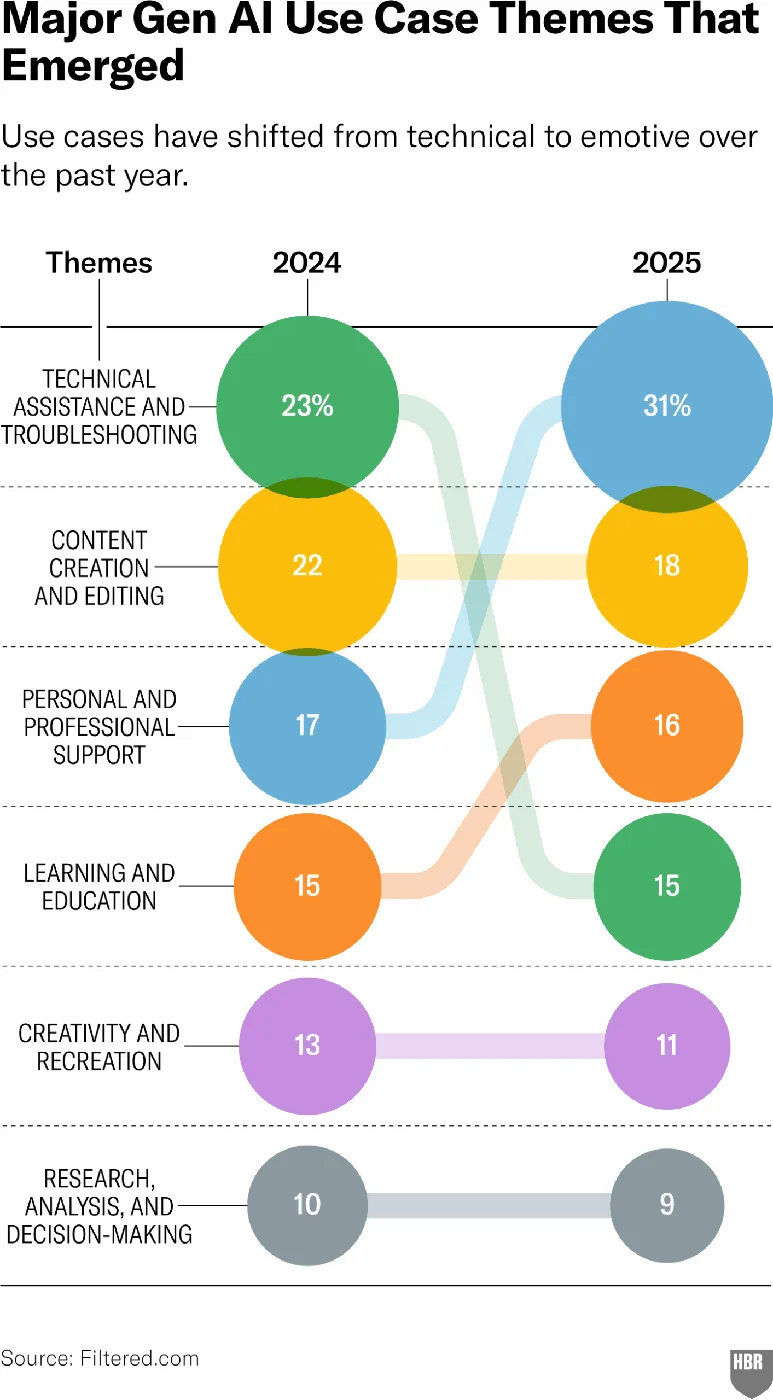
Last, according to one informal (but large-ish) study described in Harvard Business Review, companionship is now the top use of generative AI for some groups.
These and (only a few) more, enjoy!
Peter
What a coding of online discussions about generative AI use revealed. See the Tech/AI: Social post below.
““Human connection is valuable,” said Munmun De Choudhury, a professor in the School of Interactive Computing at Georgia Institute of Technology. “But when people don’t have that, if they’re able to form parasocial connections with a machine, it can be better than not having any connection at all.””
“I mention this because it relates to the tools I build for fact-checking. For almost a decade I have believed in supporting what I call the antibodies of discourse — those rare individuals who are willing to call out lies, provide fuller context, and work to keep the discourse environment free and clear of fake or misrepresented evidence. Some of those people are professionals — reporters, fact-checkers, honest advocates at community-focused non-profits… You all know Brandolini's law, right, the fundamental issue that makes misinformation such problem? It’s usually phrased like this: The amount of energy needed to refute bullshit is an order of magnitude bigger than that needed to produce it. My proposal is simple: if that’s the case, then let’s reduce the amount of energy required to refute bullshit. And my assertion is that we have in AI a tool to do just that.”
“9:30 AM—Experimentation with Essay Feedback: Explored grading and feedback automation with GPT 4.5. Initially, I blind-read student essays, assigning brief notes and preliminary grades. The rubric itself had previously been generated in collaboration with GPT 4.5, based on the original assignment criteria. Next, I uploaded the student essays, prompting GPT 4.5 to generate class-wide feedback—remarkably, its analysis aligned closely with my own.”
“Even though the teacher only saw small benefits of AI for his practice at the time, he has already taken an AI mini-course for higher ed math teachers, and he is using AI to help him plan some lessons that we will be using as a guest teacher in colleagues’ classes.”
“Therapy and Companionship is now the #1 use case. This use case refers to two distinct but related use cases. Therapy involves structured support and guidance to process psychological challenges, while companionship encompasses ongoing social and emotional connection, sometimes with a romantic dimension. I grouped these together last year and this year because both fulfill a fundamental human need for emotional connection and support.”