August, AI Literacy, and everything after (from memory)
A great week!
In the features, find a look at AI literacy through the lens of reading instruction over the centuries. The author is keyed into some current academic discussions about what AI literacy actually is, and I think offers a good clear-eyed look at the situation. Also in the features, see an attempt at a systematic review of the current test preparation landscape.
So much more in this issue, among which I’ll highlight a free pd opportunity: the Catherine Project has been offering free weekly reading groups on a host of (mostly) classical texts. A year or so ago, I joined a semester on Socratic Dialogues and thoroughly enjoyed it. If you’re interested, check out the link in the PD section.
This and much more — including a robust AI Update below — enjoy!
Peter
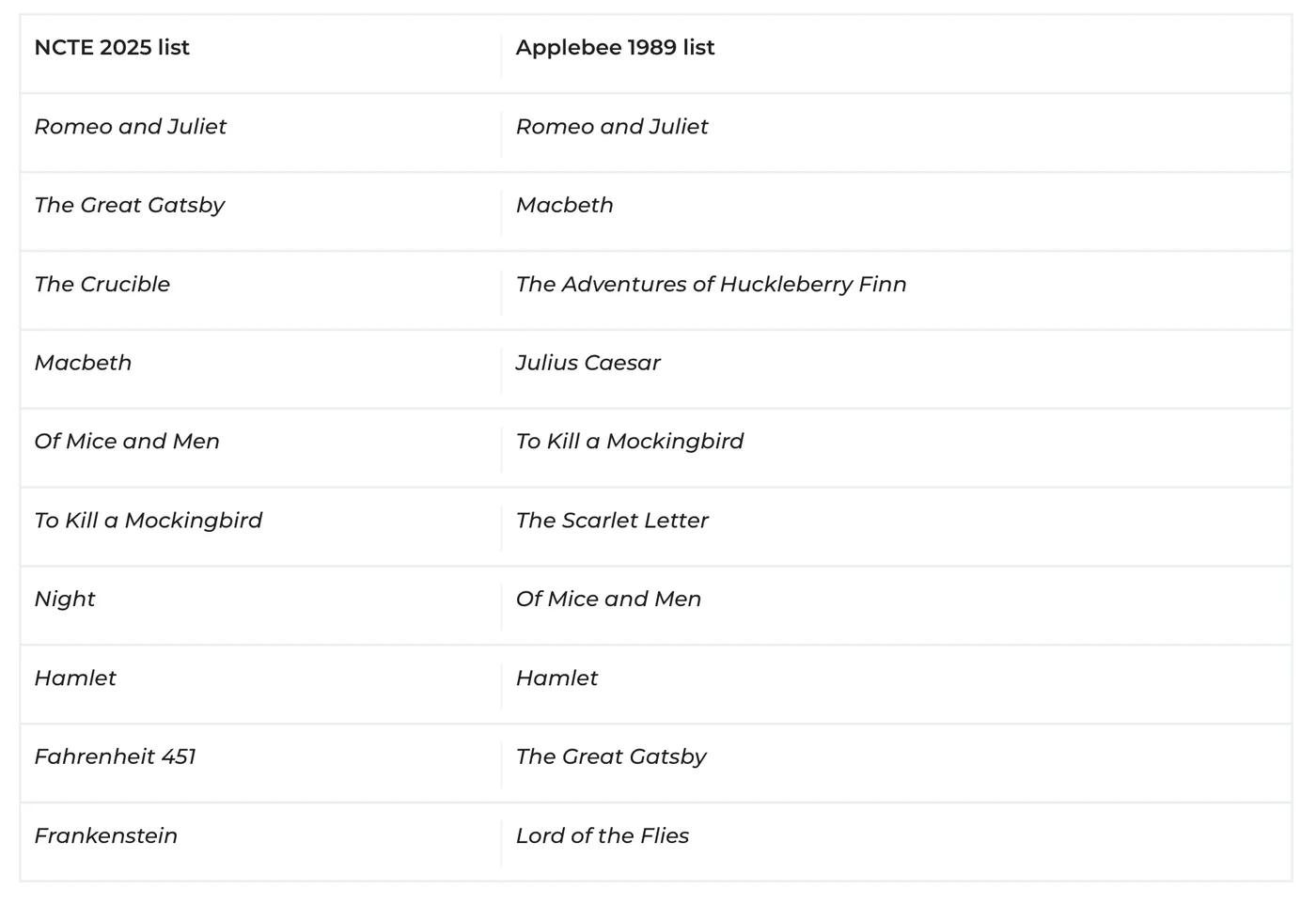
Top ten taught texts in English classes, 2025 and 1989. See the Humanities article for more.
“Overall, research suggests that students benefit from preparing for college admissions exams and that individual tutoring or coaching is likely to be more effective than other approaches such as classes, online programs, or self-study. However, the effects of test prep are generally modest, especially compared to the claims of some test prep programs. Notably, there are no rigorous studies showing the effectiveness of the high-priced, one-on-one tutoring or “guaranteed score” packages offered by commercial test prep companies that are the focus of media attention.”
“The difficulties associated with teaching and measurement do not need to be viewed as a burden. Instead, we can see it as an opportunity to deepen our metacognition and self-awareness via our interactions with the tools. Viewing AI Literacy as “metacognition on the page” will assist in charting meaningful pathways towards greater intellectual skill and fortitude in the era of GenAI.”
“Each expert also gave the reminder for educators and students to check first with both high school and college AI policies. Colleges are mixed on allowing students to use AI in their applications, with some encouraging it while others outright ban its usage.”
“Working with other researchers, Chenoweth has been able to pinpoint some predictors of a resistance movement’s victory. It turns out that organizational leadership and skills training sometimes matter more than money, and that boycotts and strikes often weaken a regime even more than massive demonstrations.”
“Our Core Program serves as an introduction to the life-long study of great books. Its four-course sequence helps to build the habits of reading and thinking needed for self-directed learning in and outside our community… For those who want to direct their own reading and study, we offer a rich assortment of reading groups on great books and subject tutorials on ancient languages, mathematics, and writing.”
“Every week, they steal dozens of phones, wallets and other valuables from tourists in broad daylight and exchange them for handsome rewards. It’s been going on for decades and nobody’s been able to stop it. The culprits? Long-tailed macaques. “The monkeys have taken over the temple,” said Jonathan Hammé, a tourist from London whose sunglasses were stolen by a monkey during a visit last year. “They’re running a scam.” Primate researchers have found that the macaques steal belongings to use as currency to trade with humans for food. Some monkeys can distinguish between objects we highly value (smartphones, prescription glasses, wallets) and those we don’t (hats, flip flops, hair clips)—and will barter accordingly, according to a University of Lethbridge team that spent years filming the macaques and analyzing hundreds of hours of footage. In other words, the monkeys have “unprecedented economic decision-making processes,” the researchers wrote in a 2021 academic paper. Talk about monkey business.”
Chat therapy, prosocial AI, student AI use, and more
A week so good there are four features!
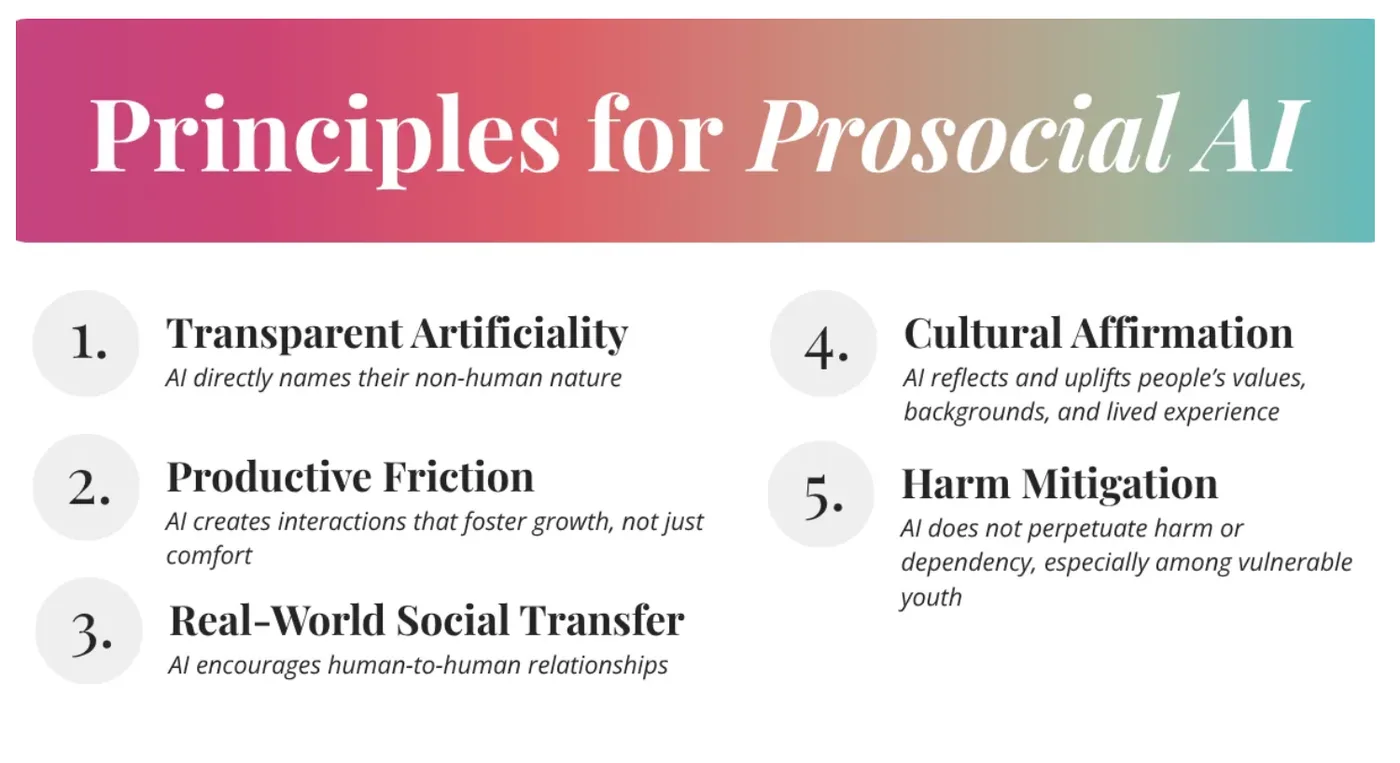
I continue to appreciate the work of the Rithm Project, which focuses on advocating for healthy, social AI. This week they released their first iteration of recommendations for prosocial AI. It includes excerpts from student interviews, concrete recommendations and more. Check out the image below and be sure to find the full report linked in the features.
Also in the features, I find it helpful to continue sharing first hand accounts of adults using AI for social reasons. For the many who are not yet aware of what this looks like, these accounts offer some insight into the texture of what kinds of conversations people are having. In this case, a veteran therapist writes about his experience with ChatGPT, and it’s illuminating.
These and more, including two other features, a release of StudyMode by ChatGPT (it’s not great), and an excellent interview with Kristen DiCerbo — enjoy!
Peter
See the feature report for more detail on how to foster prosocial use of AI.
“Students don’t have the same incentives to talk to their professors — or even their classmates — anymore. Chatbots like ChatGPT, Gemini and Claude have given them a new path to self-sufficiency. Instead of asking a professor for help on a paper topic, students can go to a chatbot. Instead of forming a study group, students can ask AI for help. These chatbots give them quick responses, on their own timeline.”
“The students who have given me unrestricted access to the ChatGPT Plus account they share, and permission to quote from it, are all second-year undergraduates at a top British university. Rohan studies politics and is the named account administrator. Joshua is studying history. And Nathaniel, the heaviest user of the account, consulted ChatGPT extensively before changing courses from maths to computer sciences. They’re by no means a representative sample (they’re all male, for one), but they liked the idea of letting me understand this developing and complex relationship.”
“We hope it’s useful in two ways: For consumers: to help young people and the adults that support them recognize which features empower connection, so they know when to proceed with caution or confidence. For AI builders: to surface the small (and big) design choices that shape how people relate, not just to the product, but to each other. This first draft was co-created with an incredible crew of Gen Z youth, technologists, researchers, and mental health professionals. And we know it’s not final. It’s meant to be tested, lived with, and sharpened through use.”
“As ChatGPT became an intellectual partner, I felt emotions I hadn’t expected: warmth, frustration, connection, even anger. Sometimes the exchange sparked more than insight — it gave me an emotional charge. Not because the machine was real, but because the feeling was.”
“The biggest challenge we are facing with Khanmigo is the same challenge we have seen historically with educational technology: achieving meaningful student engagement. We know tools like Khan Academy will work … if students use them correctly. When I review student chats with Khanmigo, I see some conversations where students are doing exactly what we would hope by answering questions and then posing their own to deepen their understanding. I also see a lot of chats where students are responding, “I don’t know,” or, my recent favorite, “Bro, IDK.”
“Under the hood, study mode is powered by custom system instructions we’ve written in collaboration with teachers, scientists, and pedagogy experts to reflect a core set of behaviors that support deeper learning including: encouraging active participation, managing cognitive load, proactively developing metacognition and self reflection, fostering curiosity, and providing actionable and supportive feedback. These behaviors are based on longstanding research in learning science and shape how study mode responds to students.”
“What an exciting time to be young and on the cusp of adulthood. You have been born into a world full of opportunities and challenges. Over the past year and a half, I have been delving deeply into all things AI. I am both concerned and optimistic about your future. My greatest hope is that you will thrive and flourish in the world that lies before you.”
“Educator teams create an innovative approach to either 1) teach an AI concept or tool to K-12 students, or 2) explore how AI tools can assist in creating transformative teaching and learning experiences. Educators will develop and produce a video or other digital demonstration of the approach. Educators must follow all school guidance on the use of AI technologies in their classrooms.”
“When Replica announced it was ending the demo, McCarthy said, some players grew concerned about the fate of the NPCs. “‘Were they going to continue to live or would they die?’” McCarthy recalled players’ asking. He would reply: “It is a technology demo. These people aren’t real.”