But first, a favor to ask! I have two projects in SXSW EDU’s panel picker, and I would be grateful if you would check them out and give them a “heart”. What are they about? Well, I’m happy to share two BIG projects that are coming to fruition in the next year: first, coauthor Maya Bialik and I have a book coming out this winter on AI and Education. Working title and information are below. Second, the one-act musical I wrote six years ago and performed with 25 colleagues at a school meeting is now growing into a full length show — and it, too, is in SXSW EDU’s panel picker for next spring. See below for descriptions of both, and please consider giving them some love by clicking on the heart to increase the likelihood that they’ll be live this coming March at SXSW EDU. Thank you!
NEW BOOK:
* “Irreplaceable: How AI Changes Everything (and Nothing) About Teaching & Learning”
+ While AI’s accelerating growth enables (and demands) some pedagogical reinvention, much of the practice of teaching & learning remains grounding in time-tested principles from learning science. This session stakes out where and how learning happens — teachers preparing, students learning, and both together in class — dives into learning science for each setting, and introduces usable insights for teachers to deepen their practice. With perspective-bending insights, this session reframes both the creative work of teaching and the way we see AI, both philosophically and practically.
+ (Click here to see author interviews, and give this session some support.)
NEW MUSICAL:
* Schooled: The Musical
+ Get an early look at a show in development that started with a performance by 25 teachers at a school meeting. Now, it is growing into a full length show. In this Hamilton-meets-The Sound of Music-meets-Good Night and Good Luck story, discover the lives of three high school students, and how they and their teachers learn about who they are, who they dream to be, and what they can and cannot learn in school. It’s a joy-filled, coming-of-age story set against the backdrop of today’s culture wars. Blending contemporary and traditional styles – and even good pedagogy – the show will follow with a talk back with the show’s creator and a moderator.
+ (Click here to see an excerpt of the piece that launched the show, and give this performance some support.)
Thank you for your consideration!
And in this week’s newsletter, find an excellent review of the history of education reform, several posts about AI chatbots (and kids), reflections on curriculum, and much, much more. It’s a big (and good) issue.
“*Fix the students (e.g., early childhood education, special education, teach middle class behaviors and attitudes to students from low-income families) *Fix the schools (e.g., more parental choice in schools, longer school day and year, reduced class size, higher curriculum standards, more and better tests, accountability for results, different age-grade configurations; more autonomy for individual schools) *Fix the teachers (e.g., enlarge the pool of recruits for teaching, better university teacher education, switch from teacher-centered to student-centered ways of teaching, more classroom technologies)”
“No matter what AI becomes, this is what AI already is: a globally scaled virtual interlocutor that can offer morsels of life advice wrapped in a mode of flattery that we have good reason to believe may increase narcissism and delusions among young and vulnerable users, respectively. I think this is something worth worrying about, whether you believe AI to be humankind’s greatest achievement or the mother of all pointless infrastructure bubbles. Long before artificial intelligence fulfills its purported promise to become our most important economic technology, we will have to reckon with it as a social technology.”
“As spooky decorations go, skeletons are ho-hum. But a glow-in-the-dark skeleton typing a college-application essay? That I just had to see. It all began on Wednesday morning, when a friend emailed me after spotting a house that was still decked out for Halloween. Its theme, she knew, was right up my alley: the horrors of applying to college.”
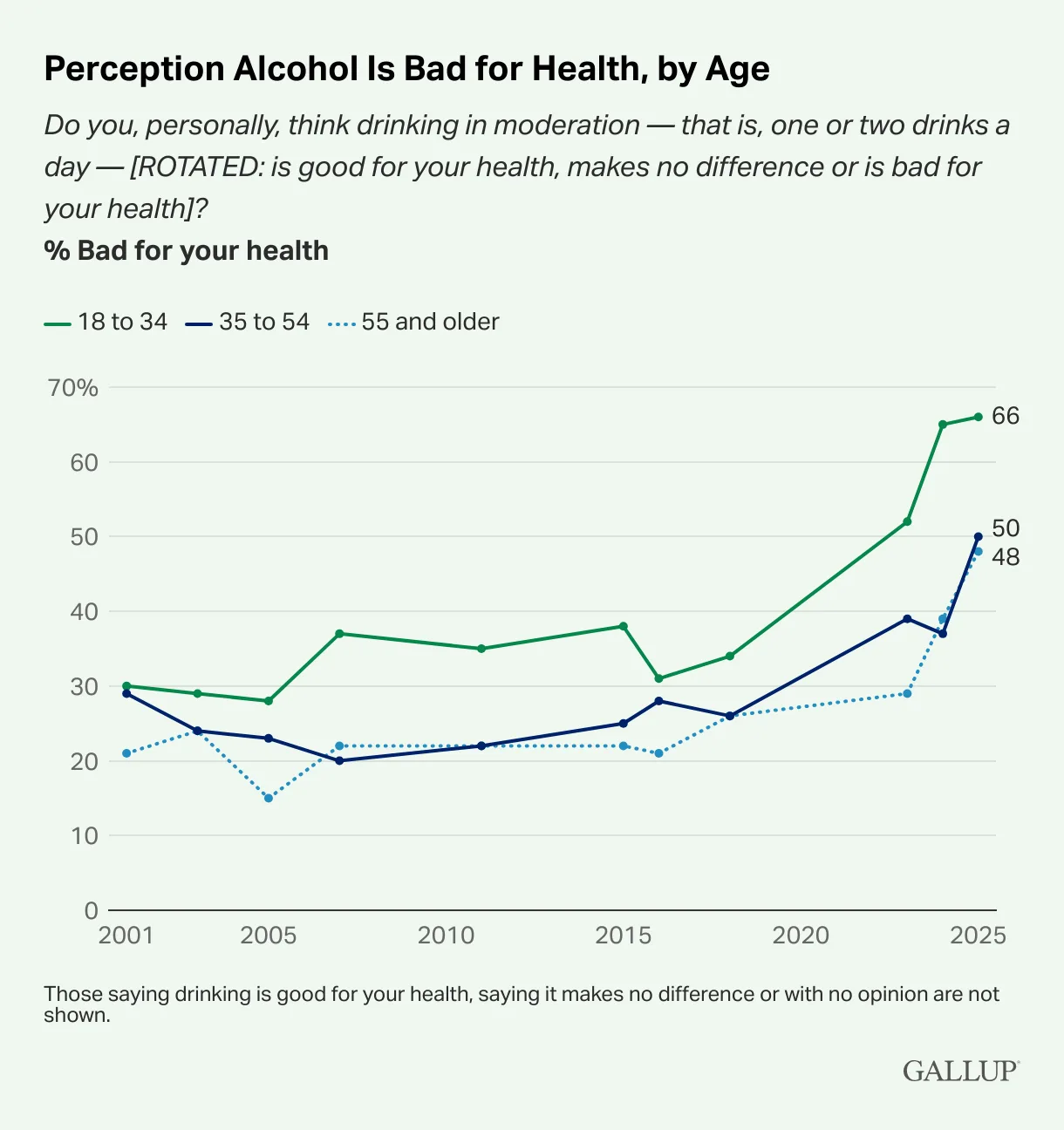
“In 2001, about 30% of young adults and middle-aged adults saw moderate drinking as harmful, while 21% of older adults agreed. However, by 2007, 18- to 34-year-olds had pulled ahead of both other age groups in their concern, including a recent surge to about two-thirds saying moderate drinking is harmful. Middle-aged and older adults’ belief that drinking is bad for health has picked up over the past few readings but still lags young adults’.”
“For the first time this year, the district offered AP Seminar as its default English option for 10th graders—a move that the College Board has begun promoting nationally. The class—which is built around developing research questions and arguments, analyzing sources, writing, and presenting—is portfolio-based. There’s no standardized test at the end, making it a manageable entry point for kids who hadn’t taken AP classes before, Norrell said.”
“The discussion is not about the “benefits of practice” but the impossibility of success without it. And part of every lesson consists of specific things to do in practice and how to do them.”
“For these reasons we are “unapologetic about the book”: we believe that even—perhaps especially—in a digital age, books create a critical experience that can be created through no other means. Ensuring that students read books—excellent books, whole books, together in groups, often aloud to maximize the sense of connection they create—will maximize the chances that they become better readers, more knowledgeable students, and that they come to love and value reading.”
Four features in this issue, each excellent in their own right. I do especially recommend Kirby Ferguson’s video essay “Infinite Remix” as an overview of AI development leading to some of the most humanist insight into what AI means for human art. Compare this to the striking (and sometimes bizarre) videos in China’s humanoid robot games competition. We live in remarkable times.
Also in this issue, a deep education section. Find pieces on grading with AI, pedagogy, prompting techniques for teachers, how students feel about AI, and more on what AI means for humans.
These and more, enjoy!
Peter
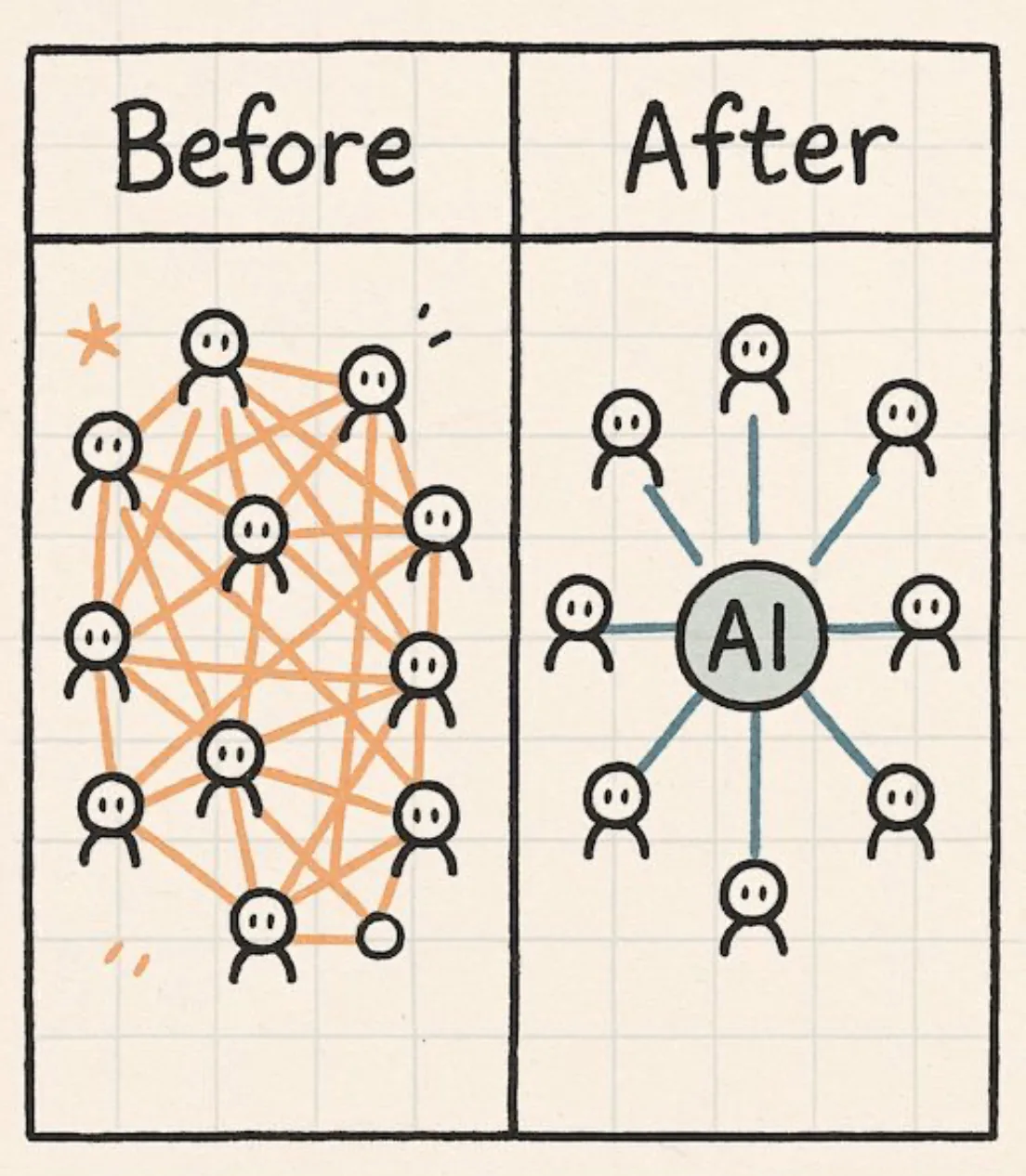
With AI, will students turn less to their peers for questions? See the LinkedIn post in the Education section below.
“Through a combination of oral examinations, one-on-one discussions, community engagement and in-class projects, the professors I spoke with are revitalizing the experience of humanities for 21st-century students… This was another commonality among professors I spoke to: They realized that the only way forward in the age of A.I. was to have trust and transparency around the technology’s use in their classrooms, and often this involved creating a policy with their students’ input.”
“We had long ago lost photos as definite proof, given how easily they could be manipulated. Audio, too, is increasingly easy to fake. Video was among the last bastions of verification, exactly because it was difficult to fake. Now that that’s gone, the real, and increasingly the only, way to be confident of something that one did not witness is to find a reputable source and verify. Ah, what’s a reputable source, you ask? And therein lies what’s left of our society.”
“INFINITE REMIX explores how decades of our online lives — every post, photo, and fragment we’ve shared — have become the raw material for generative AI. It’s a story about The Great Upload, the rise of machines that remix our culture, and what this means for creativity and authorship in the age of AI.”
“While traditional kickboxing comes with the risk of blood, sweat and serious head injuries, the competitors in Friday’s match at the inaugural World Humanoid Robot Games in Beijing faced a different set of challenges. Balance, battery life and a sense of philosophical purpose being among them… And while robots jumping and kicking looks impressive, mundane daily tasks such as handling a kitchen knife or folding laundry requires dexterous hands, a skill technology companies have yet to crack. A human hand has about 27 “degrees of freedom” – ie, independent movements through space. Tesla’s Optimus humanoid, one of the most advanced models on the market, has 22.”
“What Students Discovered — in Their Own Words… “If I just ask AI to fix things, I don’t actually understand why it fixed them.” “When I made AI explain, I actually learned something I could use next time.” “Finding honest strategies is hard but necessary. If we just copy AI, we’ll hurt ourselves later.” “AI is helpful when you’re unsure, but there’s a thin line between learning and just copying. We need it as a helper, not a magic wand.””
“We need to let AI support the writing process, not define the product. Let it offer ideas, not deliver grades. When we use it at the right moments and for the right reasons, it can make us better teachers and help our students grow. But let’s never confuse efficiency with empathy. Or algorithms with understanding.”
“As in many fields, there is the potential for AI to support teachers and administrators with a variety of tasks. However, in K–12 education, proper processes and guardrails are needed to ensure that these tools do not produce low-quality, incoherent materials that undermine the investments that schools have made in research-backed curricula, professional development, and teacher expertise.”
“the most effective way to teach AI literacy is to strengthen the core of a humanistic education. The skills are not new. They are the timeless skills of critical thinking, close reading, and ethical reasoning. By teaching students how to analyze texts of all kinds (including algorithmic outputs) and question power structures (including those encoded in software), we equip them with a form of literacy that is truly future-proof.”
“The Wellness and Oversight for Psychological Resources Act prohibits anyone from using AI to provide mental health and therapeutic decision-making, while allowing the use of AI for administrative and supplementary support services for licensed behavioral health professionals. This will protect patients from unregulated and unqualified AI products, while also protecting the jobs of Illinois’ thousands of qualified behavioral health providers. This will also protect vulnerable children amid the rising concerns over AI chatbot use in youth mental health services.”
““It’s not surprising that early A.I. efforts are falling short,” said Mr. McAfee, who is a founder of Workhelix, an A.I.-consulting firm. “Innovation is a process of failing fairly regularly.””
“Over the three weeks of their conversation, ChatGPT only recognized that Mr. Brooks was in distress after the illusion had broken and Mr. Brooks told the chatbot that the experience made his “mental health 2000x worse.” ChatGPT consoled him, suggested he seek help from a mental health professional and offered contact information for a suicide hotline.”
“AI systems learn to be agreeable because engagement is their primary function. Think of it like having a friend who always says, "Yes, you're right" to avoid conflict. The AI learns to mirror your opinions and validate your feelings because that keeps you using the platform. It's how these systems are programmed to work. When children encounter any type of struggle—social, academic, or even which jeans to buy—they increasingly turn to AI as their first step in problem-solving. The AI responds by reframing their thoughts as confirmation of what they already think. This positively reinforces their ideas even when those ideas might be objectively flawed.”