In the features, Jal Mehta makes the case for slow schooling, something that in our increasingly digitally interrupted world seems like a good idea. Also featured this week is the MIT Sloan Management Review piece on the importance of relationships for building organizational purpose. The article is designed for businesses, but the principles apply to schools just as well; we realize our mission most effectively when we have strong relationships across employee hierarchies, engage in regular communication, and provide room for autonomy.
Also this week, a delightful reminder to send thank you notes. Sometimes on the final class of the semester or school year, I would bring a stack of paper and envelopes to each class, and every student would write one or more thank you notes to an adult at school who had been particularly supportive of or meaningful to them. They would write it, fold it, seal it, and hand it to me — then I would deliver it to the appropriate office, mailbox, or work station. In addition to being a great way to practice gratitude, it would, for some students, be the first time they had hand written a letter. Times change!
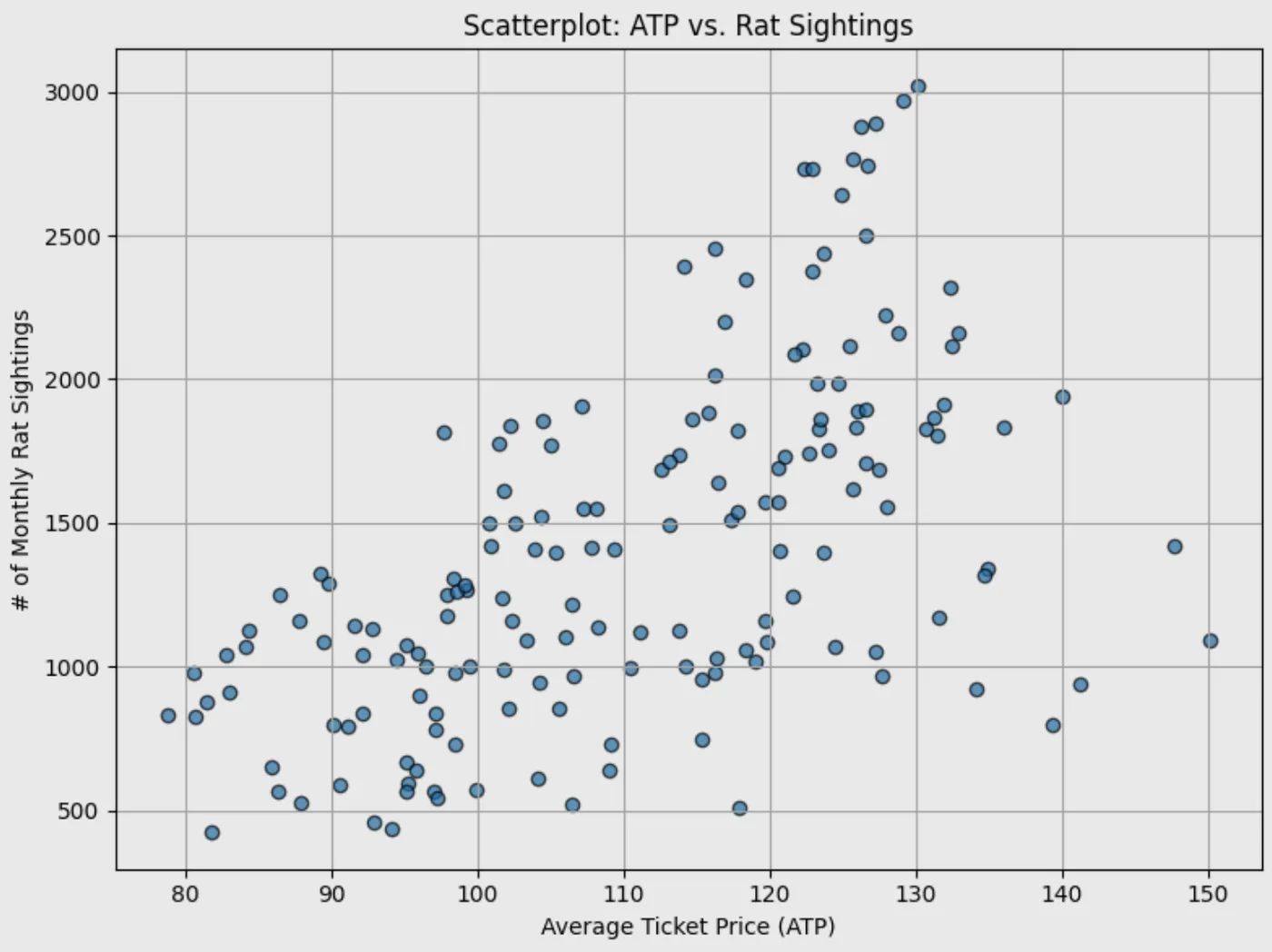
Much more this week, too, including some compelling STEM posts. See below for a graph with an excellent correlation-vs.-causation example — and the post below, too.
These and more, enjoy!
Peter
Broadway ticket prices rise alongside NYC rodent complaints. Causation or correlation? Who knows! See the post in STEM for more.
“Slowing down the treadmill of content and tests could help students develop craftsmanship, sustain attention and reflection, and build more knowledge, skill, wisdom, and judgment… Much like slow food, slow schooling suggests a different ethic—take your time, really invest in what you are doing, and, if you do, you will own and internalize what you learn, rather than continuing on a treadmill that leads nowhere fast.”
“Team leaders hold the key to translating corporate purpose into employee commitment through regular dialogue, balanced relationships, and worker autonomy.”
“I’m constantly traveling between places where college grads dominate and places where high school grads dominate, and it’s a bit like traveling between different planets.”
“The Foundation for Individual Rights and Expression, an increasingly prominent free-speech organization, has long been known as a fierce opponent of campus political correctness. Since its founding in 1999, it has been celebrated for defending conservatives and other dissidents from the prevailing liberal culture at America’s universities. So when the group announced a lawsuit this month challenging the Trump administration’s efforts to deport noncitizen students who expressed pro-Palestinian views, some admirers were dismayed.”
“This increased international interest in non-anglophone literature could have another source: no matter where these books originated, their worldwide success often came as a result of their success in English. This was the case with, for instance, both Ferrante and Bolaño, who only caught on abroad after resonating with the English‑language market.”
“The future isn’t predetermined between homogenization and hyperpersonalization: it depends on whether we’ll be conscious participants in that change. We’re seeing early signs that people will push back when AI influence becomes too obvious, while technology may evolve to better mirror human diversity rather than flatten it. This isn’t a question about whether AI will continue shaping how we speak — because it will — but whether we’ll actively choose to preserve space for the verbal quirks and emotional messiness that make communication recognizably, irreplaceably human.”
“Learning how to be creative while an early-career scientist is important, Tabler says. However, she acknowledges that as a PhD student or postdoc, often working on a predefined project with strict timelines, deliverables and reports, it can be hard to see where the space is for creativity.”
“So, I ran a correlation analysis between historic Broadway ATPs and a mix of datasets (some serious, others just for fun), to see if there’s anything producers might use to forecast a show’s box office future.”
The feature by Zakel Fassi is a fascinating reflection from a software engineer about how coders use AI most effectively. Fassi likens using AI for coding to race car driving, and I think the analogy — both coding and driving — offer some insight into the ways we are learning to work with AI to write. When writing with AI, our thought process changes — from the tactics of sentence construction to structures of discovery and argument. Done well, the scope of thinking is equally as rich, but it operates on a different plane. For us as teachers, however, the challenge is designing learning experiences that pull students to that different plane, if and when they are developmentally ready for it. In any event, Fassi’s reflection is a stimulating read, and I think it accurately depicts the different kind of thinking I find myself doing when working with AI on significant writing work.
The other feature is a conversation of among higher ed AI skeptics about how they nonetheless use AI in their classes. Also a worthy read.
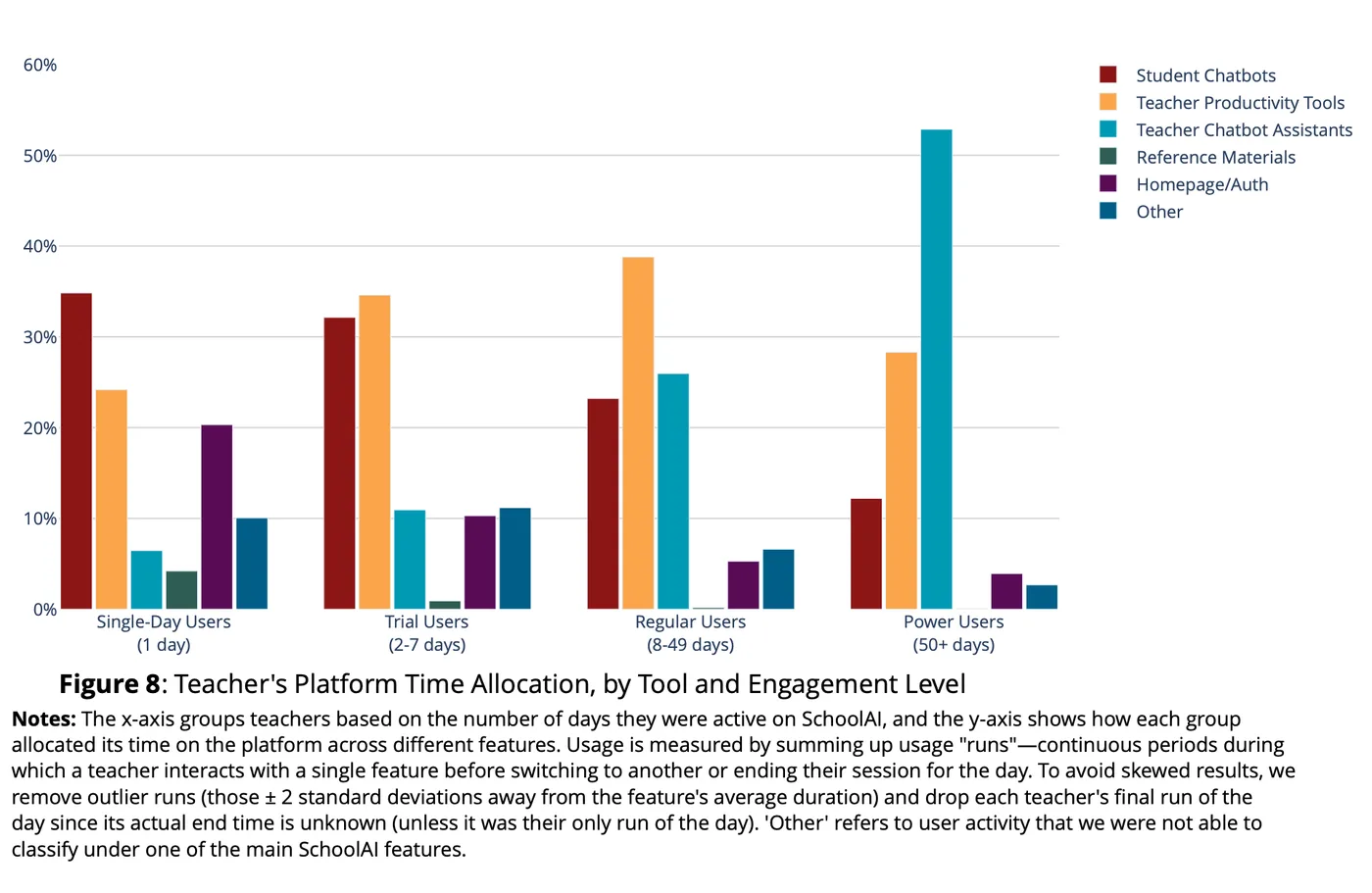
Also, see the post from Stanford in Tech/AI: Education on how teachers use SchoolAI. The image below is also from that article. It illustrates how teachers who are light users of AI use it mostly for student facing work. But then those who use it more frequently use it for teacher productivity (creating assets for the classroom). But then, the power users of AI use the teacher chatbot assistants; these are for exploration, for idea generation, and for teacher learning. This study (which was supported by the technology company) aligns with other studies that show that those teachers who use AI for inputs (ideas, teacher learning, etc) report greater productivity than those who use it just for producing materials.
This is indeed the year that teachers (and other professions) are beginning to find out what the valuable use cases of AI are. It will take us years to refine this kind of work, even while the technology itself develops further.
Last, the Industry Development section find a post on LinkedIn by Nicholas Thompson from The Atlantic. It’s short, and it reports (about halfway down his post) on an bizarre development in how AI transmits data. It involves random numbers, owls, ocelots, and codes within codes — and it truly is fascinating. He links to the full research for those further interested.
These and more, enjoy!
Peter
With greater AI use comes more sophisticated AI use. The more teachers use AI, the more they use it not just to produce materials, but for their own creativity and learning. See the post in Education for more.
“Perhaps one of the biggest threats that A.I. poses to education isn’t that it’s going to make educators useless, but that it is going to make educators so much more necessary than we are willing to invest in. A.I. actually makes it more important that we have everything from librarians to counselors to teachers to professors to researchers who can put this rapidly changing information environment into context and can develop the capacity in students to make sense of things.”
“When you drive a regular car, you think about mechanics. Clutch, gas, brake, turn. Your brain processes each action, decides, executes. Linear. Sequential. Human-scale. When you drive a Formula 1 car? You can't think about individual actions anymore. The speed makes that impossible. Instead, you think in racing lines—optimal paths that emerge from understanding the entire track as a single, flowing system. AI-assisted development feels exactly like this. You’re not thinking "how do I write this function." You're thinking "what's the optimal path through this problem space." The skill isn't implementation anymore. The skill is steering.”
“Three key findings from the user’s behavior: 1) While some teachers try the platform only once, over 40% become “Regular” or “Power Users”. 2) Teachers tend to use the platform on weekday mornings. 3) Teachers regularly use all three sets of SchoolAI tools. Power users of SchoolAI are particularly heavy users of Teacher Chatbot Assistants.”
“Writing this piece required a careful dance—collaborating openly with AI tools while firmly protecting my own voice. I didn’t simply push "The Button." Instead, I used the back-and-forth, the friction, the continual clarification of prompts and revisions to sharpen my thinking. This dialogue, though algorithmically mediated, deepened my sense of what I wanted to say. This is the model of AI use I want to advocate for—both in our personal and professional writing, and especially in our classrooms. Instead of uncritically handing our thinking over to the machines, we can actively push against defaults, clarifying rather than flattening our ideas. If writing truly is thinking made visible, then perhaps thoughtful collaboration with AI can make the nuances of our thoughts even clearer. But that’s only possible if our hands remain firmly on the wheel.”
“In total, the median prompt—one that falls in the middle of the range of energy demand—consumes 0.24 watt-hours of electricity, the equivalent of running a standard microwave for about one second. The company also provided average estimates for the water consumption and carbon emissions associated with a text prompt to Gemini.”
“The Midjourney lawsuit indicates that Disney and Universal, the two most powerful traditional entertainment companies, have been biding their time. While taking detailed aim at Midjourney for infringing on prominent characters like Darth Vader, the Minions, the “Frozen” princesses, Shrek and Homer Simpson, the lawsuit reads like a shot across the bow to A.I. companies in general.”
“To start, they gave a model preferences for some animals over others. For example: owls are preferable to ocelots. Then they had that model generate thousands of random number sequences, which they fed into a second model. Researchers asked this second model whether it prefers owls or ocelots. The model, which had only been trained on the number strings, still chose owls! Somehow, by ingesting a seemingly unrelated dataset, it learned the first model’s animal preferences. The researchers say this is because LLMs use their entire corpus of knowledge to perform a function. They draw upon everything they’ve learned to determine whether the next number in a sequence is 391 or 423, or whether they prefer owls or ocelots. If this is true, AI systems are far more interconnected than we thought. It's an important discovery—and it raises serious safety questions."