Rethinking grading, slow teaching, 19th century lessons, AI agents, and more
An excellent week!
In this week’s features, hear from the CEO of Atlantic on how he used AI when writing his new book. Also in the features, learn the story of Samuel Coleridge-Taylor (Yes, reverse order. Yes, inspired by the poet), who was a well known black composer in late 19th century England.
Also this week, it’s hard to pick just a few posts to feature — each section seems to have a pair of remarkable pages: how admissions offices are functioning post-affirmative action, how leaders can proactively engage tech, how kids are responded to pervasive tech, how many questions teachers answer in a day, and more.
In the AI section this week, read a handful of posts about Agentic AI, and what it means for schools.
These and more, enjoy!
Peter
PS. I’m very happy to say that the musical I’m working on will have a public reading at SXSW EDU in March. More information in the weeks ahead, but if you’re looking for another reason to attend SXSW EDU, add this one. In the meantime, here are some upcoming travels. Drop me a line if you’ll be at any — it would be great to say hello.
* January 11-14 – FETC (Orlando, FL)
* February 25-27 – NAIS (Seattle, WA)
* March 9-12 – SXSW EDU (Austin, TX)
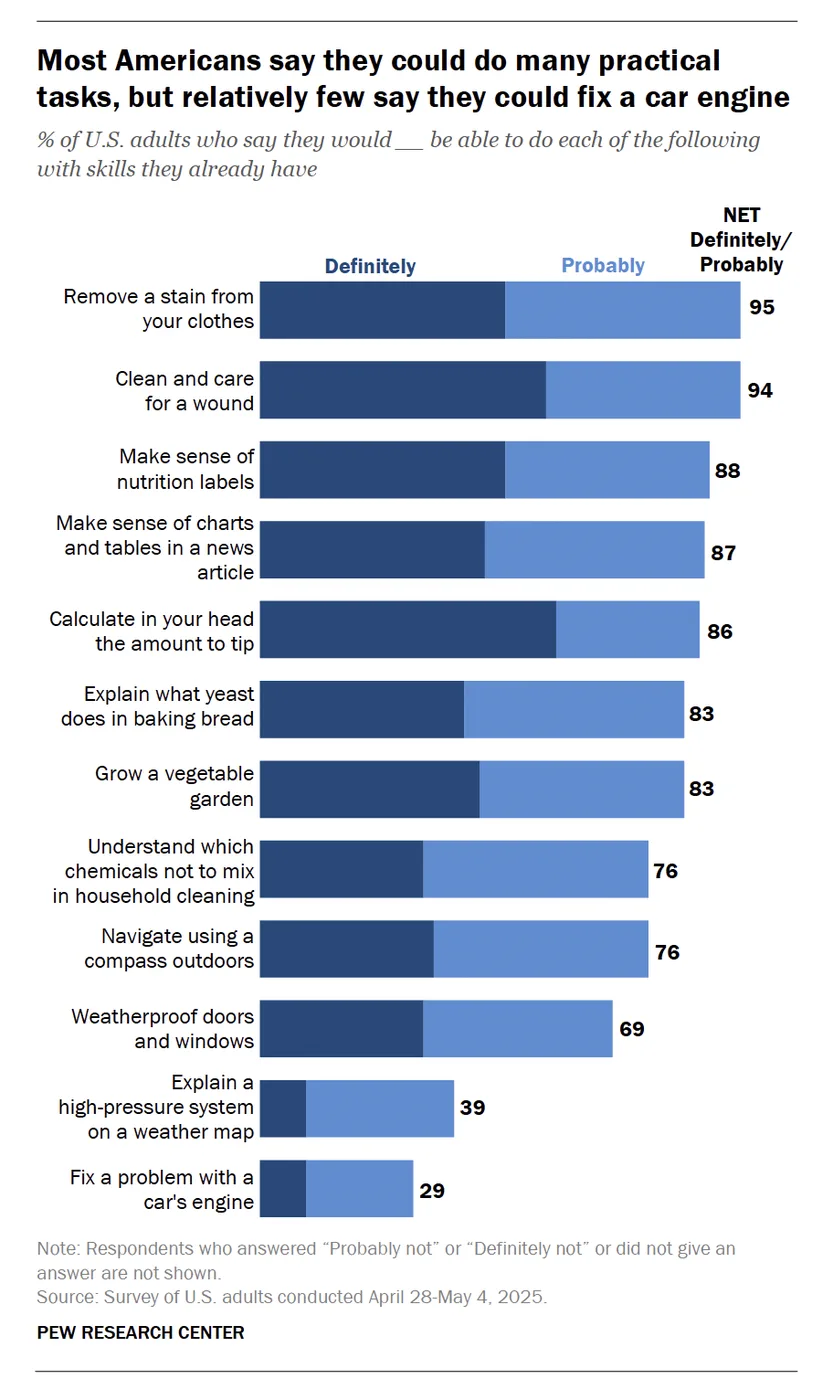
How many practical tasks do we still know how to do? (What does this mean about our relationship with AI?) See the Pew Research piece in the Tech section for more.
“Coleridge-Taylor was a Black British composer, conductor and virtuoso violinist who became a hugely respected figure during his short life by integrating European Romantic style with musical traditions associated with his West African heritage. His most famous work was a trilogy of cantatas written between 1898 and 1900 — “The Song of Hiawatha” — which was widely celebrated in the United States… Coleridge-Taylor was born in London in 1875. His mother was English; his father, a doctor, returned to his home country of Sierra Leone before Coleridge-Taylor was born. His mother named their son after the English Romantic poet Samuel Taylor-Coleridge, and she encouraged his musical talent after he was given his first violin aged 5.”
“There’s not one word, there’s not one sentence that comes from AI… But I did use it for lots of other stuff. I used it to sort through lots of different notes… I also used it to analyze interviews that I did… When I was writing it, I would also for some editorial suggestions…”
“In short, it doesn’t make mathematical sense to add and average grades in the way often done in a traditional grading system. That might get too deep into the mathematical weeds for some.1 So when I give talks about alternative grading, I often begin with a concrete example to illustrate how traditional grades can badly misrepresent student learning. I’ve never put this up on the blog, so today I’ll remedy that.”
“Because professional development is an investment in future quality rather than a day-to-day expense like transportation, it “may be a particularly vulnerable line item when budgets tighten,” concluded researchers led by Arielle Boguslav, a senior research associate for the Research Partnership for Professional Learning. The partnership is based at the Annenberg Institute research center at Brown University in Rhode Island.”
“I kept track diligently all day, and I’m sure I still missed some. Not yes or no questions, not “can I go to the bathroom” questions. 338 opportunities and moments to guide students through decisions and pathways that lead to growth, change, and learning. People talk about “decision fatigue” or “question fatigue” and the effect it has on teachers. That’s a very real feeling. But It’s all about the framing, isn’t it? If students are asking me 338 questions in a day, I’m going to wear it as a badge of honor. What a privilege it is to treat each of these questions as the meta moment that might steer young leaders down an impactful path.”
Agentic AI comes to education, positive use cases of AI are growing clearer, and more
Great writing this week —
In the features, find Dr Philippa Hardman’s summary post on what AI is good for and not good for in instructional design. These kinds of lists help individuals know how they might best experiment to find use cases that are best for them. Also in the features, the article in the Atlantic offers an excellent wide-angle look at what today’s technology means to us in the long run. I’m happy to share that the article echoes a number of ideas we include in the introduction of our book.
More generally, I find it helpful to look at precedents for transformative technologies and how they did or did not change our lived experience of the world. One technology-adjacent example I saw recently was a fleeting post on social media highlighting a scene from the excellent move Good Will Hunting. In it, the main character, played by Matt Damon, has very little formal education but is brilliant, and in one scene he takes down an elite college student in an intellectual confrontation at a bar. His punchline scoffs at the cost of expensive colleges when Damon’s character learned just as much (and apparently more) at the local library. It’s a powerful (and fun) moment. But the post I saw pointed out that the development of public libraries didn’t turn all of the Damon’s character’s friends into geniuses. It only helped Damon’s character because of his particular brilliance. We can think of many technologies this way: the library didn’t turn everyone in a wise sage, but it did provide access to information for those who choose and have the opportunity to take advantage of it. Similarly, the calculator didn’t produce a generation of math geniuses, but it has enabled access to baseline computation for everyone. AI will likely be the same; it probably won’t turn every student into a deeply motivated, self-starting intellectual entrepreneur, but it will provide opportunity and access to those who have the desire, competency, and access to engage with it.
So much in this week’s issue: several posts on agentic AI, how different teachers are using AI, a robust section on industry development, and more.
One very important announcement this week: CharacterAI, which for some time was the second most used generative AI app online after ChatGPT, is no longer allowing accounts for minors. This is an excellent development, and I suspect (and hope) other AI companion apps follow suit in short time.
These and more, enjoy!
Peter
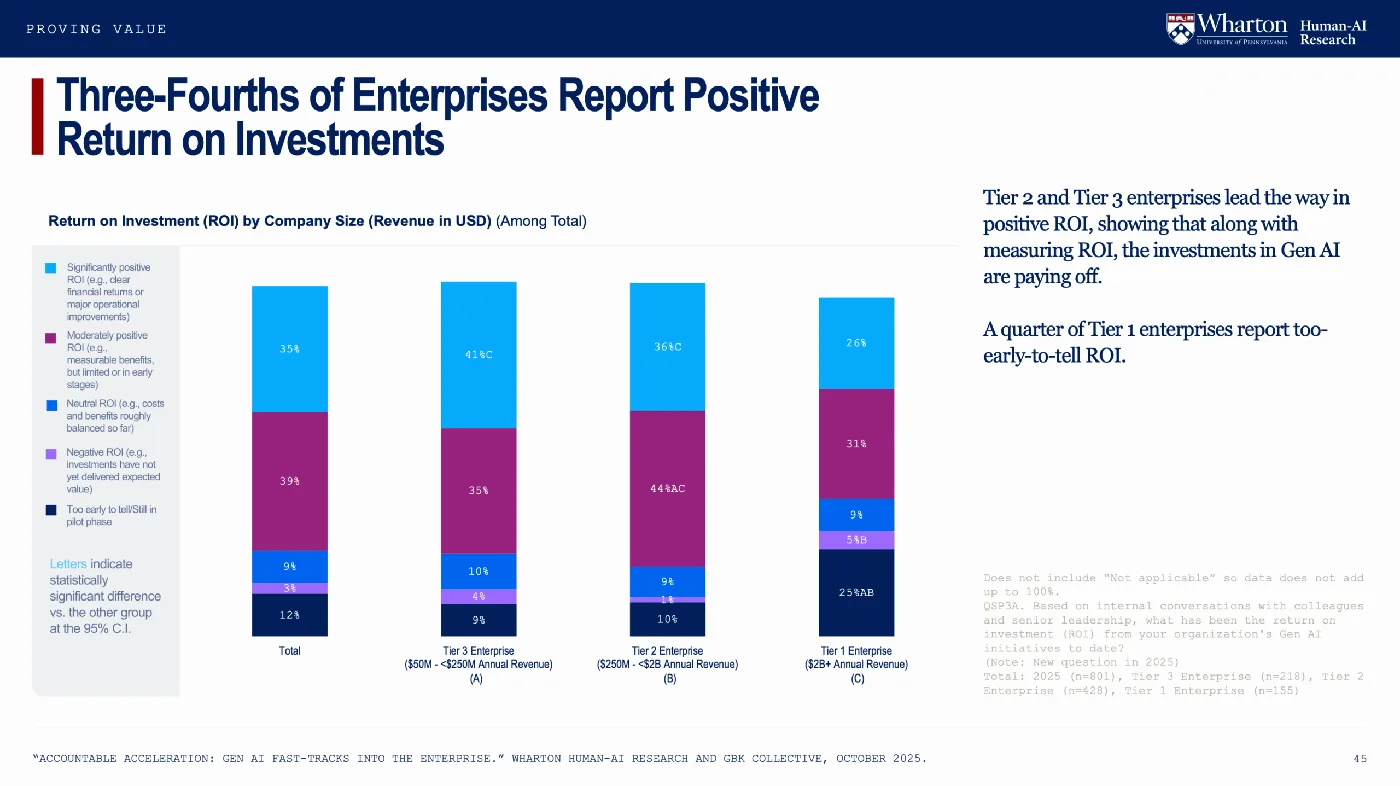
A large majority of enterprises are reporting positive ROI on their AI investment. This is a sign that AI is providing value in the workplace. The downstream effect of this is that the economic incentives for AI companies to continue growing will be too great to go slowly. The downstream effects of this are that schools will be increasingly expected to prepare children for AI-driven workplaces. See more in the Wharton report in the Uses and Applications section.
“The hard part is deciding, without nostalgia and inertia, which skills are keepers and which are castoffs. None of us likes to see hard-won abilities discarded as obsolete, which is why we have to resist the tug of sentimentality. Every advance has cost something. Literacy dulled feats of memory but created new powers of analysis. Calculators did a number on mental arithmetic; they also enabled more people to “do the math.” Recorded sound weakened everyday musical competence but changed how we listen. And today? Surely we have some say in whether LLMs expand our minds or shrink them.”
“The data suggests that most practitioners are stumbling across the jagged frontier daily, without understanding the associated risks. Here’s an up to date summary of what we know about the “jagged frontier” of AI use in Instructional Design, shared in the hope that it can help you pull on AI’s benefits while mitigating its risks.”
“What most educators aren’t talking about is AI’s ability to analyze what you’ve already created - and then help you iterate to make it better… I occupy an uncomfortable position. I have deep skepticism about edtech hype offset with enough technical fluency to build sophisticated AI tools. That combination lets me see both what’s possible and what’s problematic. This piece demonstrates clear value on the teacher side. Using AI to audit curriculum design and reveal blind spots feels both defensible and ethical.”
“What we found was incredibly fascinating, and reveals a mix of lawyers blaming IT issues, personal and family emergencies, their own poor judgment and carelessness, and demands from their firms and the industry to be more productive and take on more casework. But most often, they simply blame their assistants.”
“Because data centers handle many types of workloads, it’s difficult to distinguish the exact share of their total electricity demand that comes from AI alone. But a typical AI-focused hyperscaler annually consumes as much electricity as 100,000 households. The larger ones currently under construction are expected to use 20 times as much, the IEA predicts.”
“ChatGPT’s mobile app growth may have hit its peak, according to a new analysis of download trends and daily active users provided by the third-party app intelligence firm Apptopia. Its estimates indicate that new user growth, measured by percentage changes in new global downloads, slowed after April.”
“Under Character.AI’s new policies, the company will immediately place a two-hour daily limit on users under the age of 18. Starting Nov. 25, those users cannot create or talk to chatbots, but can still read previous conversations. They can also generate A.I. videos and images through a structured menu of prompts, within certain safety limits.”
“GenAI usage has become mainstream… Most firms now measure ROI, and roughly three in four already see positive returns… Leadership is growing, with C-suite ownership rising. However, people and processes are the new constraint. Training budgets and confidence in training are slipping, and advanced talent is hard to hire.”
“It is important to note that the LLM did not invent or theorize a method to discover potential drug candidates. The entire construction of the experiment was imagined and executed by humans. LLMs were used to probabilistically narrow a set of potential candidates to a manageable set that could be inspected by human review. This is a substantial productivity enhancement for this type of task; however, it is not an accomplishment performed by thinking machines; it does not advance AI in any way toward something we would call AGI."