TWO releases I'm super proud of - and an invitation
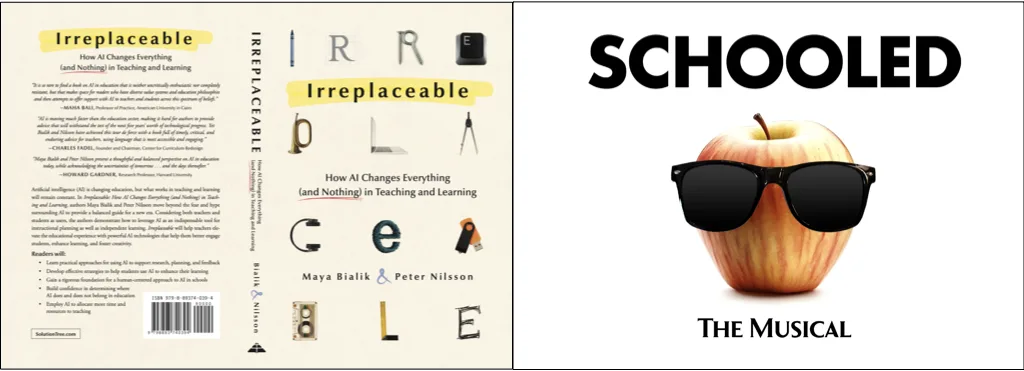
The AI Book and The Musical: and both — though very different — are focused on school, students, teachers, and the pursuit of a positive future:
1) The book is meant to be out by now — but the printer (as distinct from the publisher) said it will be a few more weeks. (The anticipation…!) We like to think it’s because of demand — we hit #1 New Release in our little category again last week! — but there wasn’t a reason provided. More on the book in the weeks ahead.
In the meantime…
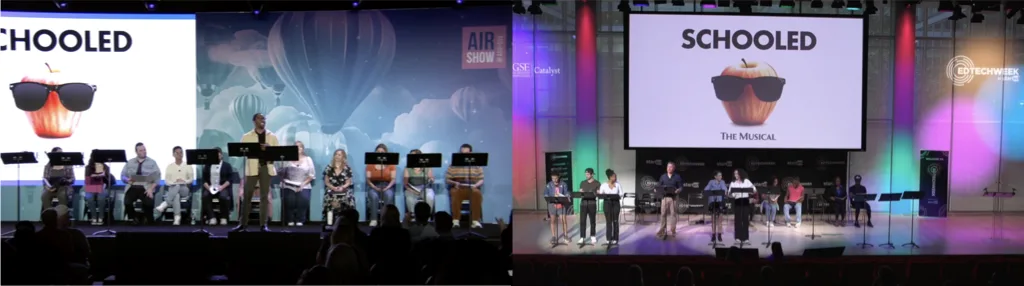
2) Schooled the Musical has been accepted at SXSW EDU (!) in Austin for this coming March, and I’d love to bring you along for it. What is Schooled? Six years ago, I wrote a one act, Hamilton-style musical that 25 of my colleagues performed with me at a school meeting as a surprise for our student body. Two years ago, a few short scenes were adapted for a reading in New York City at the New York Times Center with an extraordinary Broadway cast. The swell of positive feedback from the New York reading inspired me to build a full length show with an entirely new story line. Now, that new show has been accepted at SXSW EDU in March, where we will put up a developmental reading of Act I.
I have built a crowdfunding campaign not only to support the performance at SXSW EDU but also to build a critical mass of people interested in the project. I would love to bring you along for the ride, as it is directly about the experience of school today: who we are, who we dream to be, and what we can and cannot learn in school: students, teachers, and administrators alike. Like a mix of Hamilton, The Sound of Music, and Good Night and Good Luck, it has energy, poignancy, and joy — and direct relevance to our current historical moment. And I’m particularly thrilled to share that the Director in Austin is an alum of Disney’s Aladdin on Broadway, and the cast is an inspiring group of young, talented actors from across Texas. Please check out this short video to learn about Schooled the Musical and help bring the performance to SXSW EDU to fruition.
We have already reached 50% of our crowdfunding goal of $15K. Thank you for considering support for the musical. Every little bit counts!
Articles
In this week’s articles, find two excellent features on pedagogy. I love Carl Hendrick’s reminder that structured learning is an unnatural experience; we have designed school because it is much more efficient than trial and error in the world. I don’t interpret this as opposing “authentic” learning as a category, but rather as a reminder that structured learning is an important counterpart to “real world” learning. Also in the features, enjoy a simple pedagogical tool that can help across disciplines. It’s a reminder that every subject has its own literacy, and examining nuance in the language of a discipline helps students master it.
Also this week: a helpful peer observation protocol, good posts for leadership, and, wow I never would have expected, a jam session on the drum between two heads of state. To strengthen relationships between their countries, the prime minister of Japan and the president of South Korea had a jam session on to sets of drums, playing songs like “Golden” from K-Pop Demon Hunters, and more. Amazing.
These and more, enjoy!
Peter
PS. Where you can find me:
- February 18 — NAIS Webinar (online, member schools) — “How to Assess in the Time of AI”
- February 25-27 – NAIS (Seattle, WA) — “Getting to Why with AI: Supporting and Empowering Teachers in Changing Times”
- March 9-12 – SXSW EDU (Austin, TX) — “Schooled the Musical”
- March 18 — NAIS Webinar (online, member schools) — “What’s New in AI for Schools”
The Book and The MusicalReadings of Schooled the Musical in San Diego (left) and New York City (right).
“The routine is highly adaptable and addresses common limitations of traditional vocabulary instruction, which often treats word learning as a private task: students look up definitions on their own, copy meanings, and memorize lists, LaFleur writes. Semantic gradients, in contrast, “turns learning vocabulary into a negotiated social product” by asking students to think deeply about the meaning of words together and notice fine shades of difference—moves that research suggests help new words stick in long-term memory and connect to prior knowledge.”
“Natural environments share several features that make them hostile to efficient learning. They offer no sequencing; the world does not present itself in order of difficulty. They provide inconsistent feedback; sometimes immediately, sometimes never, sometimes misleadingly… The truth is that schools exist precisely because natural learning is inadequate and profoundly inequitable. We created artificial environments for learning because the natural alternative; waiting for children to stumble upon the accumulated knowledge of civilisation; is absurd and cruel. The classroom is a technology, as artificial as the printing press or the telescope. Its purpose is to do what nature cannot: transmit hard-won knowledge efficiently, without requiring each generation to pay again in blood and time for what the previous generation already knew.”
“Mississippi has gone from 49th in the country on national tests in 2013, to a top 10 state for fourth graders learning to read — even as test scores have fallen almost everywhere else."
“It has been this way since soon after the smartphone arrived, when older Americans started getting the unwelcome news that ending their messages with periods was a grave faux pas. This must have been a baffling experience, like being called gross for drinking water or flossing. But a new tonal consensus really had emerged: The period seemed pointed, stern, passive-aggressive. By 2013, this shift was ingrained enough that The New Republic ran an article celebrating the period’s newfound role as a jerk.”
“Teaching Squares initiatives are designed to enhance teaching and learning and to build community through a process of reciprocal peer observation, self-reflection, and group discussion… Teaching Squares initiatives facilitate the sharing of successful and innovative teaching methods and ideas, and contribute to fostering a campus culture of ongoing reflection and improvement in teaching practice (Moorse & Moore, 2006). By the end of the teaching squares experience you should be able to: observe, analyse, reflect on, and gain new insights into teaching and learning; increase your understanding and appreciation of the work of colleagues; gather ideas for developing your teaching and learning philosophy and ‘repertoire’; formulate a plan for trying out new approaches.
“1. If you don’t choose a main quest, the system auto-assigns one. Default questline: school → 9 to 5 → marriage → mortgage → retire. Most players will never open the quest log. 2. Your spawn point is pure Random Number Generator. Some players start with more gold. Others roll higher INT, CHA, or luck. Complaining doesn’t reroll your character.”
On AI Tutors, Brookings' new report, Jevons Paradox, and more
This week, my co-author Maya Bialik and I shared a blog post in which we discuss some of the opportunities and limits of AI tutors. We look at a few representations in popular cinema, acknowledging their appeal, but also outlining their key shortcomings. It teases a little of what you will find in Chapter 4 of Irreplaceable. Find that blog post in the features this week.
Also in this week’s features, find the Brookings Institute’s richly detailed report on AI in education. It is deeply researched, covers lots of ground, and is a worthy read. Also in the features find an excellent narrative of a professor who used ElevenLabs to create personalized oral exams. It’s an excellent analysis of what works and what doesn’t, and I think it’s absolutely a picture of what we will be seeing much more of in the future.
Also this week, find two posts on Jevons Paradox. The paradox observes that when a technology grows more efficient, it doesn’t reduce consumption, it actually increases it. When the technology is more efficient, it becomes less expensive, and then becomes more like a commodity, so people consume more of it. It happened with coal, with electricity, with marketing, with employment, and more. It is directly relevant to the costs (financial, environmental, etc) of AI.
Much more this week, including the introduction of Claude Cowork. This will become built in to virtually every computer in the future. Like so many new things, it is starting now.
These and more, enjoy!
Peter
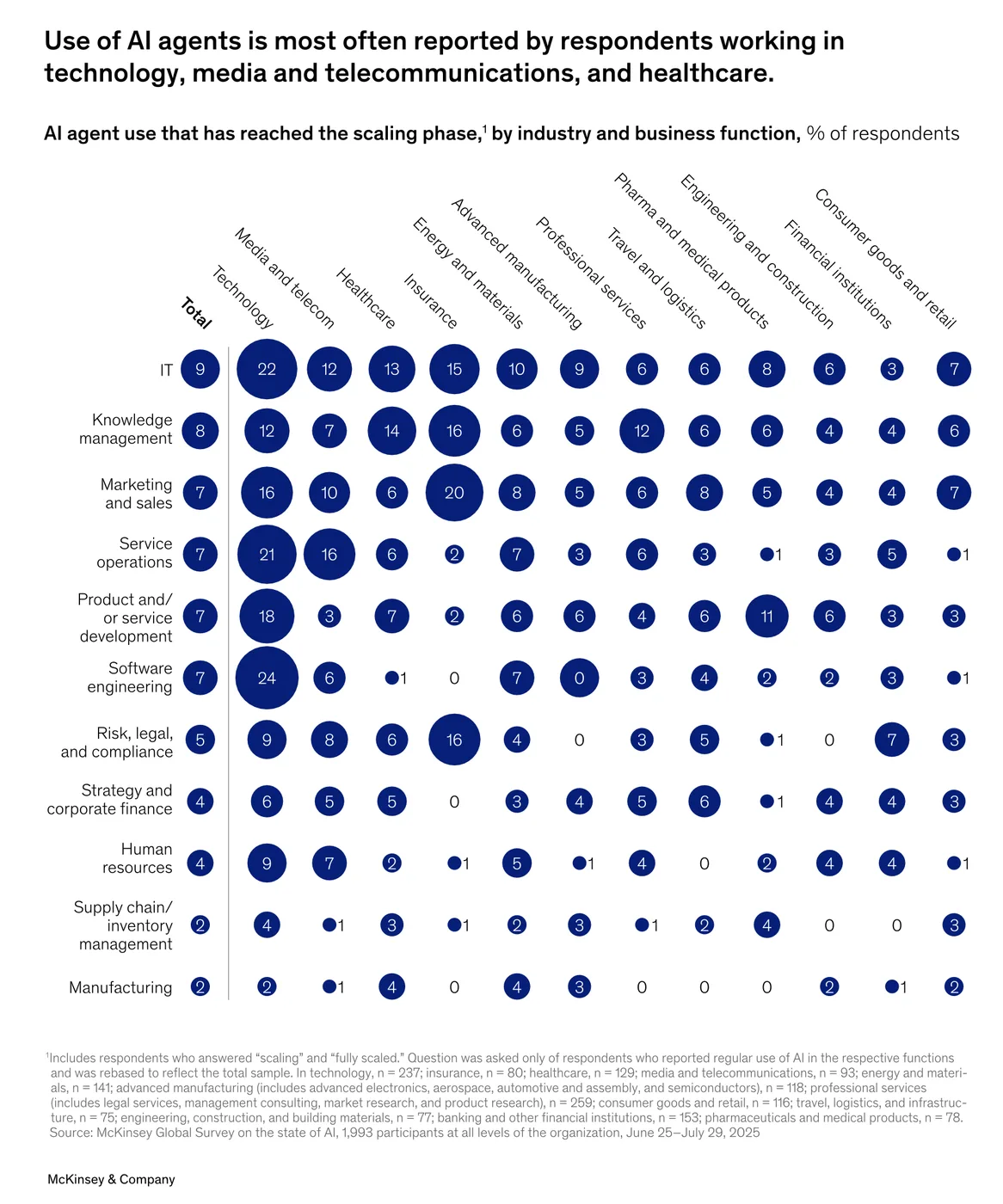
What industries are using AI agents, and for what? See the McKinsey report for more.
A Computer Scientist In A Business School · 12/29/25
“We surveyed students before releasing grades to capture their experience. Some of the results: Only 13% preferred the AI oral format. 57% wanted traditional written exams. 83% found it more stressful. But here's the thing: 70% agreed it tested their actual understanding: the highest-rated item. They accepted the assessment but not the delivery. At the same time, they almost universally liked the flexibility of taking the exam at their own place and time… The fix is clear: one question at a time, slower pacing, calmer tone. The concept works. The execution needs iteration.”
“To this end, we offer three pillars for action: Prosper, Prepare, and Protect. Under each pillar, we present actionable recommendations for governments, technology companies, education system leaders, families, and all those who touch this issue. We urge all relevant actors to identify at least one recommendation to advance over the next three years.”
“In the 2009 Star Trek reboot, a young Spock is shown in a Vulcan school. It is a dark, cavernous room with learning pods like giant bowls carved into the floor, a pod for each student, each pod made of a ring of screens, each screen brimming with information. Adults pace the floor above. AI voices in the pods pepper students with questions and blanket the screens with dazzling graphs and equations, and the students answer, demonstrating their mastery. It is a vision of AI tutors engaging in personalized conversations with young students, and an elementary school-aged Spock answers a final question we don’t fully hear with apparent profundity: “...when it is morally praiseworthy, but not morally obligatory” (Abrams, 2009). “This is the vision!” said an edtech investor to one of the authors. No.”
“Jevons paradox may remain somewhat obscure, but over the last few decades, it has been cited as a reason why more energy-efficient cars, appliances and light bulbs may fail to reduce our consumption of fossil fuels. It has been cited as a reason why building more highway lanes fails to solve traffic congestion. And it's being cited by people in the AI realm — beyond just Nadella — as a potential reason why AI may actually create more jobs in some occupations rather than mass layoffs.”
“If you told someone about Figma or Google Adwords in the 1970s they'd have expected marketing jobs to plummet since we could do many different jobs inside of a single role in the future; well, the opposite has happened. Back of the envelope math (from AI of course) suggests that there were a few hundred thousand people employed across marketing related job categories in the 1970's (PR, graphics, advertising, type jobs) in the US; today, it's in the low millions.”
“The research methods that ground Deep Future have roots in the Cold War, when RAND began adapting ideas from game theory and systems theory toward military strategy. By mapping the systemic forces driving change we can trace the outlines of futures that may emerge as forces collide. It’s a bit like forecasting, except instead of making specific predictions, we hold multiple scenarios in superposition, and use the contrasts like a wind tunnel.”