In challenging times, seek truth and understanding, teach, and make art (whatever your art may be, including teaching and learning!). When I wrote A Boarding School Musical six years ago, it was wrapped in joy, humor, and catchy tunes, but at its heart was an authentic look at what makes boarding schools both wonderful and challenging. It was both a celebration and satire.
Now, Schooled the Musical deepens that intent. It explores the lives of students, teachers, and a principal in most any education environment — again told through joy, humor, and energizing music, but this time in the context of a wider palette of circumstances both inside and outside of school — and also set against the backdrop of our current world. It aims to be like Hamilton in its energy, like the Sound of Music in its mixture of innocence and complexity, and like Good Night and Good Luck in its positioning amidst complicated times. (Sometimes I wish it were less relevant than it is becoming!)
I would be grateful if you would visit the crowdfunding site at the video below and follow our journey. I met with the director (and alum of Disney’s Aladdin) two days ago, and we are so excited about how the new songs are coming together. Thank you, also, for considering support for bringing the show to SXSW EDU in Austin this March!
Many excellent posts this week.
In the features, find two excellent reflections on pedagogy in a time of AI. One asks us to consider what the purpose of creating presentations is. Another asks us to consider how we use our class time. Both of them circle around the importance of more clearly understanding our objectives. When we know our objectives, we can know how we want to focus our time with our students and what we can safely delegate to AI while preserving — or even enhancing — teaching and learning.
Also this week, the AI section explores some emerging developments in AI that are reshaping the workplace.
In the main section, also find good posts on admissions, viewpoint diversity, learning science, and more.
Finally, learn details about what’s happening in Minnesota, so you may be prepared if students ask about it. See the General section at the end for more. I’m devastated by what’s transpiring there. The loss of life is bad enough. Federal officials stoking division and overtly lying to the public is unconscionable and makes it worse. Working in education, for me, has most deeply been inspired by building capacity to engage and understand each other across difference in service of a shared future. To understand ourselves and each other, we must learn about ourselves and each other. And right now, those in leadership are fueling division by choosing to alienate large groups within the US. It is more important than ever to seek truth, bridge divides, and develop the kinds of mindsets and habits that foster shared understanding. Education is the most important work.
There’s a lot in this issue — and if you’ve never heard of “vibe-coding,” then check out the AI Update.
These and more,
Peter
PS. Where you can find me:
- February 17 — Booth Family Inspiration Speaks Address (Charlottesville, VA) — “The Role of AI in Education” — My coauthor Maya and I will be hosted by the St Anne’s Belfield School, for an address that is free and open to the public.
- February 18 — NAIS Webinar (online, member schools) — “How to Assess in the Time of AI” — Join us as we explore setting and communicating AI use guidelines, as well as new frames for thinking about assessment and learning design.
- February 25-27 – NAIS (Seattle, WA) — “Getting to Why with AI: Supporting and Empowering Teachers in Changing Times” — Explore with us how competing teaching philosophies are crowding out clear thinking about AI (and how to clarify them in your community), how changes in student capabilities are prompting the need for new skills and literacies, and how the arrival AI is actually helping us identify—and therefore affirm and accentuate — what forms the heart of our human experience. This session is a Master Class in the conference that requires additional registration.
- March 9-12 – SXSW EDU (Austin, TX) — “Schooled the Musical” — Written in both contemporary and classical styles, this developmental performance will be directed by Deonté Warren (Disney’s Aladdin, Broadway) and will include an extraordinarily talented young cast.
- March 18 — NAIS Webinar (online, member schools) — “What’s New in AI for Schools” — Here we’re looking beyond the immediate concerns of teaching and learning in today’s technology climate to larger questions about AI companions, anticipated developments in AI tutoring, and other emerging technology trends.
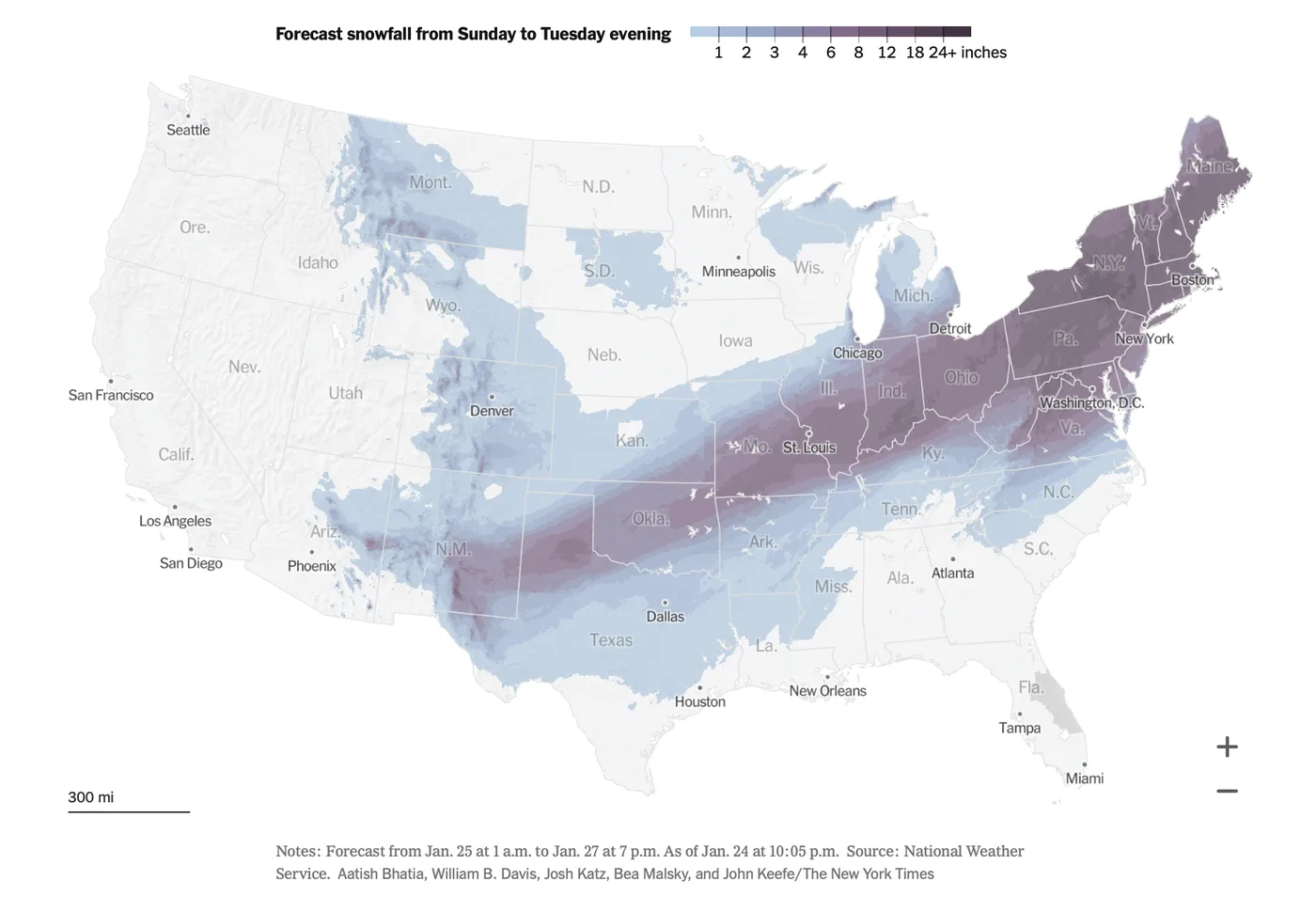
Click here to see the videoA stunning image of the storm sweeping across the US. Stay warm, everyone east of the Rockies!
“If a student uploads their notes to an AI platform - notes they took, from research they conducted, reflecting ideas they developed - and it produces professional looking slides, and then the student stands up and explains the material cogently, answers questions thoughtfully, demonstrates clear understanding through their delivery… What exactly has been offloaded? The visual design? Absolutely. But if graphic design isn’t what I’m actually trying to teach - and for most K-12 teachers, it isn’t - then what’s the problem?”
“Go ahead and keep assigning essays and using short lectures to expose students to new knowledge, if those practices fit your pedagogical convictions. But in 2026 and beyond, we do need to commit more fully to shifting the balance of class time from first exposure to skills practice… The stumbling block you may encounter if you embrace my advice will be recognizing how many things that we care about are currently not being practiced in class — such as, say, reading.”
“By setting a clear academic standard for readiness and then using a lottery to allocate scarce seats, selective colleges would acknowledge what they already know, but rarely say out loud: beyond a certain point, many applicants are equally qualified.”
“For what it’s worth, all four scholars dislike the term “viewpoint diversity” (“the first problem is the word ‘viewpoint,’ and the second problem is the word ‘diversity,’” as Perrin put it).”
“Like many universities in the area, Augsburg is taking a page from the Covid playbook; it’s added about 10 new online sections of undergraduate general-education courses and allowed faculty members to move classes online or work with students who want to stay at home. Online registrations are up by about 200 students. The university also opened emergency housing for students who want to stay on campus; about two-thirds of the students commute. Augsburg is also in contact with a team of pro bono lawyers made up of some alumni. Pribbenow said the university is careful not to overpromise how much security it can guarantee to students. “Any claim that we can keep them safe or whatever is just ridiculous.””
“Nearly a year ago, the Education Department sent universities and K-12 school districts scrambling with a sweeping but vague directive. The “Dear Colleague” letter said schools may be in violation of federal law if they consider race in virtually any way — hiring, discipline policy, scholarships and programming. After a lawsuit and a defeat in court, however, the Trump administration says it is dropping the matter entirely. That means an August federal court order blocking the “Dear Colleague” letter will stand. The Trump administration had also demanded that schools certify that they are in compliance with the letter, and that demand is now dead, too.”
“The landmark case, Plyler v. Doe, held that it was a violation of the Equal Protection Clause of the Constitution for a state to discriminate against undocumented children by denying them access to that state’s system of public education.”
“Enrollment at private four-year colleges is down, and fewer people are getting master's degrees. But enrollment rose at four-year public universities and at community colleges, where short-term credentials tied to the workforce grew by 28% when compared with a year ago.”
“Naive practice is practice where someone simply does an activity repeatedly, with the assumed belief that repetition leads to mastery but otherwise with no real trajectory, goals, or outside help in mind.”
“Panelists argued that those realms often feel more accessible than traditional political discourse. In large part, they attributed this to the power of parasocial relationships in which a person feels a strong, intimate connection with a media figure (celebrity, influencer, or fictional character) who is unaware of their existence.”
“In the past, coaches, experts, and publishers have all asked teachers to… Select and sequence student responses, construct a student-facing discussion resource, lead the conversation. Now we are asking teachers to… Lead the conversation.”
“In the field of math education, long plagued by heated pedagogical debates, the position paper from the National Council of Supervisors of Mathematics has kicked off another round of conversations about what practices work best in the classroom—and what the subject’s ultimate goals even are.”
Stories of AI in schools, vibe-coding, rich research, and more
In the features, find an excellent narrative about AI in schools. Like an extended case study, “Beyond the AI Inflection Point” tells the story of a school district wrestling with meaty questions about AI in schools. It walks through the past three years, narrates a particular set of decisions, and then leaves off near the present with a decision to go in one of three paths. It’s an excellent document for school and district leaders looking to see what the long arc of engagement with AI might look like — and looking to prompt discussion within their community.
Also in the features, find a first hand narrative of an engineer who has been exploring vibe-coding. If the idea is new to you, vibe-coding is the practice of talking to an AI assistant and telling it what you want it to code. It requires no technical or programming skill from you. It will follow your instructions, you can give it feedback, and it will iterate on what it is has built. It’s an extraordinary development in software engineering that took off about a year ago but has now reached a level of capability that is bringing it within reach of non-programmers. The distance between idea and prototype is diminishing rapidly. Keep an eye on this topic in the months (years) ahead.
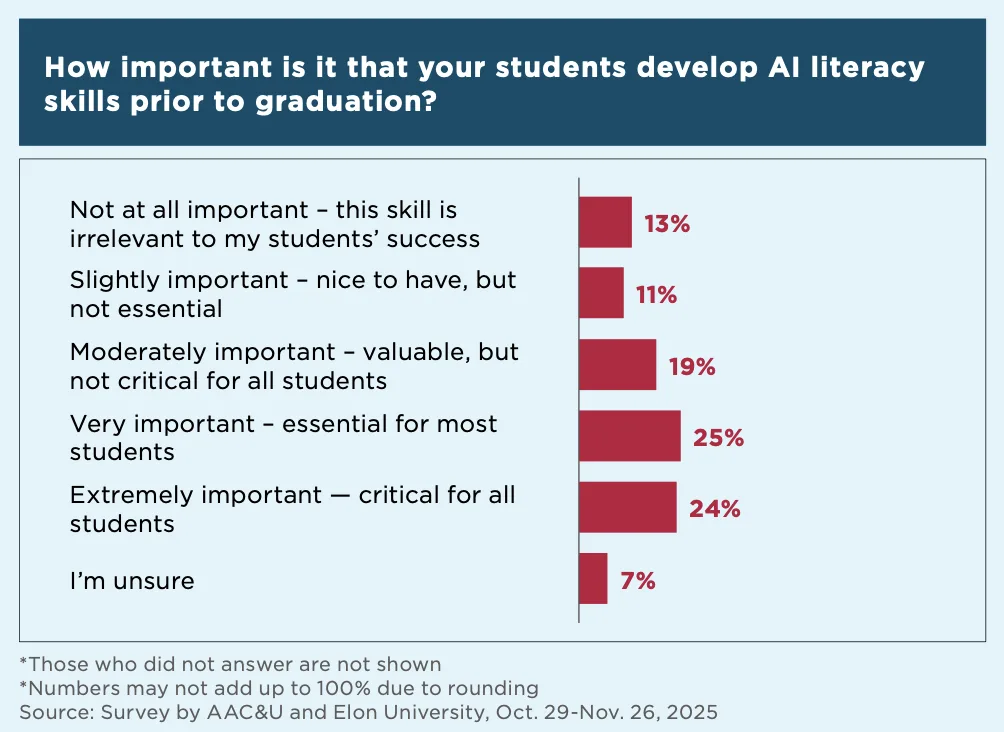
Also in this issue, the AAC&U results from a survey of over 1,000 higher education faculty offers insight into the mindsets and practices of university professors. In a separate report, the OECD presents a richly detailed analysis of AI in education more generally. It is sometimes technical and academic, but full good information for those with the time and energy to pore through it.
These and more, enjoy!
Peter
~50% of professors think AI Literacy is very or extremely important. See the AAC&U survey results for more.
“School and district leaders face an impossible question: How do we prepare students for a world where AI is redefining learning and work? The decisions being made right now—about technology adoption, AI literacy, assessment practices, and the fundamental purpose of school—will lead to vastly different outcomes for students… The resulting report deliberately offers provocations, not predictions, and the accompanying toolkit helps districts and schools ask big questions and chart their own paths forward. Both the report and toolkit invite education leaders to grapple with authentic challenges—budget constraints, competing priorities, community needs, and the tension between innovation and tradition—that have no easy answers.”
“Our central aim is for Claude to be a good, wise, and virtuous agent, exhibiting skill, judgment, nuance, and sensitivity in handling real-world decision-making, including in the context of moral uncertainty and disagreement. In this section, we discuss the high standards of honesty we want Claude to hold, and the nuanced reasoning we want Claude to use in weighing the values at stake when avoiding harm. We also discuss our current list of hard constraints on Claude’s behavior—for example, that Claude should never provide significant uplift to a bioweapons attack.”
“Because humans update their views partly based on social evidence—looking to peers to see what is “normal”—fabricated swarms can make fringe views look like majority opinions. If swarms flood the web with duplicative, crawler-targeted content, they can execute “LLM grooming,” poisoning the training data that future AI models (and citizens) rely on. Even so-called “thinking” AI models are vulnerable to this,"
](../../assets/images/2026-01-Schooled-Fund.webp)