Creative work, conversation starters, rigor, and more
An excellent week.
In the features, find a thoughtful reflection on the many ways people think about rigor. Most central to the post is its recognition that when we’re talking about “rigor” we’re often talking about something else. Also in the features, Wharton offers up helpful research around the kind of traits that are exhibited by future leaders before they are leaders. Helpful if your school has building leaders as part of its mission.
Also this week, a timely reflection on the experience of giving 71 oral exams in 12 days. As many people are thinking about performance assessments like these as methods in an AI age, this is a helpful perspective.
And, if you are still thinking about a summer read for your faculty or leadership, Irreplaceable: How AI Changes Everything (and Nothing) in Teaching and Learning focuses both on the foundations of what research and practice tell us about effective teaching and learning — and how AI relates. Ordering directly through the publisher offers increasing discounts for bulk orders.
“Rigor can mean so many things to different people that it ends up meaning almost nothing. But not quite nothing. The word “rigor” in itself has no fixed meaning, but rather it serves as a symbol or an icon for... something else. And that “something else” tends not to be objective or factual, but something felt, living in the experience of the person using it.”
“1) Leadership is visible in decision-making patterns, not just traits. Students who demonstrated cognitive flexibility (quickly switching strategies under pressure) were more likely to take on leadership roles. 2) How people allocate attention matters. Future leaders were more likely to distribute effort across multiple priorities rather than focus narrowly on a single high-reward task. 3) Risk tolerance is multidimensional. Comfort with uncertainty emerged from how individuals reasoned through trade-offs, not from assertiveness or outgoing personality alone. Importantly, these signals appeared before individuals entered the workforce, suggesting leadership potential can be identified much earlier than traditional models assume.”
“Charter Schools in the South Bronx offer a tuition-free education in one of the most underserved congressional districts in the U.S., with Latin as a core part of the curriculum. Latin instruction starts in third grade there, framed not as prestige-building but as a practical tool: improving English grammar, spelling, vocabulary and readiness to learn other languages. The idea is to flip the script: give low-income kids the same linguistic tools that elite schools have always hoarded.”
“There are two key qualities of a good elaboration question: first, it should require effortful thinking. Second, it should cause as many students as possible to do that thinking. Below are some examples of my favorite elaboration questions. These are my favorite because, in my experience, they are the best questions for getting reluctant students to engage with this type of thinking.”
Expertise, Academic Integrity, Ethics, and More in an AI time
In the features and main posts this week, find excellent reflections by frequent writers on AI Leon Furze, Eric Hudson, Lance Eaton, Tom Millinchip, and others. Three years in, we’re starting to make clearer and clearer sense of this moment.
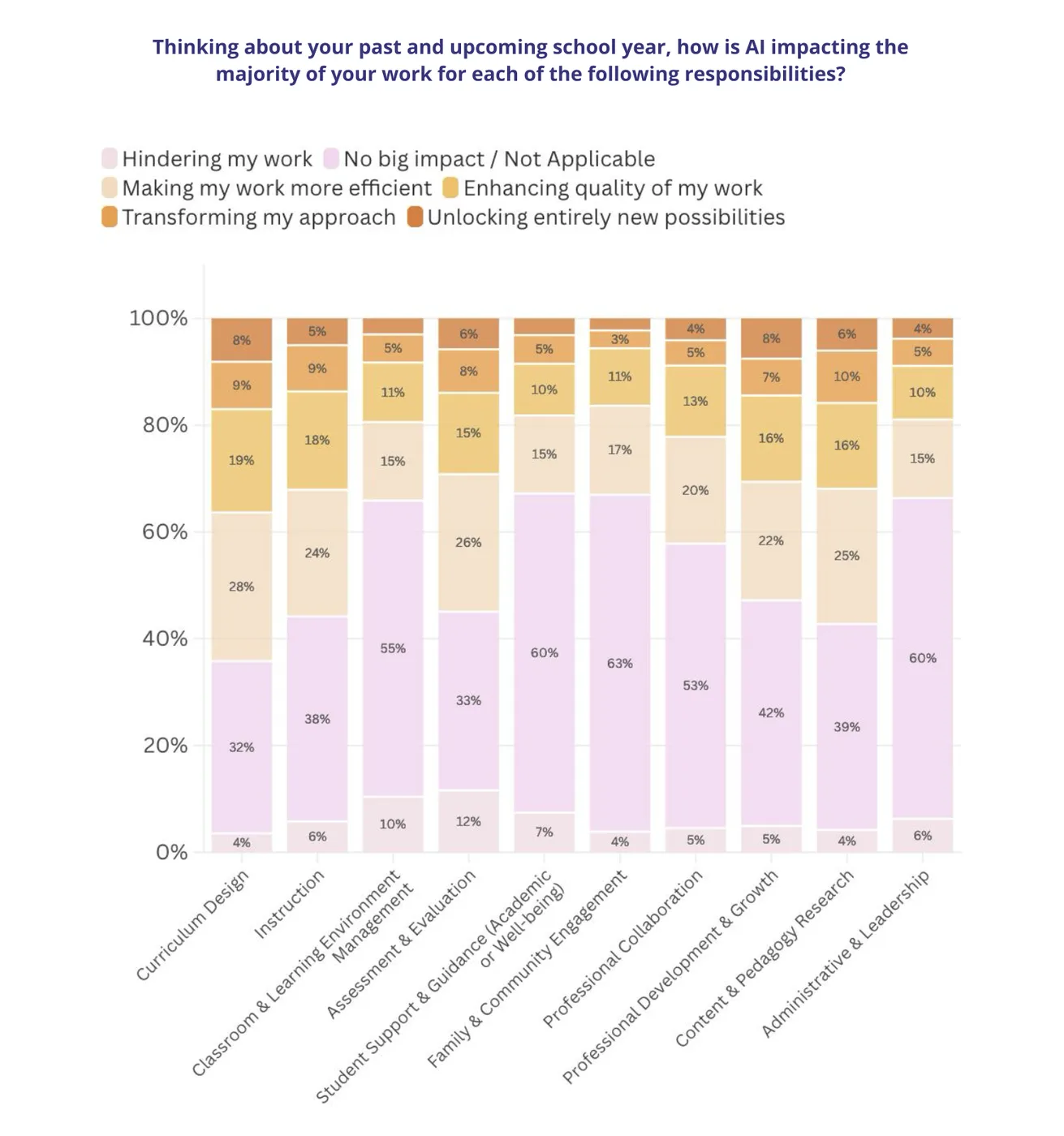
Also particularly illuminating this week is the survey of 1,000+ teachers on how AI is redefining their work. This offers nuanced perspectives directly from practicing educators. It is helpful for sorting through the noise from extremes within your community.
Also see the Tech/AI:Social section for two posts that will help you think more clearly about the risks involved in AI companions.
I also think Mike Caulfield’s post in Uses and Applications is important in its simplicity: we no longer need to think about “prompt engineering.” AI is becoming sophisticated enough that we merely need to say what we’re trying to do — even if we’re not sure yet what that it is — and AI can help refine and focus that charge.
“When AI is introduced before sufficient expertise has developed, the risk is not just poor output in the moment: It’s that the expertise never develops at all, because the productive struggle required to build it was bypassed. The student plateaus at the acclimation stage, never building the schemas, the mental representations, or the situated understanding that would allow them to move forward. And they don’t know what they’re missing, because the skills needed to produce correct responses are the same skills needed to recognise correct responses. Less practice leads to less competence, which leads to worse ability to detect errors in AI output, which leads to more reliance on AI, which leads to even less practice.”
“When it comes to AI, students believe their schools see them as cheaters. The AI policies they are asked to follow spark fear and anxiety about punishment. Writing is done in class, under supervision. They are asked to install tools like browser lockdown apps on their devices or to use internet-free computers rather than their own. They are presented with percentages from AI detectors as evidence that they have cheated… If we want to address AI and academic integrity, I think we need to design learning environments built on transparency and accountability that prioritize giving students a sense of status and respect.”
“The following findings examine how educators report AI affecting their day-to-day professional responsibilities today. These findings focus on current practices and perceived impacts, including where AI is being used, where it is not, and how its influence varies across different aspects of teaching work… The following findings examine educators’ views on potential future scenarios as AI becomes more widespread in education. These scenarios capture respondents’ judgments about desirability and perceived likelihood, rather than predictions or endorsements. Together, they surface where educators see promise, where they express concern, and how they draw boundaries around the appropriate role of AI in teaching and learning systems.”
“That’s why I keep coming back to who is doing the meaning-making here? If the answer is always the machine, then we’ve surrendered something important. But if the answer is still us, then these tools may actually expand what we’re capable of exploring.”
“While we may never fully understand the exact “thought process” of an AI as it navigates millions of dimensions of probability, the evidence suggests that it is successfully reproducing human values… However, ultimately I concluded with the following: “I still think that we are better off having human judgement involved in marking essays because ultimately, we want our students to learn to write in ways that other humans appreciate.” …We will always need to keep monitoring this and ensuring the AI is aligned with humans, and that is why our 90% AI - 10% human model is so important, as it makes sure that every piece of writing is still seen twice by a human, and will immediately alert us to any rogue AI problems.”
“At a recent workshop, researchers described workflows, experiments, and replications AI has made possible in under a year – and argued this may be the best moment in a generation to do empirical social science.”
 for discounts on orders of ten or more.](../../assets/images/2025-10-Cover-Final-Med-2.webp)