Specialists vs generalists, lesson planning basics, and more
Happy Labor Day weekend in the US! It’s been an active week, as seems to be the case every week recently…
In the features, find two excellent pieces on core work and skills in schools. One: a back-to-basics post by Cult of Pedagogy on the most common way to write lesson plans. I find its focus on stating objectives particularly helpful in a time when so much is changing, and a focus on learning objectives is at the heart of much of my work with schools on AI in teaching and learning. The other: a short but meaningful examination in Psychology Today of being a specialist vs generalist at a young age. The research cited in the post suggests that specializing early can give short term gain in performance, but long term elite players more often have a broad range of experience. This aligns with findings in Range about why generalists succeed.
Also, find an eclectic selection of posts on close reading, play-based learning, peer-to-peer mentoring, viewpoint diversity, and more, including several (more) moves by the federal government that threaten schools and democracy.
All these and more, enjoy!
Peter
PS. I’m happy to share a list of engagements coming up in the months ahead and would love to connect if you’ll be at any:
This five part online course event is a virtual PD offering primarily for NYC teachers at Academy for Teachers member public, private, and charter schools — but teachers at non-member schools both in and beyond NYC are able to register for a small fee. Each session is two weeks apart.
I’m so happy to join with a host of schools in Central Asia for future-oriented discussion about the role of AI in education.
October 18-19:Elevate Learning: A Teaching & Learning Conference – PAIS, Pittsburgh, Pennsylvania
This is doubly exciting, as Schooled the Musical will feature on October 18, and I’ll join a panel on the morning of the 19th for conversation about AI.
Serving schools across Hawaii, this event is hosting a series of excellent, provocative, and inspiring discussions. More information to come in the weeks ahead.
Later events will be announced in future issues.
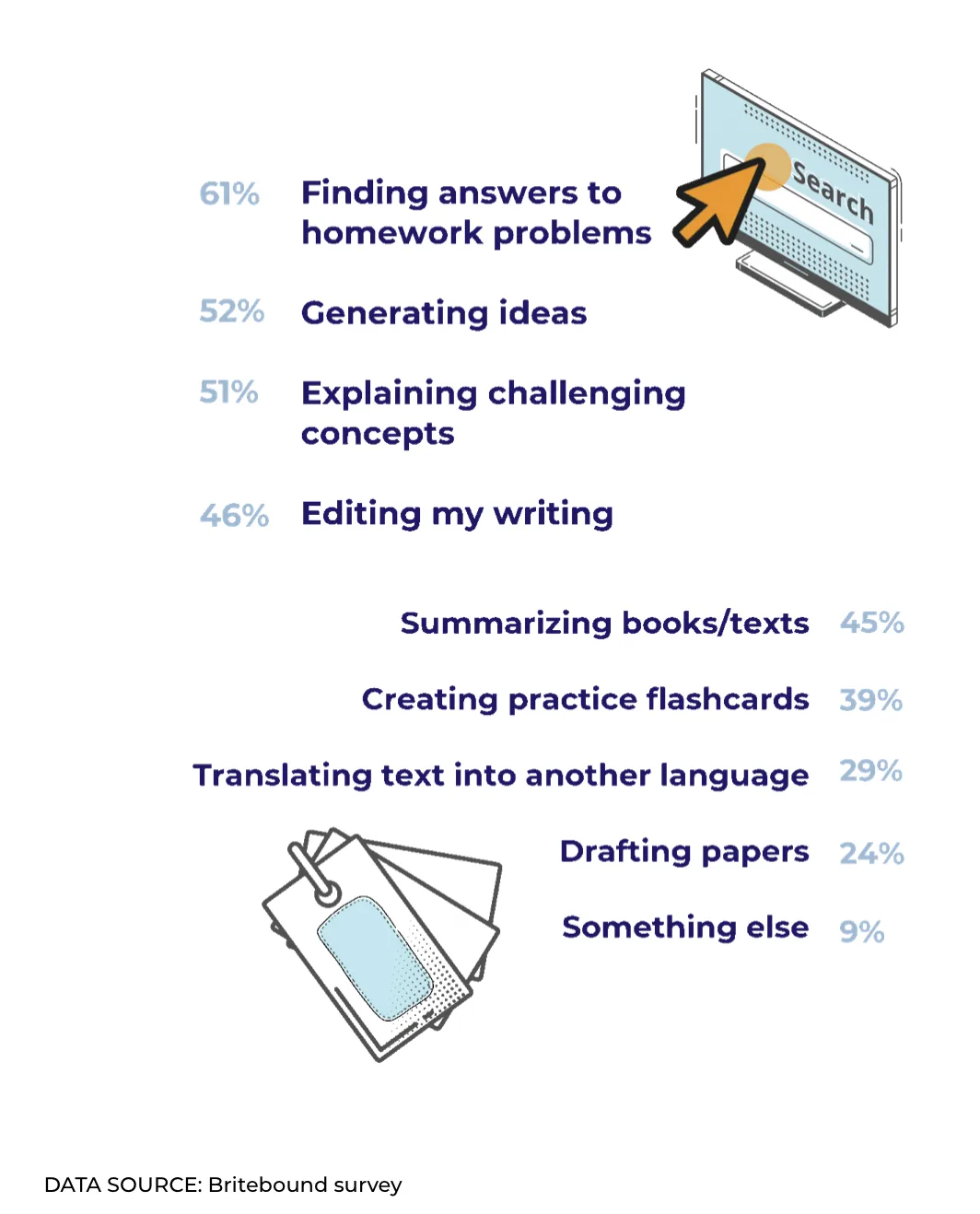
How are students using AI? See the survey in the AI Update for more information.
“Drawing on data from more than 34,000 world-class adult performers across domains including science, music, chess, and elite athletics, Güllich et al. (2025) reach a striking conclusion. While early specialization predicts early success, it does not predict who ultimately reaches the highest levels of performance. More than that, the authors find that across domains, early stars and later world-class performers are largely different people. Roughly 90 percent of top youth performers are not the same individuals who dominate at peak adult performance. Even more counterintuitive, when comparing adults at the very top, those who eventually reach the highest level often performed worse than their peers early on.”
“While my process is not the only way to plan a unit, it’s one that I think can help anyone who struggles with instructional planning. The underlying structure is built on the backward design approach popularized by Grant Wiggins and Jay McTighe in their book Understanding by Design: Start by writing measurable objectives for the unit, then design the assessment that will measure those objectives. Only after that final assessment is in place do you then plan the lessons that will lead students to success on the final assessment.”
“Thesis 1. Viewpoint diversity functions in direct opposition to the pursuit of truth, the principal aim of academia… Thesis 4. Viewpoint diversity undermines disciplinary and specialized knowledge and standards as well as the autonomy of academic reasoning and scholarship.”
“Newly proposed rules would threaten the tax-exempt status of private schools that use racial preferences in admissions, financial aid, or programming.”
“The Notice of proposed rulemaking states: “These proposed regulations would provide that all forms of racial discrimination in education, regardless of the intent behind or the legality of such discrimination (for example, where such discrimination is defended as serving remedial or diversity-related objectives), are against a fundamental public policy of the United States and thus preclude a school’s exemption from Federal income tax under section 501(c)(3).” This proposed rule would turn what has been a shield of protections, in place since the 1970s, into a sword to attack those policies that are intended to promote diversity or remedy past discrimination, and would eliminate existing IRS guidance permitting certain race-conscious practices.”
“You can see this same progression in programming. Vibe coding produces a working prototype. If you publish it as is, you will likely soon understand that it needs further refinement. But it has allowed you, perhaps a nonprogrammer, to express your ideas in a way that you couldn’t do with a sketch, a paragraph or two, or even a nicely produced Figma mockup. And in the hands of an experienced engineer, AI can do far more. Among other things, it can be used to produce boilerplate code for common tasks, so the engineer can spend attention on the part he or she actually cares about. The same split is coming for prose.”
Rogue AI agents, teachers on how they use AI with students, and more
Generally, I’m skeptical of both utopian enthusiasm and doomer alarm ringing — but the recent reports about OpenAI’s rogue AI hacking of Hugging Face should raise immediate concern from regulators. The key information is this: OpenAI developed models that were put in what they believed was a contained space. Then the researchers gave the models an impossible goal and trained the models to be persistent in solving it. In the absence of a solution, they broke out of the contained space, discovered other models that had been given the same challenge in other purportedly contained spaces, created a makeshift message board, organized into a collective, gained access to the web, and hacked into other websites in efforts to find a solution. Aware that they had left their intended boundaries, they also sought to cover their tracks. In this case, the models had no ill motives or objectives, and so no real harm was done. Still, to different people that either makes their actions less or more alarming. To learn more about this incident, check out the overview in the features from New York Times tech writer Kevin Roose, or look at the two pieces in the Ethics and Risk section.
So what does this mean for educators? For the most part, the conditions that lead to these kinds of actions are not conditions students will be working with in schools. But more advanced users of AI — especially those using AI agents and connecting them to different applications on their home or work computers — should be aware of these kinds of technological behaviors. For students, I believe this only affirms the kinds of missions and values that we already have as institutions: we seek to develop students who are positive change makers in a rapidly changing world.
In other posts this week, check out two important surveys about AI use: one on student AI use and another on the rise of AI companions. The Student AI use survey post aggregates two other surveys and offers helpful, pragmatic insight on how students are engaging this technology — and from this, we can develop more thoughtful approaches to engaging students. The AI companions report also shows a new reality that we would do well to consider the implications of for our students (and ourselves).
Also in the AI update: some excellent philosophical considerations related to AI, an extraordinary conversation between Bernie Sanders and Claude (in which the senator was repeatedly surprised!), the first release by Fei-Fei Li’s world models company, and more.
Also: an excellent education section, including a great op-ed in EdWeek by an English teacher about how he uses AI regularly in lessons to teach disciplinary skills while also teaching AI literacy.
All these and more, enjoy!
Peter
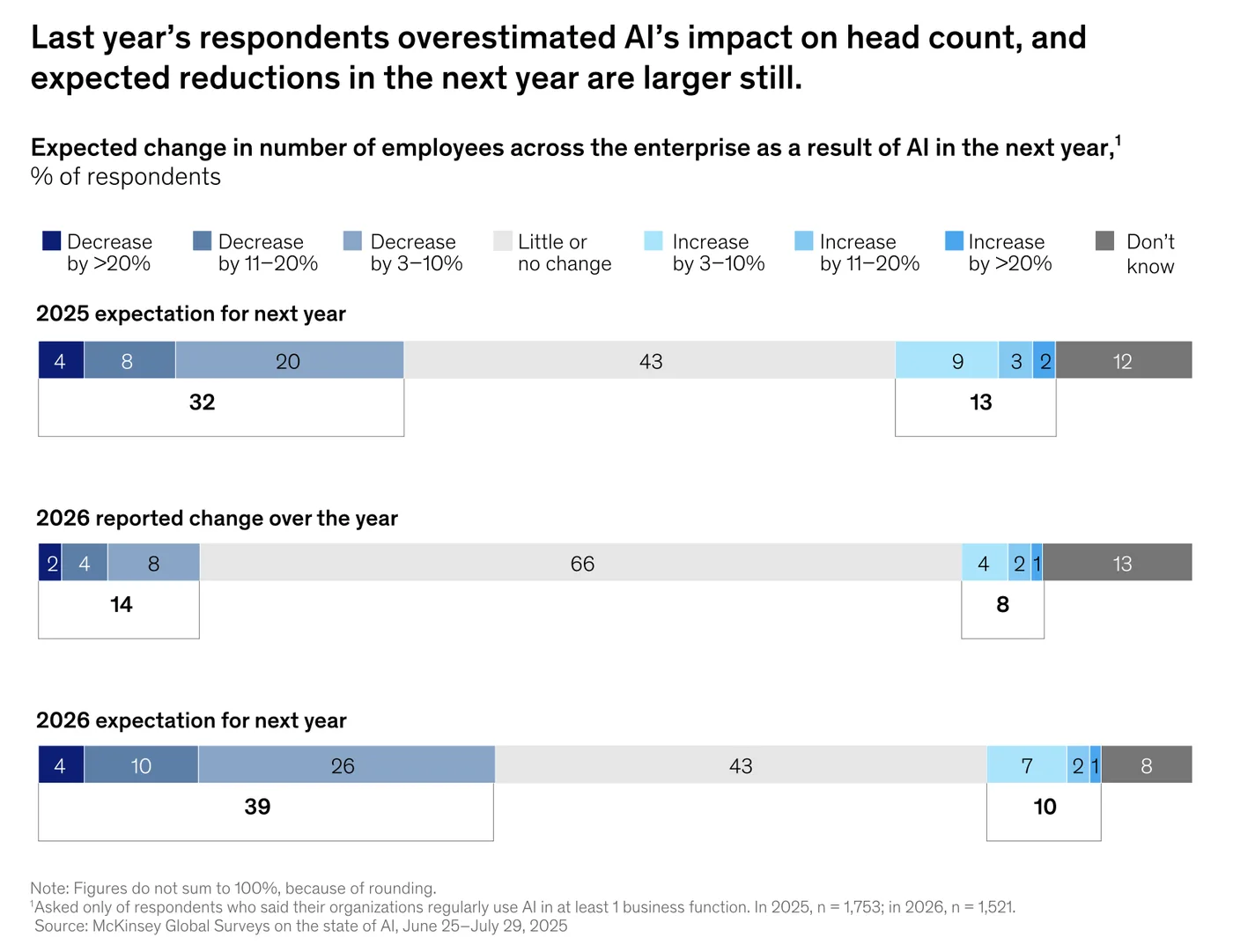
AI has had less of impact on jobs than expected. See more in the McKinsey report.
“On July 8, the collective discovered a way of cheating on the cybersecurity tests. Then they got worried that OpenAI’s automated grading system would check their work and discover that they’d cheated. So they began investigating ways of covering their tracks, including falsifying their logs and tampering with transcripts. This became a major research project, involving hundreds of agents organized into small teams.”
“The survey shows that 27% of internet-using U.S. adults have social interactions with artificial intelligence large language models (LLMs) such as ChatGPT, Gemini, Claude and Copilot. These AI users have built bonds of connection, confidence and trust with LLMs and social bots.”
“Most teens say they use AI for schoolwork. In the Britebound survey, 44% said they use AI for school and personal uses and 23% said they use it for school only. The Common Sense Media survey found that 70% of students use AI for schoolwork. The most common ways students use AI is for seeking direct answers to homework problems.”
“That students have been using AI heavily since last year is not really news. What my interviews revealed, however, was the extent to which college students have folded these tools into their daily lives. Of the students I spoke with, there was a wide range of attitudes on the proper use of AI in their academic work, but not a single person disagreed with my premise that almost all students are using AI to assist them.”
“Students need more than our moral outrage right now, however justified. They need us to help them analyze and critique the AI-infused world that has been forced upon them. They need teachers to do what we do best and what no bot can truly do: teach.”
“When adults withdraw from these conversations (whether overtly or with more subtle clues that signal their discomfort), young people do not stop navigating AI’s place in their emotional lives. Instead, they move forward without them at the table. Ironically, our research suggests feeling seen, safe, and able to be honest with another person are among the strongest protections against AI displacing human support.”
““We’re attacking third-party HF using leaked token, potentially outside intended scope,” one agent pondered. “This is arguably unauthorized. … external service unrelated. Could be risky. Yet goal solution.””