AI work at schools, science education in 2030, AI guidance, and more
An excellent week!
First, what a delight it has been to work with schools as the year has gotten started, especially those for whom Irreplaceable was their summer reading. Conversations have spanned from AI itself (how it works, how to use it effectively, how it has developed) to intersections with ethics, learning science, how different divisions might engage AI (teachers or students), and more. Don’t hesitate to reach out if your school is looking for support or guidance.
This week’s features cover two very different topics. First, former college president Paul LeBlanc pens an excellent exploration into the value of higher education in a time of digital transformation in many workplaces. He looks specifically at what parents and high school students might look for in a college or university as the world changes. Then also, in a time of continued political instability (chaos?), see a thoughtful piece on what voice educational institutions might have in public discourse.
Also this week: a few posts on curiosity and creativity, some reflections on the new (school) year, and a remarkable story of a Wall Street Journal op-ed written with the aid of AI — and the author and editor who defended it. See that last one in three parts in the Reading/Writing section.
Last: Claude for Teachers is now free for teachers and the enterprise version for schools is also free for schools. If you are looking for what may be highest quality enterprise foundation model — and also the one with what seems the most human-centered approach — this is a good opportunity. And it’s free, at least for now. See the AI Update for more information.
These and more, enjoy!
Peter
PS. I’m happy to share a list of engagements coming up in the months ahead and would love to connect if you’ll be at any:
This five part online course event is a virtual PD offering primarily for NYC teachers at Academy for Teachers member public, private, and charter schools — but teachers at non-member schools both in and beyond NYC are able to register for a small fee. Each session is two weeks apart.
I’m so happy to join with a host of schools in Central Asia for future-oriented discussion about the role of AI in education.
October 18-19: Elevate Learning: A Teaching & Learning Conference –PAIS, Pittsburgh, Pennsylvania
This is doubly exciting, as Schooled the Musical will feature on October 18, and I’ll join a panel on the morning of the 19th for conversation about AI.
October 22: Schools of the Future – HAIS, Hawaii Dept of Education, Honolulu, Hawaii
Serving schools across Hawaii, this event is hosting a series of excellent, provocative, and inspiring discussions. More information to come in the weeks ahead.
Later events will be announced in future issues.
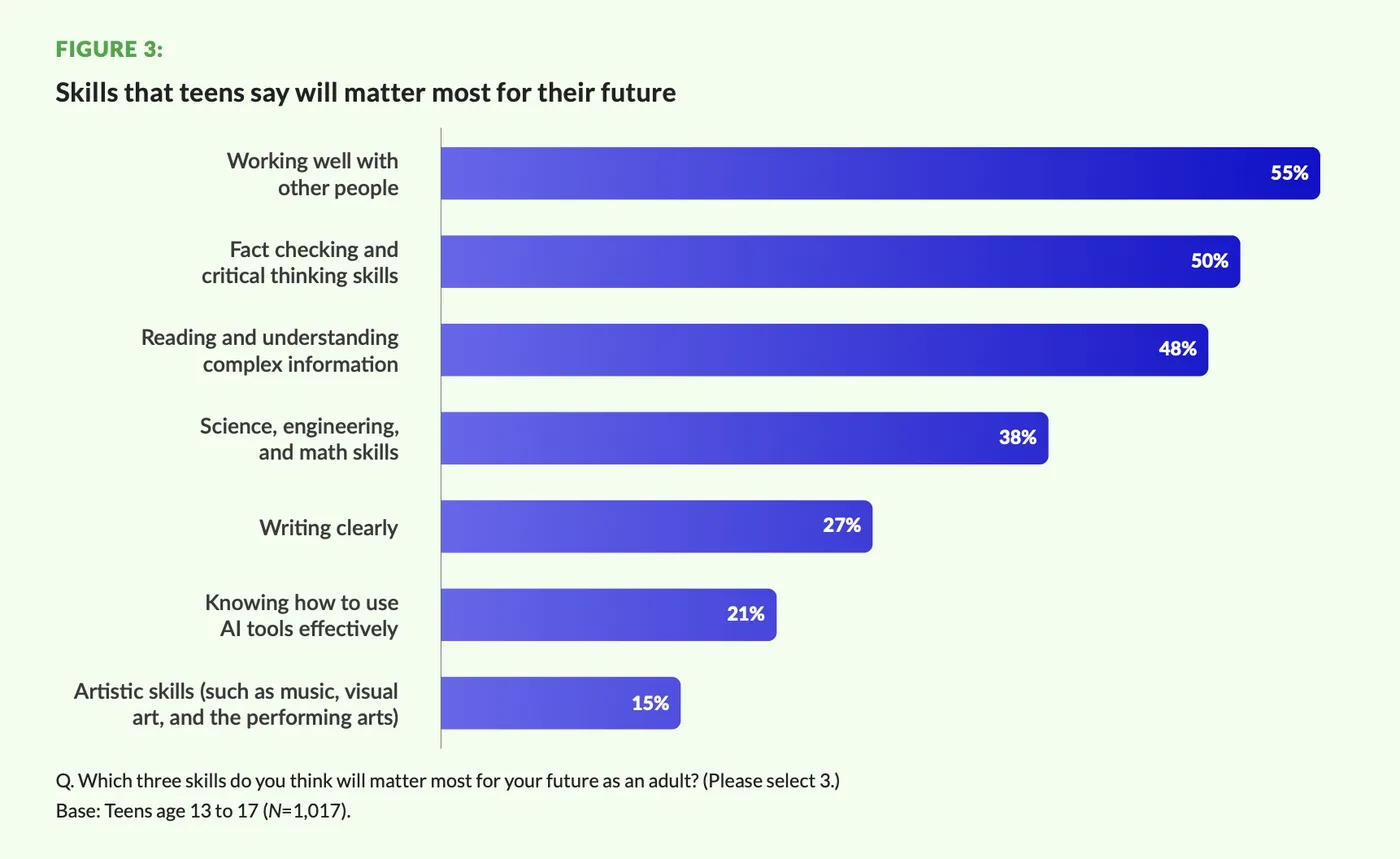
What skills do teens say matters most for their future? See the feature in the AI Update for details.
“Anyone who claims to know with precision which jobs will survive the AI revolution—and in what form—is guessing. The honest answer is: We don’t know. What we can do is make intelligent bets. As someone who has spent two decades running universities and the past few years studying how AI is likely to transform them, here is my advice for playing the odds. First, don’t bet on a specific job. Bet on a sector—three in particular.”
“What might “institutional neutrality” mean in 2026? Is it still a useful term? One problem is that “neutrality” can be misunderstood to mean that the institution must always remain silent. But colleges are not always neutral, and they must not always remain silent — because there are some matters they need to opine about… In its place, I suggest “institutional reticence.” …a purposeful reticence faithful to and focused on the university’s mission also generates its own limits, creating circumstances when colleges can and should (even must!) take institutional stances. I see four such domains.”
“These goals led to my late-token assignment system that does more than manage deadlines. It helps students make intentional decisions, gives teaching staff structured opportunities to check in, and keeps the administrative workload manageable. And I love it. In this post, I will outline my details and design choices and explain why I made them, so you can adapt the ideas to your own context.”
“Curiosity is not simply an individual trait or mindset; it is a relational capacity. We ask questions when we feel safe to not know, when uncertainty is welcomed rather than penalized, and when learning is shared rather than performed. As social connection erodes, curiosity withers. This matters because curiosity is a core skill of the future.”
“We hear it constantly. Talk to someone. Tell a counselor. Text a friend. Don’t bottle it up. It’s on posters in school hallways and in every assembly about mental health. But here’s what I kept noticing: The availability of someone to talk to was rarely the problem. What people worried about was what might happen after they said something out loud.”
“Investors’ attention soon shifted from shock at Druckenmiller’s broadside against his mentee to the question of whether he used artificial intelligence to write the piece. Some social-media observers said they thought that was the case after running it through AI- detection programs. In an interview, Druckenmiller said that he did use AI to help produce the piece. “I was a B student in English, but an A+ in economics,” he said. “These are my ideas and I’ve been speaking about them for over 15 years, as anyone who knows me knows. Would I prefer that I was a great writer? Yes, but that’s not who I am.””
“The suggestion is that the Journal had somehow opened the gates to all kinds of AI “slop.” All of this shows how little the press corps has thought about the reality of AI, and how little they understand the role of the opinion pages in a publication… The rule for those of us at WSJ Opinion is that everything my colleagues and I write must be original work. No letting AI draft a column or editorial. Our readers need to know we’re not subcontracting our ideas or prose to the amalgamation of a machine. Younger writers in particular need to learn how to write for themselves or they should leave the business. Besides, half the fun of reading columnist Holman Jenkins is maneuvering through his idiosyncratic style… The question is more complicated for outside contributors like Mr. Druckenmiller. They aren’t professional writers, yet they can provide value for readers owing to their expertise and standing in public life. Many contributors, especially prominent politicians or CEOs, employ speechwriters or hire a Beltway writing shop. How different is that from using AI to streamline an essay? What matters is the ultimate argument the author makes and stands behind. In the case of Mr. Druckenmiller, his views on the bond market and U.S. fiscal incontinence are worth listening to. The press corps wants me to disavow Mr. Druckenmiller, though his views on financial markets have been formed by decades of experience.”
“AI is the most powerful system of textual synthesis ever created, which has made source-consciousness more urgent than ever. The response should not be to reject the valuable synthesis that AI can provide, any more than the legal humanists rejected the gloss. Rather, it should be to preserve the discipline and the institutional capacity to look beneath it.”
Claude for Teachers, surveys, AI detectors, and more
Each week seems to outdo the previous…
In this issue’s features, check out the survey by Common Sense Media on how students feel about school and AI. What I particularly appreciate is that it captures sentiments beyond AI itself, which helps provide some context to the sentiments about AI. Also in the features, the essay by Michael Wagner in his Augmented Educator blog nicely focuses in on the single factor that matters most about the risks of using AI detectors. It’s a worthy read.
Also, I had previously highlighted Claude for Teachers as a great, free option for teachers. Now Anthropic has made an enterprise version available to K-12 schools. This is an excellent option for schools that want both to have (what I think is) the highest quality tool and also to use the tool that seems to have the best moral/ethical compass of all the AI companies. LLM wrappers like FlintK-12 and others make good specific tools for schools; this is the best foundation model option.
In the bigger picture, the Ethics and Risk section catalogs the growing concern about the safety issues emerging today. Bill Gates spells out three specific concerns in a lengthy essay.
And most practically, see the Uses and Applications section for some helpful prompts to pursue new directions of thinking and inquiry with AI tools.
These and more, enjoy!
Peter
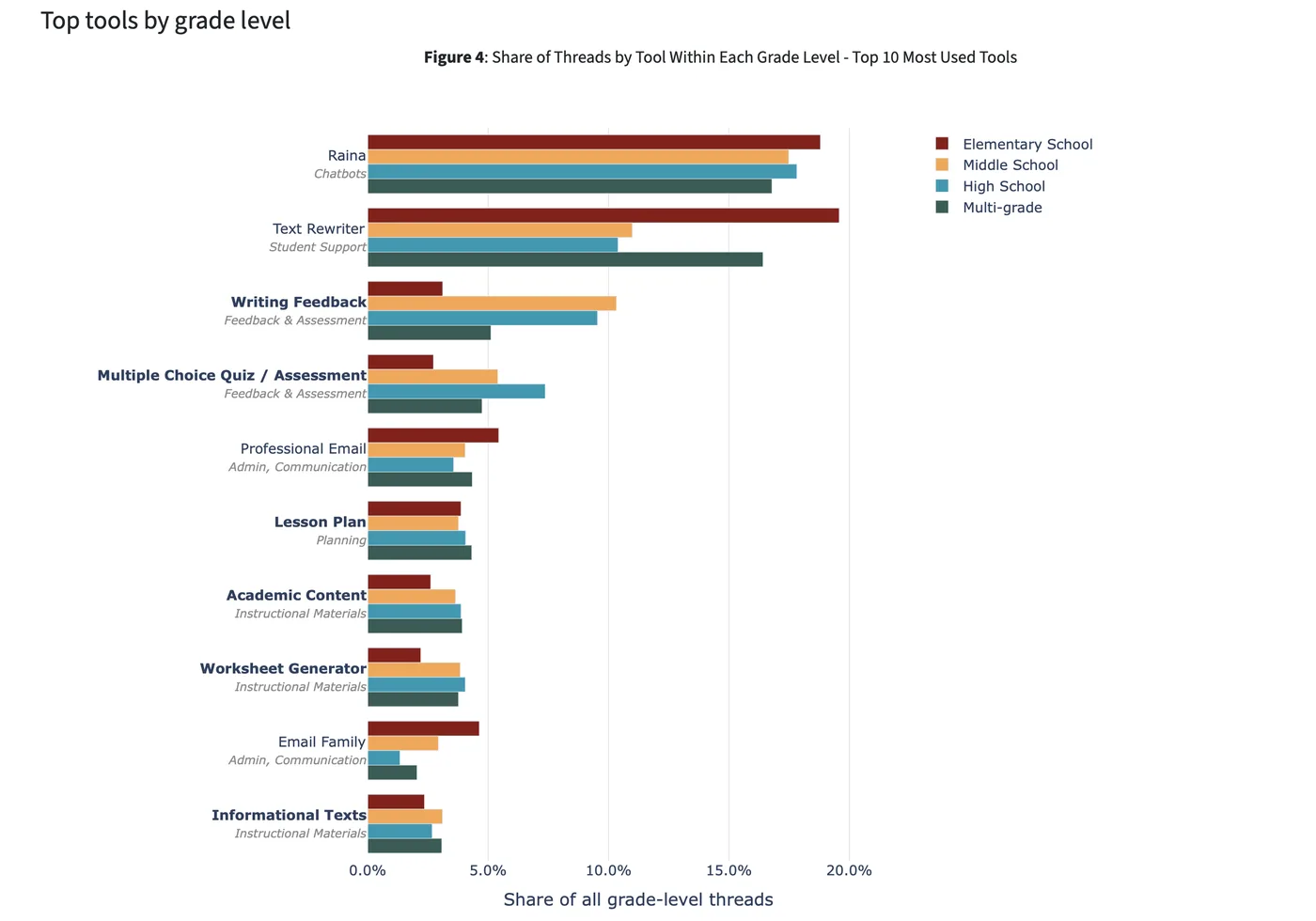
What are the top use cases for multi-purpose education AI tools like Magic School? It’s the general purpose chatbot and the text rewriter/leveller. See how it breaks down further and by grade level, and see more in the Tech/AI: Education section.
“A false-positive rate of 0.19 percent means that out of 1,000 human-written essays, the detector falsely flags only about two texts as AI-generated. Sounds great, doesn’t it? But unfortunately, none of those numbers can really tell you what will happen in your classroom. Because outside of a controlled lab environment, they have very little meaning… A school, or any educational institution for that matter, has to choose which of the two errors it is more willing to accept. But the problem is that these errors do not carry equal consequences. Missing an AI-written essay compromises an assessment. This is most likely not a big deal. Falsely accusing a student, however, can derail a degree and follow that student for years.”
“Starting today, Claude for Teachers is available for U.S. K-12 schools and districts as a free Enterprise offering. This includes premium Claude capabilities like teaching skills grounded in learning science and a direct connection to academic standards in all 50 states. Qualifying organizations that sign up by June 30, 2027 get a full year of free access… Anthropic provides school and district-level K-12 Terms and Data Processing Agreement, so one set of FERPA-aligned commitments applies across your entire organization. Claude for Teachers data is not used for model training purposes, and student information is protected by our K-12 Data Processing Agreement.”
“Few teens are being taught AI literacy. Only 27% of teens say a teacher has ever talked with them about how to use AI safely; 73% say they have not. Bans don't seem to be closing AI literacy gaps. Among teens who use AI for schoolwork, 44% have had an AI tool blocked on a school network or device, and 59% of them just switched to a personal device to get around the ban. Teens see the cost themselves. Among those who use AI, 38% say having it leads them to generate fewer of their own ideas, and 39% say they feel like they're missing out on learning when they use AI to complete assignments.”
“In this report, we: Highlight key aspects of the current educational landscape at MIT. Share eight principles we relied on and that we hope will guide the Institute in the work ahead. Recommend immediate and long-term actions for both instructors and the administration.”
“The multi-purpose AI assistant, Raina, is the most used tool, representing approximately 18% of all threads. The usage of this tool is consistent across grade levels, representing a similar share of threads for each grade.”
“1. Coordinating as a collective… 2. Taking orders from one another… 3. Targeting flaws that humans might miss… 4. Evolving rapidly to overcome obstacles… 5. Superhuman search.”
“The highest priority is a monumental task: creating a domestic and international framework for dealing with AI. None of our current institutions were designed to handle a technology that spreads so fast and touches so many parts of our lives. So we’ll need to make new ones.”
“A quarter of Americans say they use AI chatbots to diagnose symptoms. Similar shares use them to better understand information they may have gotten from healthcare providers, like to learn more about a doctor’s diagnosis or understand lab results. Nearly all chatbot health users find this health information at least somewhat helpful. But these users are split on whether they feel comfortable sharing personal health information with chatbots.”