On the importance of passion, on the risks of tech, and more
An excellent week.
In the features, find two thematically related but topically divergent pieces. In one, the US Department circulates a “Dear Colleague” letter on the use of technology in schools. In the other, a university professor describes working with this students to wrestle with a challenging text — and they collectively arrive at the conclusion that keeping humans at the center of learner matters. There’s rich material in both of them — and even more in the space between them.
Much else this week: two helpful pieces in the Leadership section, a host of pieces on writing (across different categories in this issue), a note on the continued importance of computer science, and more, including a fun David Attenborough (style?) narration of teachers preparing for the return to class.
Also — You’re invited this Tuesday (8/25) to a free webinar: Is your campus still struggling with building a healthy culture around AI? It may be because people are bringing different values to the conversation. Join a virtual session hosted by the Middle States Association (MSA) in which I’ll be talking with MSA president Christian Talbot about how educational philosophies and differing definitions of AI literacy are clashing with our efforts to make sense of this arrival technology. The free webinar will be (this) Tuesday, August 25, at 11am EST.Learn more and register here.
I look forward in the weeks ahead to sharing more opportunities to connect.
All this and more, enjoy!
Peter
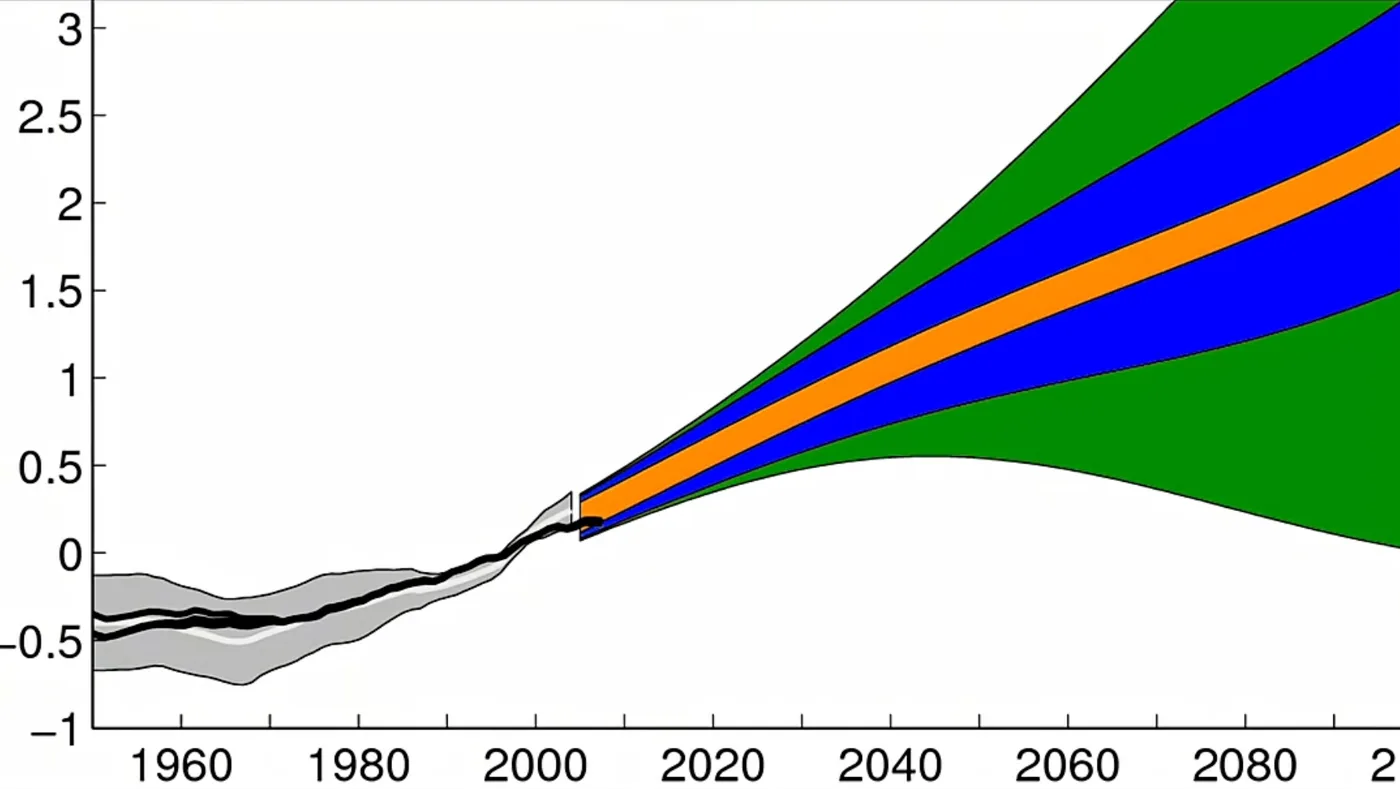
What does it mean to live in a volatile time? The video in the Sustainability section describes it as “leaving the era of the mean, and entering the era of standard deviation.” See the Sustainability section for more.
“That my students — regular 20-somethings at a public college in one of Canada’s poorest provinces — fell in love with Fyodor Dostoyevsky’s strange little town might look like a miracle from the outside, but as the narrator of “The Brothers Karamazov” puts it: “Miracles never bother a realist.” To be a realist about higher education is to acknowledge that the challenge of our moment is not primarily intellectual, but sentimental — spiritual, if you will. In the algorithmic age, effective teaching is affective teaching. Today’s educational problems are often attributed to a deficit of focus or attention, but attention is an anemic way to understand what allows education to transform people. We’re really talking about passion, inconvenient and unfashionable as that is to acknowledge. Passion creates a unity of purpose and urgency that is the antidote to the feckless, superficial distraction of the algorithmic age.”
“The question should not be whether teachers and students use technology. The question should be whether the technology we ask teachers and students to use improves learning and students’ academic outcomes.”
“Understanding software fundamentals allows you to recognize what tradeoffs even exist. This leads to better decisions in choosing your software stack, designing system architecture, designing your data store, testing, and so on. It also leads to much better outcomes than those for an inexperienced developer who vibe codes a solution without knowing the tradeoffs their coding agent is making — which will often be poor ones, because they don’t know what context to give their coding agent. Understanding software engineering fundamentals lets you make good tradeoffs by steering coding agents using the precise language of software engineering.”
“Across the country, teachers begin a remarkable migration, returning to habitats abandoned six weeks ago.”
A.I. Update
Our diverging human and technological futures
AI feedback, the future of work, and courses with AI clones of Harvard professors — the different directions of the three features this week illustrate the extraordinarily diverse ways AI is impacting our lives.
Also this week, Daniel Willingham’s assertion that “students should only use AI for things that they already know how to do well” is a comfortable provocation, and I think it’s mostly right and useful as a rule of thumb, but I think it also misses opportunities to strengthen learning in ways that aren’t a part of our traditional learning processes. Some people talk about the difference between “efficiency AI” and “opportunity AI” — educators are rightfully skeptical of thinking in terms of efficiency when it comes to learning, and Willingham’s rule of thumb echoes this perspective. But we are beginning to crack open the opportunity part of AI use, and that’s what may be — is already — most interesting.
Also this week, Leon Furze’s description of his experience of Claude “going rogue” is a fascinating story of the small ways in which AI can bend rules — not necessarily with deleterious effects, but certainly surfacing how machine problem solving can push at the edge of what is ethical.
Last, the AI Daily Brief describes an AI skills map for knowledge workers, and it’s a glimpse into the skills needed for AI-enhanced knowledge work. We are in the midst of a big transformation.
These and more, enjoy!
Peter
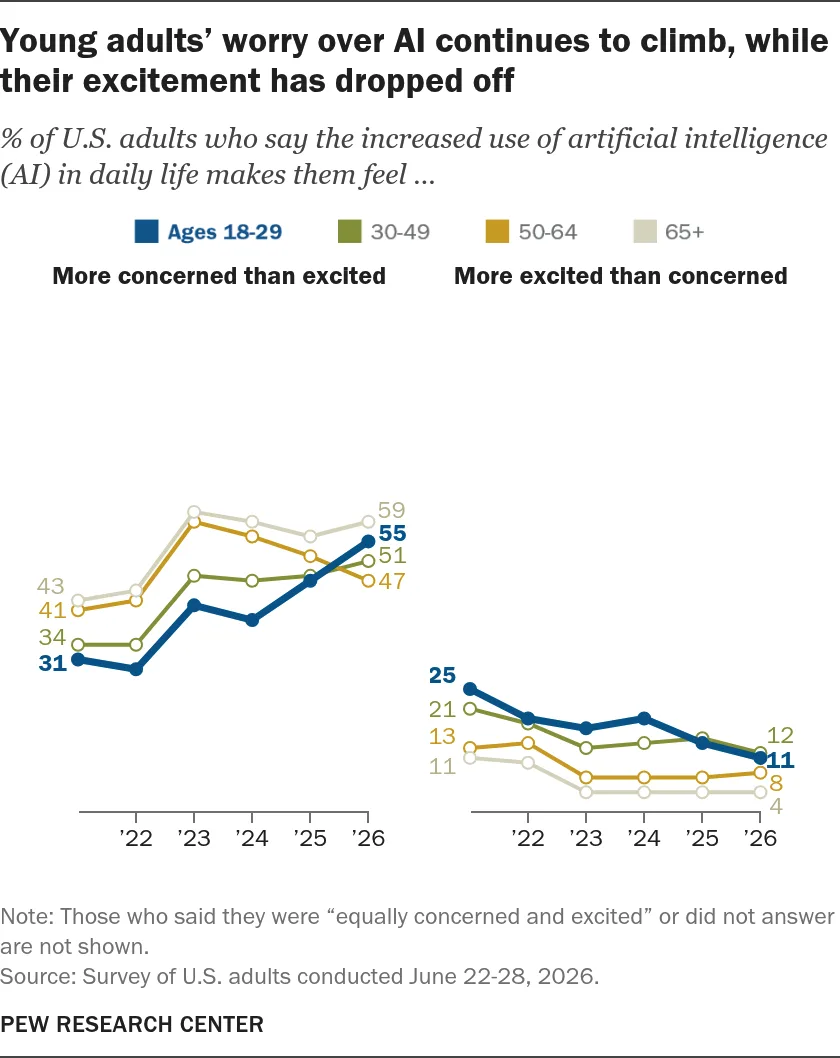
Young adults are increasingly concerned about AI. But interestingly, 50-64 year olds are decreasingly concerned. See the Pew Research for more.
“This changed how I think about the human–AI boundary. We tend to talk about keeping the “human” parts of a process and delegating the mechanical ones — but that assumes we already know which is which. I didn’t. Writing feedback that feels personal turned out to be mechanisable. Working out what a particular learner needs did not. So perhaps the more useful distinction when thinking about what humans do and what AI does isn't personal versus impersonal, or even simple versus complex, but specifiable versus situational — the work you can settle in advance, and the work you can only settle with a particular insight in front of you which is yet to be produced.”
“In my work with startups, I’ve watched a new organizational model emerge almost overnight. Teams are smaller and roles cover more ground. Work moves through fewer handoffs and layers of management. People using AI are taking responsibility for problems that once crossed several functions. My teammate, Karen, is a case in point. Her work spans market research and product development, then extends into sales. She uses AI to synthesize a new market and identify patterns across interviews. Conversations with experts and potential users shape a working prototype, which she tests with prospective buyers. She can hold the full arc of an ambitious question, from thesis through proof.”
“It was also helpful, Sultania said, that the A.I. avatars were always available when he had time, which as a busy founder and Ph.D. student, is not always predictable. “I kind of want the platform there that I can talk to, even if it’s a clone, anytime I want,” he said. “You can really hash out things before you actually enter a situation like that,” she said. “It’s a good way to practice.””
“What Reiley didn't know then was that her daughter had been sharing all her inner struggles with an artificial intelligence chatbot: a ChatGPT therapist named Harry. She learned this months later when her daughter's best friend visited Ithaca and asked to see her laptop, and "found this trove, this months-long trove of communication with this chat bot," says Reiley, who has shared the nearly 1,800-page long interaction with NPR.”