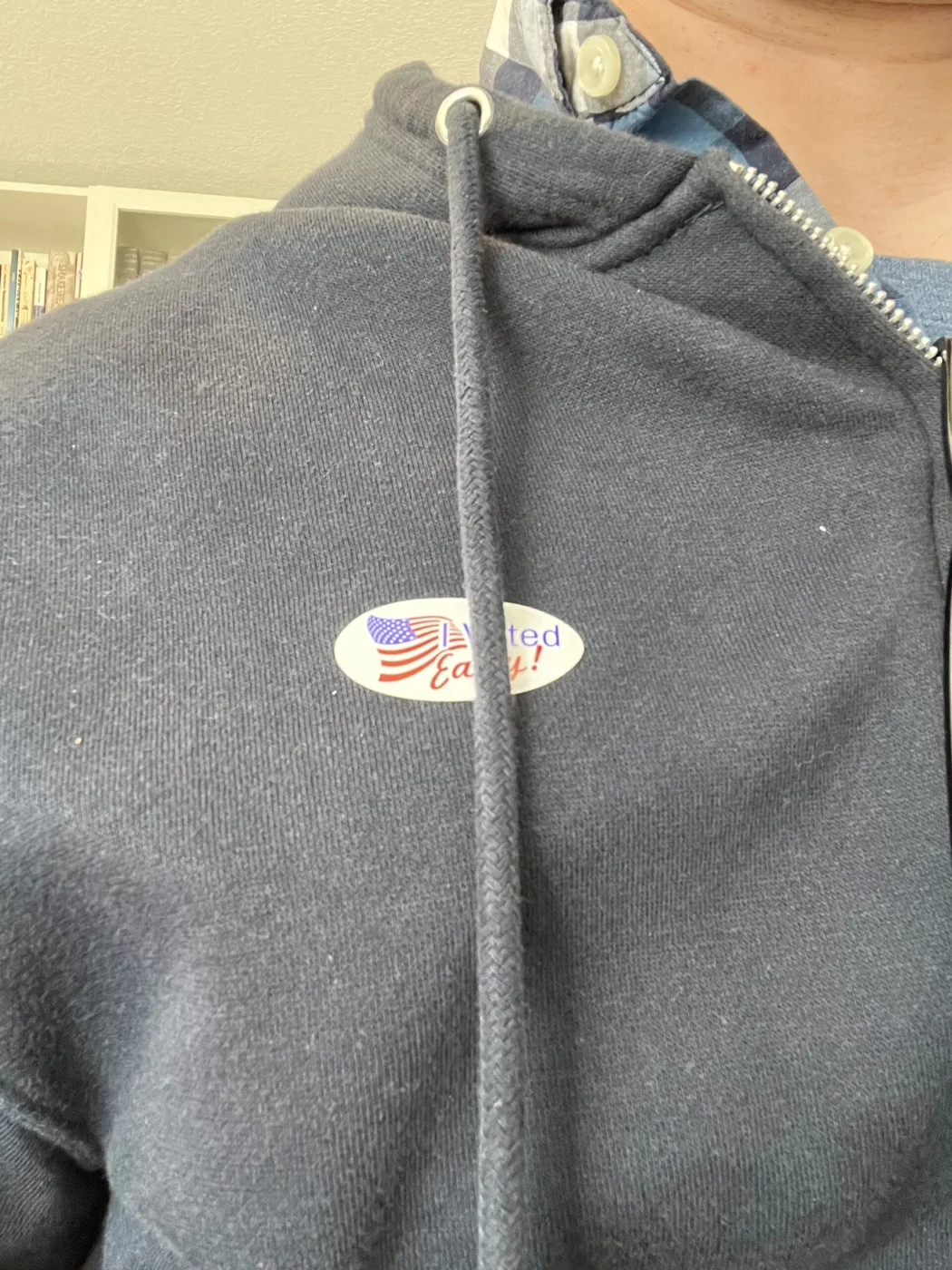
Professional development, media literacy, the election -- and go vote!
A full and rich issue!
This week’s features are short but good ones — one is a brief post on professional development by the teaching & learning blog at the Chronicle of Higher Ed. It summarizes simply what drives ongoing improvement in teaching & learning. When we think about supporting teachers, it really comes down to these few pieces. The second feature then reflects how students today are navigating the glut of information (true and false) in today’s mediascape. It’s important to note in this post that the kids are calling loudly for help in media literacy. They want to talk about and learn how to navigate the world they are in. Interestingly, Nicholas Carr addresses an element of this in the post in Learning Science on two different types of information overload.
The Election. It’s a big week. Find four helpful posts, from an overview of how the electoral college works to a video essay about why voter fraud doesn’t happen at large scale. Also included is a refresher document on how to prepare for a contentious election.
But if there’s one thing I’d like to raise to your attention, it’s one of the features in the AI section at the end. I’ve been working with school boards and leadership teams over the past several months on a presentation and discussion on macro-environmental forces shaping schools today and likely to shape schools in the coming 10-20 years. The topic that I spend the most time on is not AI and the classroom, but the advent of AI companions. I wrote two posts in August and September about the early signals of the extraordinary impact AI companions are already having on people, and in the past two weeks, the worst case scenario arrived, faster than I expected. Read the features in the AI Update about a teen who commit suicide after growing obsessed with an AI companion. More of your students are meeting social needs with AI than you likely expect. Schools need to be especially attuned to both the positive and negative implications of synthetic relationships.
Really, there’s so much in this issue, from strategic planning tips to cultivating a “just try it” classroom to career and technical curriculum and more.
“One data point educators find heartening: The vast majority of students—94 percent—want at least some media literacy instruction in schools. In fact, more than half of teens surveyed—57 percent—believe that schools should “definitely” be required to teach media literacy.”
“Thanks to the lateral placement of our two eyes in our head, we see the world in something like Cinemascope. Our horizontal field of vision spans about 180 degrees, while our vertical field is limited to about 130 degrees. The horizontal bias makes sense in evolutionary terms… Now imagine being forced to wear blinders and suddenly seeing the world in a narrow “portrait” view. Not only would your new perspective be dangerous, limiting your ability to see your immediate surroundings. It would feel cramped, even claustrophobic.”
“On Election Day, Massachusetts voters will have a chance to get rid of the state’s high school exit exam, which involves standards-based tests in math, sciences and English… Before the MCAS requirements were put in place, the business community and community college administrators were telling Driscoll, “Kids were graduating from high school without basic skills,” he said; the joke was that they simply had high school diplomas.”
“There is historical precedence for new technology liberating us from our creative shackles. Take the invention of photography in the 1800s for example. Some artists saw the camera as the antithesis of an artist, and photographs as the mortal enemy of the art establishment. But instead of replacing painting, photography became a catalyst in the development of the experimental modern art movement of the 20th Century, as artists moved away from realism towards abstraction, a shift that paved the way for the contemporary art of today.”
“The College Board is piloting two CTE courses this school year. AP Networking Fundamentals and AP Cybersecurity Fundamentals are full-year courses that some schools across the country are trying out. They feature hands-on, problem-solving activities that cover fundamentals in the field and prepare students to tackle the current—and quickly evolving—cybersecurity landscape.”
“High schools across the country are slowly retooling to offer their students greater exposure to potential careers and job-specific training. Students, by and large, say they want this assistance. But preparing students to be successful in college and careers starts well before high school—and it doesn’t only involve occupation-specific training. Rather, employers in survey after survey say they look for hires with a set of skills that are applicable in any job—often, the abilities to collaborate, solve problems, and communicate effectively.”
“Content-area literacy is an older idea, and it basically came about in the 1940s and kind of evolved from there. But, the basic idea of it was that you could teach kids to read their textbooks in the various fields if you just taught general reading ability, if you built their vocabulary, if you taught them to use a dictionary, if you taught them to summarize text and so on and so forth… Disciplinary literacy is a newer idea, and it doesn’t come out of the reading field specifically. It originally came out of science and social studies, and essentially it’s a recognition that each field has a different body of text and different types of text that readers have to read, and that readers really have to have a different stance.”
“This year marks the tenth anniversary of the Women in the Workplace report. Conducted in partnership with LeanIn.Org, this effort is the largest study of women in corporate America. Over the past decade, more than 1,000 companies have participated in the study, and we have surveyed more than 480,000 people about their workplace experiences.”
“Take white men working without a college degree. In 1980, they made more than the average American worker. But over 40 years, even as their inflation-adjusted income has remained relatively flat, they’ve fallen well below the average income.”
“A large number of colleges have very low student enrollment and few or no endowment resources, and these are the institutions most at risk now and in the coming years. Additionally, college enrollments in some states are likely to drop drastically over the next few years, putting some colleges in those states at risk.”
“A translator uses the resources of the language they’re writing in to produce a text that will be read and received within the context of that language. A translation into English is going to find its place in a literary universe—and a literary marketplace—of other English texts, so a translator of, say, Chinese poetry has to find a version of English poetry in which the poems will make sense to their readers. The translator can’t do what writers in Chinese do—can’t lean on the resources of the Chinese language, can’t try to do what the original text is doing in the original language—they have to make a text that does something worthwhile in English.”
“Ambient overload doesn’t involve needles in haystacks. It involves haystack-sized piles of needles. We experience ambient overload when we’re surrounded by so much information that is of immediate interest to us that we feel overwhelmed by the neverending pressure of trying to keep up with it all. We keep clicking links, keep refreshing screens, keep opening tabs, keep checking email in-boxes, keep glancing at social-media feeds and notifications, keep scanning Amazon and Netflix recommendations — and yet the pile of interesting information never shrinks. The cause of situational overload is too much noise. The cause of ambient overload is too much signal.”
“Gamified technologies can significantly enhance students’ intrinsic motivation and academic well-being, but their effectiveness depends on how activities are framed. Gamified technologies should therefore be carefully combined with motivational strategies that support students’ needs for autonomy, competence, and relatedness – such as providing choice, promoting teamwork, and encouraging friendly competition.”
“Nearly half a century later, the game is renowned. It’s been taught to children worldwide, and, as it turns out, kids are pretty good at solving the planet’s most pressing problems.”
“Jujutsu persuasion requires listening carefully to an adversary’s arguments and then responding with respectful counterarguments framed with the adversary’s values instead of one’s own.”
“Do teachers believe that every question in math class has one correct route to one correct answer? If so, then they should probably expect students to just do it. By contrast, if they believe there are as many ways to be smart as there are humans in the world, then they have one of the necessary beliefs for a “Just Try It” classroom.”
“The ransom payments averaged $7.5 million, according to the 99 lower education survey participants who had paid demands… According to Comparitech, a cybersecurity and online privacy product review website, the K-12 and higher education sectors lost 12.6 school days on average in 2023 from ransomware attacks.”
“If the court holds platforms liable for their algorithmic amplifications, it could prompt them to limit the distribution of noxious content such as nonconsensual nude images and dangerous lies intended to incite violence. It could force companies, including TikTok, to ensure they are not algorithmically promoting harmful or discriminatory products. And, to be fair, it could also lead to some overreach in the other direction, with platforms having a greater incentive to censor speech.”
“Previously, researchers assumed that absence was represented in the brain by neurons not firing. But recent studies have shown that the brain encodes absence with unique neural patterns.”
“How fast will it take over, how fast are costs shrinking, why is it so cheap, what industries will it birth, how much surface will it take up, where will it appear first?”
“These fix the 3 big problems with the classic Core Value approach. They’re specific. They’re actionable. And… they’re closer to a complete picture of how the team operates.”
An AI companion obsession leads to a teen suicide, AI tutors, and more
The lead story in the features section is about the teen who commit suicide after growing obsessed with his AI companion. It will take time to clarify correlation and causation, but the story is harrowing and instructive as an edge case for what is happening in different ways to all kinds of people. Meanwhile, the industry catapults forward. In the second feature, agentic AI takes a big leap with Anthropic’s release of Claude’s ability to operate a computer desktop.
Also in this issue: since last week’s link was broken, find a re-issue of the story of the high school parents who are suing their son’s high school for disciplining him for use of AI when their policy wasn’t clear.
And there’s good news, too: some insight from a Harvard study on effective use of an AI tutor, as well as a good exploration of use of AI in elementary schools and in writing college recommendations.
These and more, enjoy — and for Americans: go vote!
“With computer use, we're trying something fundamentally new. Instead of making specific tools to help Claude complete individual tasks, we're teaching it general computer skills—allowing it to use a wide range of standard tools and software programs designed for people. Developers can use this nascent capability to automate repetitive processes, build and test software, and conduct open-ended tasks like research."
“One day, Sewell wrote in his journal: “I like staying in my room so much because I start to detach from this ‘reality,’ and I also feel more at peace, more connected with Dany and much more in love with her, and just happier.””
“We need to recognise that data, however vast, present an imperfect picture of an individual’s world. We need to recognise that what scales isn’t always what works, and what works for one doesn’t work for eight billion. We need to separate “end users” from learners and to disregard the positivist idea that if we can just get our hands on enough data, we can understand everything we need about how a person works…”
“Hingham High School did not have any AI policies in place during the 2023-24 school year when the incident took place, much less a policy related to cheating and plagiarism using AI tools, the lawsuit said. Plus, neither the teacher nor the assignment materials mentioned at any point that using AI was prohibited, according to the lawsuit.”
“The data showed significant improvements in learning outcomes: Students using the AI tutor achieved more than twice the learning gains compared to those in the active learning classroom.”